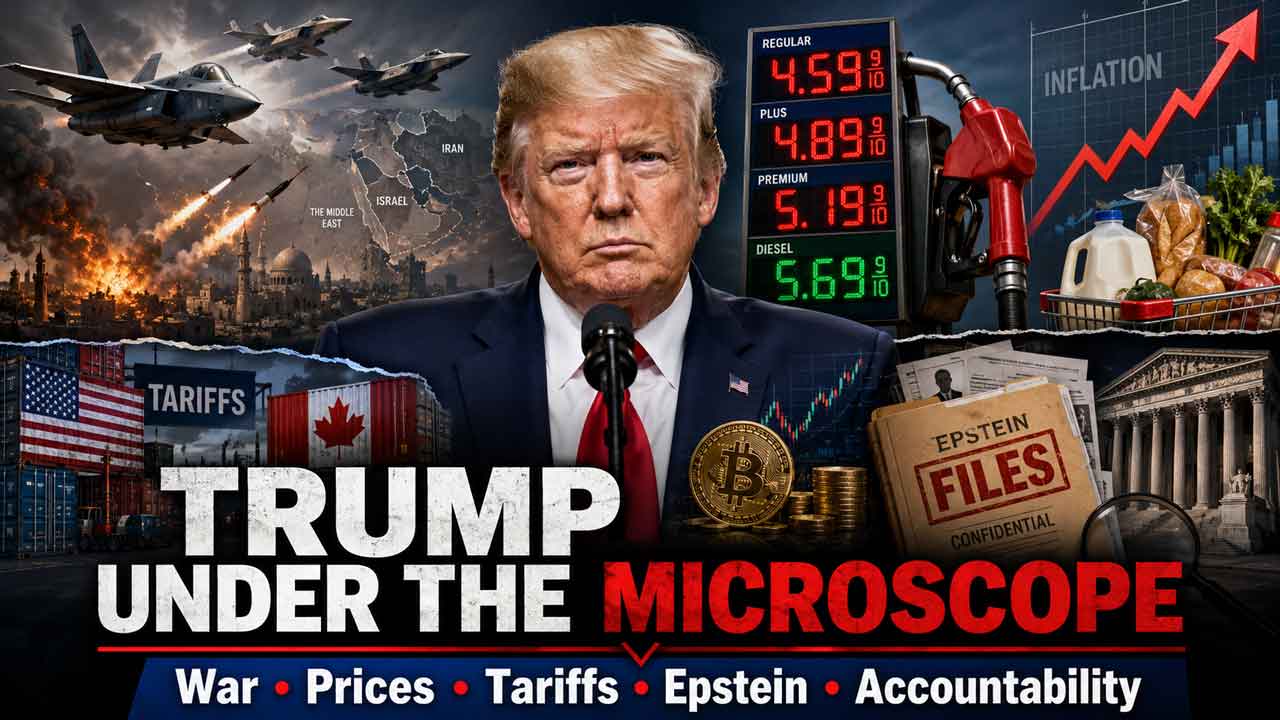
Trump analysis: war, inflation, tariffs, Epstein, health and family wealth examined against the facts
THUNDER BAY — ANALYSIS — For almost two years, Donald Trump has dominated the North American political news cycle, first as the Republican candidate promising peace and lower prices, and then as the returning U.S. president pursuing an extraordinarily aggressive agenda at home and abroad.
The contrast between some of Trump’s most memorable campaign promises and the situation on Aug. 27, 2026, is increasingly difficult to ignore.
Trump said he would stop wars. The United States is now six months into a conflict with Iran and has carried out major military operations in Venezuela and against suspected drug-trafficking vessels around Latin America.
He promised to attack inflation from “Day One” and repeatedly said energy costs could be cut roughly in half. Inflation remains above the U.S. Federal Reserve’s target and gasoline has risen sharply over the past year.
He campaigned as the ultimate dealmaker. His tariff strategy has instead produced repeated trade confrontations, most recently a serious rupture between Canada and its largest trading partner.
At the same time, questions surrounding Jeffrey Epstein continue despite Trump’s attempts to dismiss the issue, while the remarkable growth of Trump family cryptocurrency income has raised legitimate questions about conflicts between public power and private financial interests.
But critical analysis requires equal caution in the other direction. U.S. gasoline prices are not at an all-time record. Released Epstein documents have not established that Trump participated in Epstein’s crimes. And speculation based on video clips is not a medical diagnosis of the president.
The stronger case against — or for — this presidency should rest on evidence.
Promises Made, Outcomes Measured
Perhaps the fairest way to assess Trump is against standards he set for himself.
During his 2024 campaign and after winning the election, Trump repeatedly portrayed himself as the candidate who could prevent wars.
In his election-night remarks, Trump said: “I’m not going to start a war. I’m going to stop wars.”
That was not an incidental campaign line.
At the Republican National Convention, Trump said “the years of war, weakness and chaos will be over” following his election.
Those promises now collide with the realities of his second term.
The Peace President Is Now a Wartime President
The United States and Israel launched their military campaign against Iran in February.
Six months later, the conflict has become what Reuters describes as a costly stalemate. Iran’s conventional military capacity has been severely damaged, but its government remains in power, its missile and drone capabilities remain a threat and the Strait of Hormuz remains a major problem for international energy markets.
The Pentagon said last week that more than 750 U.S. military personnel had been wounded since the Iran conflict began.
Supporters of Trump can reasonably argue that preventing Iran from obtaining nuclear weapons, protecting Israel and degrading Iranian military capabilities are legitimate national-security objectives.
That is a debate worth having.
What is much harder to argue is that the current situation resembles Trump’s campaign promise of avoiding wars.
The contradiction is even clearer in Latin America.
On Jan. 3, Trump announced that U.S. armed forces had conducted a major operation in Venezuela’s capital. In Trump’s own description, U.S. forces employed “air, land, and sea” power during the operation that captured Venezuelan leader Nicolás Maduro.
The administration has also conducted an extended military campaign against vessels it alleges are involved in drug trafficking.
The Associated Press reported this week that at least 227 people have been killed in 68 U.S. strikes on vessels since that campaign began. The administration describes the operation as an armed conflict against narcoterrorists. Critics, including legal experts, have questioned the legal basis and the evidence supporting individual attacks.
Washington is now looking at expanding joint military operations on land with Latin American governments.
Again, there may be arguments supporting the policy.
But a critical assessment should start with a simple fact: Trump ran as the candidate who would stop wars and has become a president using American military power extensively in two different regions.
Whether voters believe those interventions are justified is a separate question.
Trump Promised to End Inflation — Prices Kept Rising
Trump was equally explicit on affordability.
During the 2024 campaign he declared: “Starting on Day One of my new administration, we will end inflation.”
He also repeatedly promised dramatic reductions in energy costs, at times saying prices could be cut in half within 12 months.
That has not happened.
The U.S. Consumer Price Index was 317.671 in January 2025. By July 2026 it stood at 333.918.
That means the overall consumer price level has increased by roughly five per cent since Trump returned to office, based on U.S. Bureau of Labor Statistics data.
Inflation itself was running at 3.4 per cent annually in July, above the Federal Reserve’s two-per-cent objective. Food prices were three per cent higher than a year earlier, while energy prices were up 14.7 per cent. Gasoline prices measured through the CPI were 24.6 per cent higher than a year earlier.
That does not mean every price increase was caused by Trump.
Presidents do not control the global price of oil, interest rates, harvests, shipping costs or every element of inflation.
The Iran conflict has become an especially important factor in rising energy prices.
But that qualification cuts both ways.
Trump repeatedly blamed former president Joe Biden personally when prices rose during Biden’s term and repeatedly told voters that presidential action could quickly reduce those costs.
A president who claims extraordinary personal control over prices during an election cannot reasonably disown all responsibility when prices move in the opposite direction once he governs.
No, Gasoline Is Not at an All-Time High — But Trump’s Promise Still Failed
Accuracy matters here.
The claim that American gasoline prices are “higher than ever” is incorrect.
The U.S. Energy Information Administration reported an average regular gasoline price of US$4.085 a gallon on Aug. 24.
That is approximately 94 cents more than a year earlier, but it remains below the nominal U.S. record of about US$5.01 per gallon reached in June 2022.
The distinction is important because political criticism becomes weaker when it exaggerates.
The stronger criticism is supported by the actual numbers.
Trump promised sharply lower energy costs. Instead, gasoline is considerably more expensive than it was a year ago, and his administration is now taking emergency steps to try to reduce prices, including ending summer gasoline requirements early and considering additional refinery exemptions.
That is a measurable failure against Trump’s own campaign benchmark, without needing to claim gasoline has reached a record.
The Economy Is More Complicated Than Either Side’s Talking Points
It would also be misleading to describe the U.S. economy as being in collapse.
Unemployment was 4.1 per cent in July, still low by historical standards, although payroll employment declined by 23,000 that month and previous job-growth estimates were revised downward.
Business investment has remained comparatively strong, particularly around artificial intelligence, and second-quarter economic data showed underlying private domestic demand performing better than some headline figures suggested.
That is part of the Trump record too.
The more defensible conclusion is not that the economy has failed outright. It is that the affordability revolution Trump promised has not materialized.
That distinction matters.
Tariffs: Economic Strategy or Self-Inflicted Inflation?
Trump has arguably changed international trade policy more dramatically than any modern U.S. president.
His supporters see tariffs as leverage.
The argument is that decades of trade liberalization allowed manufacturing capacity and strategic industries to leave the United States. Tariffs, in this view, force foreign producers to either pay for access to the U.S. market or move production into the United States.
There is evidence that protected industries can gain from that approach.
But there are also costs.
The non-partisan Congressional Budget Office assessed the tariffs imposed in 2025 and concluded they would raise import costs, reduce household purchasing power, lower real investment and temporarily increase inflation. CBO also acknowledged that increased domestic production and relocated investment offset some of those losses.
Research released this month by the Federal Reserve Bank of New York found that tariffs also increase prices on domestically produced goods because companies face more expensive imported inputs and less competition from imported finished products.
That means tariffs are not simply taxes paid by foreign governments.
At least some portion reaches businesses and consumers inside the country imposing them.
Canada Is Now Living With the Consequences
For Canadians, Trump’s trade strategy is no longer an abstract economic debate.
The United States imposed 50-per-cent tariffs on $27.6 billion worth of Canadian goods effective Aug. 22.
Canada is responding with matching tariffs scheduled to take effect Sept. 8. Ottawa says its countermeasures will target products in sectors including steel, dairy, agricultural equipment, appliances, pulp and paper and electronics.
Trump has gone further, threatening 50-per-cent tariffs on Canadian-built cars, trucks and automotive parts beginning Jan. 1, 2027.
This matters profoundly in Ontario.
Canada and the United States do not operate as completely separate industrial economies. Automobiles cross the border repeatedly during production. Canadian aluminum enters American factories. American machinery enters Canadian mines and mills.
Canada supplies the United States with major quantities of crude oil, electricity, aluminum and potash. Total bilateral trade in goods and services was approximately US$872 billion last year.
In Thunder Bay and Northwestern Ontario, prolonged trade disruption can reach forestry, mining equipment, steel, pulp and paper, agriculture, rail transportation, trucking and cross-border tourism.
The region’s proximity to Minnesota also means Canadians experience political decisions in Washington more directly than many Americans realize.
Trump’s trade confrontation with Canada therefore carries a useful test of his theory.
If the tariffs produce new U.S. investment without creating significant consumer inflation, his supporters will claim vindication.
If businesses face disrupted supply chains, consumers pay more and traditional allies simply retaliate, the policy will look increasingly like economic nationalism imposing costs on both sides of the border.
The Epstein Files: Separate Evidence From Suspicion
Jeffrey Epstein remains one of the most politically combustible issues surrounding Trump.
There are two facts that must be held simultaneously.
First, Trump’s past social relationship with Epstein is documented.
Trump’s name has appeared in Epstein’s phone book and flight records. Documents released by the U.S. Department of Justice in December included a prosecutor’s email stating Trump flew on Epstein’s private jet eight times during the 1990s.
The released documents did not accuse Trump of criminal wrongdoing.
Second, Trump has repeatedly denied wrongdoing and denied visiting Epstein’s island.
Following an Epstein joke made by comedian Trevor Noah earlier this year, Trump said he had not been to Epstein’s island and declared: “I have nothing to do with Jeffrey Epstein.”
That broad statement sits awkwardly beside the documented historical acquaintance and flights.
But a past social relationship is not evidence that Trump participated in Epstein’s sexual crimes.
That distinction is essential.
The Justice Department says approximately 3.5 million pages of material have now been released under the Epstein Files Transparency Act, along with thousands of videos and approximately 180,000 images. DOJ explicitly warned that the files include unverified and potentially false material submitted by members of the public.
Justice Department officials have also said their review produced no new evidence supporting additional prosecutions.
The responsible journalistic position is therefore neither “there is nothing here” nor “the files prove Trump was involved.”
Neither conclusion is supported by the evidence currently available.
The legitimate questions concern Trump’s documented relationship with Epstein, inconsistencies in his public descriptions of that relationship, the government’s handling of the records, and whether all legally releasable material has been made public.
Is Everything a Distraction From Epstein?
That leads to one of the most persistent theories about Trump’s political behaviour.
Late-night television hosts, political opponents and commentators have repeatedly suggested that Trump’s rapid-fire controversies, confrontations and dramatic announcements are designed to push Epstein out of the news.
Reuters published an analysis during the height of the controversy in 2025 examining Trump’s long-established ability to redirect the political conversation and the difficulty he was having making the Epstein issue disappear.
It is reasonable to analyze that pattern.
Trump frequently creates several major news events almost simultaneously. A tariff threat, an attack on an opponent, a military announcement and a cultural controversy can arrive within hours of one another.
That has an obvious effect: yesterday’s controversy can be buried beneath today’s.
But effect is not the same thing as motive.
Without documentary evidence or credible testimony showing that Trump launched a particular tariff, military operation or policy specifically to distract attention from Epstein, journalism should not state that conclusion as fact.
A president can simultaneously have genuine policy objectives and understand that political spectacle controls the news agenda.
The intellectually stronger question is therefore not, “Was every Trump action an Epstein distraction?”
It is: How much does Trump’s governing style depend on constantly changing the subject before the public has time to examine the previous one?
That is a question readers can evaluate from the record.
Trump’s Health: Legitimate Questions Do Not Justify Amateur Diagnosis
Trump turned 80 in June and is the oldest person ever to serve as U.S. president.
That makes his health a legitimate matter of public interest.
Photographs showing swollen ankles and bruising on his hands have generated extensive commentary.
The White House has acknowledged those symptoms.
Trump’s physician reported in May that he continued to experience slight lower-leg swelling and benign hand bruising. Trump had previously been diagnosed with chronic venous insufficiency, a common condition among older adults.
His physician reported strong cardiac, pulmonary and neurological function and said Trump was fully fit to perform his duties. The May examination also reported a perfect score on a cognitive screening test.
There is therefore a legitimate case for transparency.
At the same time, physicians and political commentators diagnosing dementia, Parkinson’s disease or other neurological disorders from television footage are moving beyond what verified medical evidence supports.
The standard applied to Trump should be the same standard that should have been applied to Joe Biden: presidents have enormous power, their health matters, medical transparency is in the public interest, and unsupported diagnosis should not substitute for evidence.

The Trump Family’s Extraordinary Financial Gains Raise a Different Question
The financial issue is more concrete.
Trump’s 2025 financial disclosure, certified through the U.S. Office of Government Ethics, showed extraordinary cryptocurrency-related income.
Reuters calculated that Trump reported more than US$1.4 billion in income from family crypto ventures in 2025.
A separate Reuters investigation concluded that the Trump family had generated at least US$2.3 billion in profit from its major cryptocurrency ventures since Trump returned to power, while outside investors in those ventures collectively suffered approximately US$2.3 billion in losses, including unrealized losses.
At the same time, Trump has promoted policies favourable to cryptocurrency and called for legislation establishing a clearer regulatory framework for the industry.
That does not prove a bribe or illegal quid pro quo.
It does create an obvious conflict-of-interest question.
A conflict of interest does not require proof that a politician sold a government decision.
The concern exists when a public official has substantial private financial interests that could benefit from decisions the official is empowered to influence.
A Reuters/Ipsos poll released last week found 63 per cent of Americans surveyed believed Trump and his family had inappropriately profited since his return to office, while 69 per cent believed Trump’s private business interests influenced his policies.
Those are measurements of public opinion, not proof of misconduct, but they demonstrate the scale of the credibility problem.
The White House has said Trump’s market investments are independently managed and that neither the president nor his family directs individual trades.
That defence should be reported.
So should the unprecedented scale of money flowing into businesses carrying the president’s name while his administration sets policy affecting those same industries.
What Trump’s Supporters See That His Critics Sometimes Miss
A serious examination of Trump also has to acknowledge why millions of Americans remain committed to him. His supporters see a president willing to use American power rather than merely threaten it.
They see Venezuela’s Maduro removed, Iran’s conventional military severely degraded, aggressive action against drug cartels, tighter immigration enforcement and a government willing to confront allies as well as adversaries over trade.
They see tariffs as a long-overdue response to deindustrialization rather than an economic mistake.
They see cryptocurrency deregulation as innovation rather than corruption.
They see attacks from traditional media, Democratic politicians and late-night comedians as evidence that Trump continues challenging an establishment that dislikes him.
And despite slowing hiring, the unemployment rate remains relatively low and the American economy continues to grow.
Those arguments cannot simply be dismissed if the goal is understanding the presidency rather than caricaturing it.
But neither can political loyalty erase measurable contradictions between what Trump promised and what his administration has delivered.
The Central Question: Judge Trump by Trump’s Own Standards
The most useful way to think critically about Donald Trump’s second presidency may therefore be surprisingly simple.
Do not judge it primarily by what his opponents say about him.
Do not judge it primarily by what Trump says about himself.
Judge it against his own promises and measurable outcomes.
He promised to stop wars. The United States is deeply engaged militarily in the Middle East and has dramatically expanded the use of force in Latin America.
He promised to end inflation beginning on Day One. Consumer prices are roughly five per cent higher than when he returned to office and annual inflation remains above target.
He promised substantially cheaper energy. Gasoline is almost a dollar per gallon more expensive than a year ago, although it remains below the 2022 record.
He promised that tariffs would strengthen America. They have provided protection and leverage in some sectors, but independent economic analysis also finds they raise consumer prices and reduce purchasing power.
He presents himself as independent from the political establishment. His family has simultaneously generated extraordinary private income from industries affected by his administration’s policies.
He says he had nothing to do with Epstein. There remains no released evidence establishing Trump participated in Epstein’s crimes, but their former social relationship is unquestionably documented.
And while critics speculate about Trump’s health, the available official medical evidence currently says he is fit for office.
Trump’s great political skill has always been his ability to make every political conversation about Donald Trump.
The greater challenge for journalists, voters and political opponents is refusing to let that spectacle replace evidence.
For Canadians — and particularly people in Thunder Bay and Northwestern Ontario — this is not merely Washington political theatre.
Trump’s decisions are influencing the price of energy, continental supply chains, Canadian manufacturing, forestry, mining, cross-border trade and the future of the Canada-U.S. economic relationship.
The question facing Canadians is therefore not whether they like Donald Trump’s personality.
It is whether the policies emerging from his presidency are making North America more prosperous and secure — and whether the evidence matches the promises that put him back in the White House.
As of Aug. 27, 2026, on several of Trump’s biggest promises, that evidence presents a far more complicated record than either his supporters or his critics often acknowledge.