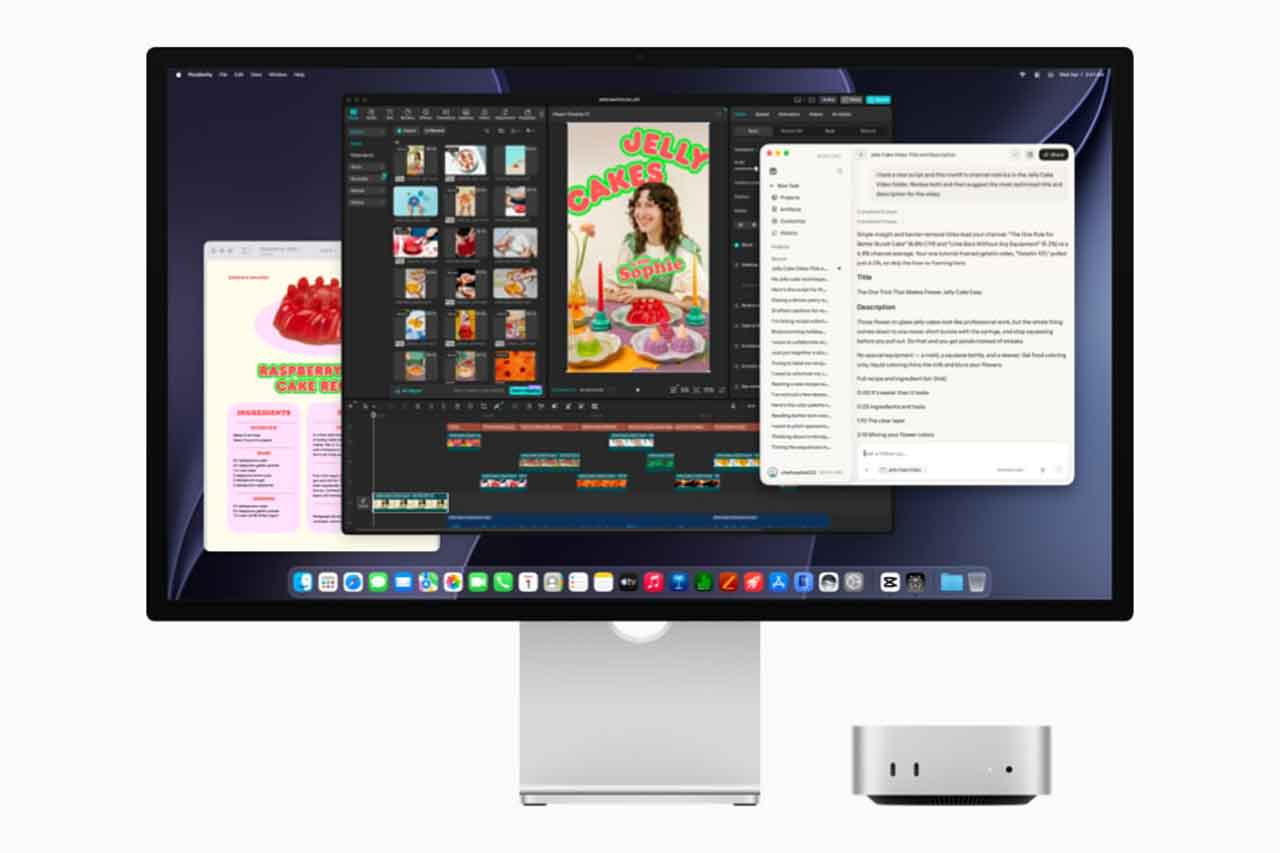
Apple Launches New Mac mini With M6 and M5 Pro, Putting AI Computing in a Smaller Desktop
THUNDER BAY — TECH NEWS — Apple has unveiled a new generation of its Mac mini desktop computer, introducing models powered by the new M6 chip and the higher-performance M5 Pro, with the company placing a major emphasis on artificial intelligence, faster local processing and always-on computing.
The new Mac mini is available for pre-order in Canada and is scheduled to reach customers and retailers on Sept. 22. Canadian pricing starts at $1,249 for the M6 model and $2,399 for the M5 Pro version.
For Thunder Bay and Northwestern Ontario users, the most significant change may be less about raw benchmark numbers and more about what Apple is positioning the small desktop to do: run increasingly sophisticated AI applications locally, power creative and technical work, and act as an always-on computer for automated tasks without requiring a large workstation.
Apple Puts AI Performance at the Centre of the New Mac mini
Apple says the M6-equipped Mac mini delivers up to four times faster AI performance, twice the graphics performance and storage performance, and up to 40 per cent faster CPU performance than the previous M4 model.
Those performance claims are based on Apple’s own testing conducted in July and should be viewed as manufacturer benchmarks rather than independent third-party results.
The M6 version includes a 12-core CPU and 12-core GPU, with Apple’s Neural Accelerators built into each GPU core. It also includes what Apple calls a dual 16-core Neural Engine designed to accelerate machine-learning and generative-AI workloads.
The base configuration includes 16 GB of unified memory and can be configured with as much as 32 GB. Memory bandwidth reaches up to 170 GB per second.
Apple says the system can process large-language-model prompts in LM Studio up to 13.5 times faster than an M1 Mac mini and 4.8 times faster than an M4 model under its test conditions.
For consumers, those numbers matter most if software developers actually make use of the hardware.
Local AI processing can potentially allow tasks such as summarization, image generation, coding assistance, transcription and document analysis to be completed directly on the computer rather than relying exclusively on cloud servers.
That may become increasingly important for organizations concerned about latency, connectivity costs or keeping certain data on local hardware.
M5 Pro Model Targets Video, Development and Professional Workflows
The higher-end Mac mini with M5 Pro is aimed at developers, video professionals, researchers and other users who need more processing and graphics performance.
Apple says the M5 Pro can be configured with up to an 18-core CPU and 20-core GPU, along with as much as 64 GB of unified memory.
Memory bandwidth rises to 307 GB per second.
The company says that level of memory capacity will allow users to run larger AI models locally, work with complex three-dimensional projects, edit ProRes RAW video and process large research datasets.
Apple is also promoting the computer as an always-on platform for AI agents.
“Agentic AI” generally refers to software designed to carry out multi-step tasks with limited ongoing human direction — for example, monitoring information, organizing files, generating reports or triggering other software actions.
The technology is developing quickly, and the usefulness and reliability of these systems varies considerably depending on the software being used.
Why This Matters
The new Mac mini arrives as artificial intelligence is moving rapidly from cloud-based services into personal computers.
That shift could be especially relevant in Northwestern Ontario, where connectivity quality and bandwidth can vary considerably outside larger centres.
Running more AI functions directly on a desktop could reduce dependence on a continuous high-speed internet connection for some applications.
Potential regional users include:
- video and photography businesses producing local digital content;
- small companies using automated administrative tools;
- software developers and technology startups;
- post-secondary students and researchers;
- architectural, engineering and design firms;
- Indigenous organizations managing digital communications and records;
- media organizations working with video, audio and large image libraries; and
- remote workers who need workstation-level capabilities without a large desktop tower.
The ability to run artificial intelligence locally does not eliminate the need for internet connectivity. Many AI services will continue to depend on cloud models, online databases or external APIs.
However, increasingly capable local processors give developers more options for keeping at least part of a workflow on the user’s own hardware.
Wi-Fi 7, Faster Ethernet and Thunderbolt Upgrades
Apple is also upgrading connectivity.
Both new Mac mini versions support Wi-Fi 7, Bluetooth 6 and 2.5-gigabit Ethernet, with a 10-gigabit Ethernet option available.
The front of the computer includes two USB-C ports and a headphone jack.
The M6 model includes three Thunderbolt 4 ports on the rear, while the M5 Pro version receives three Thunderbolt 5 connections.
Thunderbolt 5 provides substantially more bandwidth for high-speed storage, displays and other peripherals.
Apple also says multiple M5 Pro Mac mini systems can be connected together to help run larger AI workloads across several computers.
That clustering capability will likely be of more interest to developers, laboratories and professional users than typical home buyers.
The new models also support genlock through USB-C, allowing precise synchronization between displays and cameras for specialized video-production environments.
macOS 27 Golden Gate and Siri AI
The computers will run Apple’s upcoming macOS 27 Golden Gate operating system.
Apple says the software will include its new Siri AI system and expanded Apple Intelligence capabilities.
According to the company, Siri AI will be able to use information from messages, emails and photos to provide more context-aware responses and complete tasks across applications.
It is also being integrated into Spotlight search and system-wide context menus.
Apple says users will be able to ask Siri about content displayed on the screen using Visual Intelligence and use the assistant for writing and editing in many applications.
The operating system also includes expanded automation through Shortcuts and additional AI-assisted photo editing.
However, not all of those features will arrive simultaneously.
Apple says Siri AI is currently being tested through its public beta program and is expected to launch as a beta later this year for supported devices set to English. Other languages are expected to follow.
That qualification is important for buyers considering the computer primarily for new AI features: some capabilities being promoted at launch will still depend on future software availability.
Canadian Pricing and Release Date
Canadian customers can pre-order the new Mac mini now.
The Mac mini with M6 starts at $1,249, while education pricing begins at $1,109.
The Mac mini with M5 Pro starts at $2,399, with education pricing beginning at $2,259.
The computers are expected to begin arriving to customers and appear at Apple Stores and authorized retailers on Sept. 22.
Final pricing can increase substantially depending on memory, storage, Ethernet and other configuration choices.
Apple has not included a display, keyboard or mouse in the Mac mini’s basic desktop concept, so buyers moving from an all-in-one computer should factor peripherals into the total purchase cost.
Small Computer, Larger Shift Toward Local AI
The Mac mini has occupied an unusual position in Apple’s computer lineup since its introduction in 2005.
Its appeal has traditionally been straightforward: buyers get a relatively inexpensive Mac desktop while supplying their own monitor, keyboard and mouse.
Apple’s transition from Intel processors to its own Apple silicon beginning in 2020 significantly increased the performance available from the small enclosure.
With the M6 generation, Apple is now trying to redefine the machine again — this time as a compact AI workstation.
The broader technology trend extends well beyond Apple.
PC manufacturers, chipmakers and software companies are increasingly building neural-processing hardware directly into consumer computers as they compete to move more artificial-intelligence processing from distant data centres onto personal devices.
For Northwestern Ontario businesses and consumers, the practical test will not simply be whether an M6 benchmark is several times faster than an older machine.
It will be whether software developers produce useful local AI applications that save time, improve productivity and justify upgrading existing hardware.
Apple’s performance figures and comparisons are based on company testing, and independent reviews after the Sept. 22 release will provide a clearer picture of real-world performance, power consumption and value.