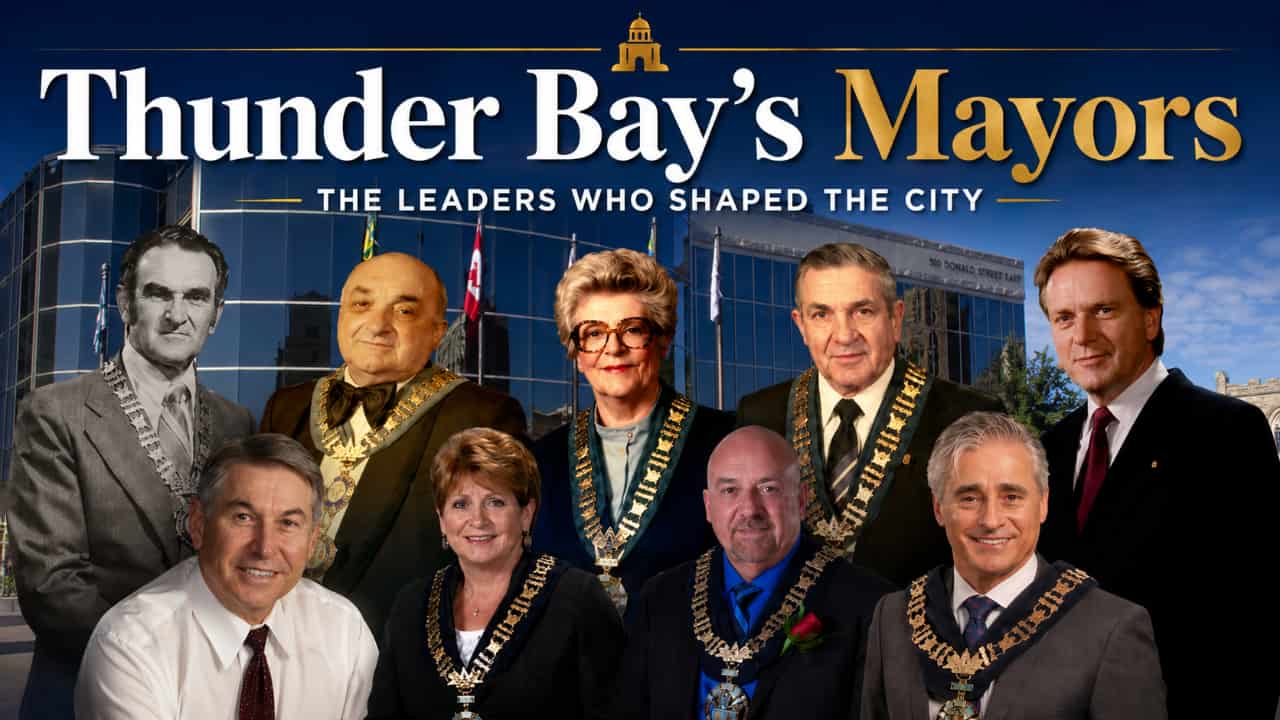
Thunder Bay mayors from Saul Laskin to Ken Boshcoff and the civic legacies they left
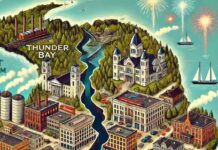
Thunder Bay’s civic story is the story of a young city still defining itself. The full account of the city’s mayors begins with amalgamation in 1970, when Port Arthur, Fort William and parts of Neebing and McIntyre became the City of Thunder Bay.
From Saul Laskin’s dignified role as the first mayor to Assef’s colourful populism and Ken Boshcoff’s return to office, each mayor left a mark on how Northwestern Ontario’s largest city sees itself and how it is seen by the rest of Canada.
From Lakehead Rivalries to a Regional Capital
Thunder Bay’s mayoralty has never been only ceremonial. The city sits at the head of Lake Superior, where rail, road, air and marine transportation connect Western Canada, the United States and the Great Lakes-St. Lawrence Seaway.
The Lakehead once handled virtually all grain exported from the West, while the Port of Thunder Bay today describes itself as a major facilitator of regional commerce and the preferred marine route for European trade with Western Canada.
That geography has made every mayor part local manager, part regional advocate and part national salesperson for Northwestern Ontario.
Saul Laskin, 1970-1972: The First Mayor of the New City
Saul Laskin’s legacy begins with the difficult work of making amalgamation real. Born in Fort William, Laskin had served as mayor of Port Arthur from 1962 to 1969 and was a long-time supporter of amalgamation. When the new city was created in 1970, he became Thunder Bay’s first mayor, giving the new municipality a measured and experienced hand at a time when old Port Arthur and Fort William identities still mattered deeply.
Laskin’s contribution was institutional rather than theatrical. He represented continuity from the Lakehead’s two-city past into a single municipal government. His later recognition by Lakehead University and his involvement with community organizations reflected a civic style rooted in service, business and public respectability. His legacy remains that of a dignified bridge between the old Lakehead and the modern City of Thunder Bay.
Walter M. Assef, 1973-1978 and 1981-1985: Colour, Conflict and Consolidation
Walter Assef remains one of the most memorable figures in Thunder Bay municipal history. Born in Sioux Lookout, he served as a Fort William councillor before joining the first Thunder Bay city council and later serving 11 years as mayor over two separate periods.
The City of Thunder Bay credits his time in office with helping establish the city’s governance structure and with infrastructure work aimed at bringing basic services up to common standards across the new municipality.
Assef’s public image was larger than life. Nicknamed “Jolly Wally,” he became known nationally after Queen Elizabeth’s 1973 visit, when photographs appeared to show him being unusually familiar with the monarch. He was also a fierce opponent of the Thunder Bay Community Auditorium and refused to attend its opening in 1985.
Yet behind the colourful reputation was a mayor whose years coincided with the basic building of a unified city. His legacy is that of a populist who could divide opinion, but who governed during the years Thunder Bay was still stitching itself together.
Editors Note: My first morning in Thunder Bay listening to 580 CKPR and the Rick Smith Morning News had Mayor Assef on the show. He was expressing how each child in Thunder Bay should have a pony, and how they could ride them to school. He also wanted residents to put a one litre pop bottle full of water in their toilet tanks to save water.
Eleanor “Dusty” Miller, 1978-1980: Arts, Culture and Civic Confidence
Eleanor Joan “Dusty” Miller was Thunder Bay’s first female mayor and brought a distinctly cultural lens to city hall. A major figure in local theatre, she was connected to Port Arthur Community Players, Lakehead Musical Productions, Theatre Northwest and what later became Magnus Theatre. She entered municipal politics after recognizing that arts and culture were not being treated as core civic responsibilities.
Miller’s time as mayor was brief, but her legacy was lasting. The City credits her with helping develop an arts policy, chairing the Arts and Heritage Committee, and being actively involved in the creation of the Thunder Bay Community Auditorium.
Planning for the 1981 Canada Summer Games also took shape during her mayoralty. Miller helped make the case that a northern city needed more than roads and pipes; it also needed stages, public spaces, heritage and imagination.
Jack Masters, 1985-1991: Broadcaster, MP and Civic Stabilizer
Jack Masters entered the mayor’s office after a public life already familiar to many residents. A broadcaster who helped create local television programming, he later served as Liberal MP for Thunder Bay-Nipigon from 1980 to 1984. The City notes that, as MP, he helped secure funding for the Thunder Bay Community Auditorium and the 1981 Canada Games.
As mayor, Masters is remembered as a stabilizing figure. The City says he helped move municipal government out of turbulence and toward a more progressive, forward-looking culture, with attention to regional transportation, parks and recreation. His legacy was communication and confidence: he understood how Thunder Bay needed to speak to itself, to Queen’s Park and to Ottawa.
David Hamilton, 1991-1997: Fiscal Control and Administrative Reform
David Hamilton brought a public-administration mindset to the mayor’s chair. A former Northwood ward councillor, he became mayor in 1991 and served two terms. His priorities included closer control over city spending and a major restructuring intended to make municipal government operate in a more business-like way.
Hamilton’s years also reflected the practical pressures of running an aging northern city. The City’s profile notes debates over the future of Fort William Gardens, possible expansion of the Balmoral police station, repair of city facilities and the 1997 giardia contamination that raised questions about water safety.
Thunder Bay also hosted the 1995 World Nordic Ski Championships during his tenure. His legacy is tied to fiscal discipline, infrastructure management and a more administrative model of municipal leadership.
Ken Boshcoff, 1997-2003 and 2022-present: Regional Advocate and Returning Mayor
Ken Boshcoff’s career spans more of Thunder Bay’s municipal history than any other modern mayor. First elected to council in 1979, he served as mayor from 1997 to 2003, later represented Thunder Bay-Rainy River as a Liberal MP, returned as councillor-at-large from 2010 to 2014 and was elected mayor again in 2022.
Boshcoff’s legacy is broad and still unfolding. The City points to initiatives including Crime Stoppers, 911, Neighbourhood Watch, women’s shelters, community policing, recycling and environmental stewardship.
His “Mayor’s Walkabout” is described as fostering relationships with Indigenous and community groups, as well as city employees. He also advocated and fundraised for the regional hospital and medical school.
In his current term, his legacy will depend on how Thunder Bay handles public safety, Indigenous relations, housing, infrastructure and economic transition.
Lynn Peterson, 2003-2010: Economic Diversification and the Waterfront Era
Lynn Peterson’s mayoralty is associated with economic development, diversification and civic beautification. Before becoming mayor, she served on the Lakehead Public School Board and as a councillor-at-large. As mayor, she helped lead the incorporation of the Thunder Bay Community Economic Development Commission in 2006.
Peterson’s years pushed Thunder Bay toward a more diversified economy. The City credits her work with helping secure contracts for the Bombardier plant and supporting the city’s lead investment in the Thunder Bay Regional Research Institute. Her administration also introduced the city’s first strategic plans, advanced the Clean, Green and Beautiful policy, and was active in waterfront development.
Her legacy is the idea that Thunder Bay could move beyond dependence on older industrial patterns and invest in research, transit manufacturing, public art, environmental greening and a renewed waterfront.
Keith Hobbs, 2010-2018: Public Safety, Social Challenges and a City Under Scrutiny
Keith Hobbs was elected mayor in 2010 as a first-time political candidate after 34 years with the Thunder Bay Police Service. Re-elected in 2014, he brought a policing background to city hall and emphasized community safety, crime reduction, poverty, equality, housing and economic opportunity.
Hobbs’s years also overlapped with a difficult period in Thunder Bay’s public life. The city faced growing national attention over racism, policing and the deaths of Indigenous people.
In December 2018, shortly after Hobbs left office, the Office of the Independent Police Review Director released its systemic review of the Thunder Bay Police Service, finding significant deficiencies in sudden-death investigations involving Indigenous people and systemic racism at an institutional level. That broader context remains central to how the city understands the public-safety debates of that era.
Bill Mauro, 2018-2022: Provincial Experience and Pandemic Leadership
Bill Mauro came to the mayor’s office with extensive provincial experience. He had served as MPP for Thunder Bay-Atikokan from 2003 to 2018 and held cabinet roles including minister of municipal affairs, minister of municipal affairs and housing, and minister of natural resources and forestry. That background gave him direct knowledge of Queen’s Park and the machinery of provincial government.
Mauro’s mayoralty was shaped heavily by COVID-19. The City of Thunder Bay’s own records show a first state of emergency was declared April 23, 2020, and a second emergency was declared in February 2021 to seek immediate provincial assistance during a surge affecting vulnerable residents.
His legacy is likely to be viewed through that crisis: maintaining services, navigating emergency rules, supporting local organizations and pressing senior governments during one of the most disruptive periods in municipal history.
What Their Legacies Mean for Thunder Bay Today
Taken together, Thunder Bay’s mayors tell the story of a city still balancing its old and new identities. Laskin gave the new city legitimacy. Assef gave it colour and hard-edged local politics. Miller put culture and heritage on the civic agenda. Masters steadied the institution. Hamilton tightened administration. Boshcoff pushed regional advocacy and environmental initiatives. Peterson advanced diversification and waterfront renewal. Hobbs brought public safety to the centre of debate. Mauro governed through a public-health emergency.
For Thunder Bay and Northwestern Ontario, those legacies matter because the city remains the service, transportation, health, education and political hub for a vast region. The mayor’s office is not only about city taxes or council votes.
It is about how Thunder Bay represents itself to Indigenous communities, rural municipalities, mining and forestry interests, the port, the border economy, Queen’s Park and Ottawa.
The next chapters will be judged by the same question that has followed every mayor since amalgamation: whether Thunder Bay can turn its geography, history and regional responsibility into a fairer, safer and more confident northern city.