
The digital entertainment industry now covers streaming services, mobile games, esports, sports content, social platforms, and iGaming. These sectors compete for the same user attention, run on similar infrastructure, and follow comparable design principles around speed, personalization, and mobile access. The iGaming industry has grown within this space because user expectations moved toward fast, interactive, on-demand experiences, the same standards set by Netflix, Spotify, and mobile gaming platforms.
Online casinos today go well beyond classic slots and table games. Modern platforms combine live streaming, mobile-first design, digital payment systems, algorithmic personalization, and built-in safety tools. Ontario is a clear example of how regulated markets are shaping the online casino industry in practice, with licensed operators required to meet strict standards for transparency, player protection, and responsible gambling.
This article covers key online gambling trends, casino technology developments, mobile casino gaming, live dealer games, online casino payments, responsible gambling tools, and the future of iGaming in regulated markets such as Ontario.
iGaming and the Digital Entertainment Industry
The iGaming industry brings together several forms of real-money play under one digital roof. All of them run on shared infrastructure: payment systems, account verification, streaming technology, and mobile interfaces. In short, iGaming includes:
- Online casino games
- Sports betting
- Poker
- Live dealer games
- Mobile gambling platforms
| iGaming Format | Digital Entertainment Connection |
|---|---|
| Online casino games | Work like on-demand gaming platforms with instant access and large game libraries |
| Sports betting | Connects real-time sports content with interactive digital participation |
| Poker | Combines strategy, social interaction, and online multiplayer-style rooms |
| Live dealer games | Use video streaming, real-time chat, and broadcast-style production |
| Mobile gambling platforms | Follow the same mobile-first habits as apps, games, and streaming services |
This technical overlap explains why analysts now treat iGaming as one part of the digital entertainment industry, alongside video streaming, mobile apps, sports media, video gaming, and social content. A casino app competes for screen time with Netflix, TikTok, and live sports broadcasts, while operators design their products with this competition in mind.
The connection goes deeper than shared screen time. iGaming and other entertainment sectors rely on the same user habits, shaped over years of smartphone use and on-demand media consumption. The most important of these habits are:
- Mobile-first access
- Fast content delivery
- Personalization
- Social interaction
- Instant payments
- Live and interactive formats
Casino gaming platforms apply the same engagement logic as streaming services: short loading times, tailored recommendations, and on-demand content. Live dealer studios borrow production techniques from broadcast television, while in-game chat features mirror social media mechanics.
Ontario shows how this evolution works inside a regulated framework. Since the province opened its market in April 2022, iGaming there has become more structured, transparent, and technology-driven. Licensed operators must meet standards set by the Alcohol and Gaming Commission of Ontario, so the focus extends beyond entertainment to licensing, safe online gambling, and responsible gambling tools built into every platform.
Why the Online Casino Industry Keeps Growing in Ontario
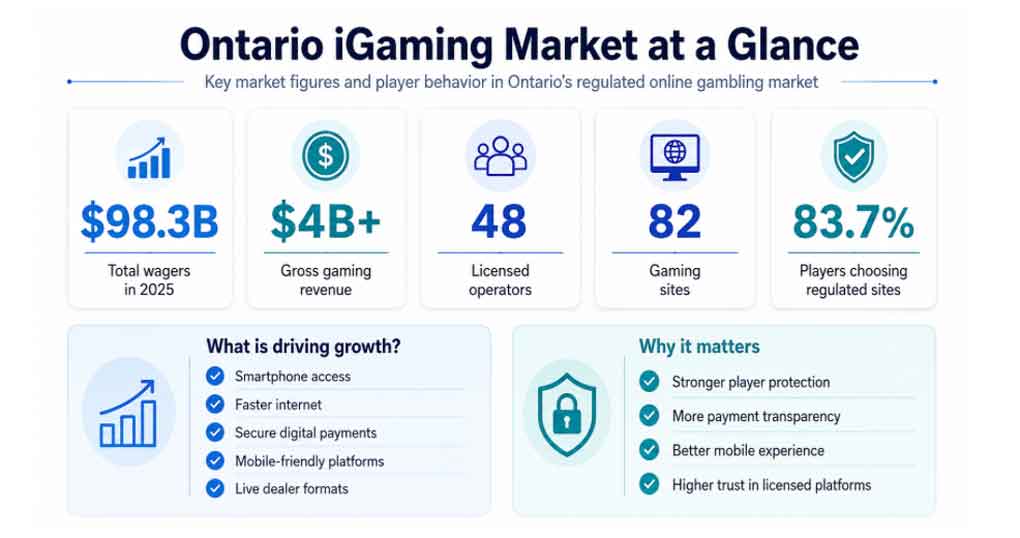
The online casino industry has expanded over the past decade, and the growth rests on measurable changes in technology and consumer behaviour. Several documented factors stand behind this expansion:
- Smartphone access
- Faster internet
- Secure digital payments
- More polished casino gaming platforms
- Live dealer formats
- Wider acceptance of online entertainment
- Regulated market development
Ontario illustrates this growth in concrete numbers. Licensed operators handled approximately $98.3 billion in total wagers during the 2025 calendar year and generated just over $4 billion in gross gaming revenue, increases of 26% and 34% over 2024. Cumulative operator revenue since the market opened in April 2022 has passed $10 billion, and monthly wagers set a record of $9.52 billion in January 2026. As of early 2026, 48 licensed operators run 82 gaming sites in the province.
An annual IPSOS survey found 83.7% of Ontario players chose regulated sites, with iGaming Ontario targeting 90% by the 2026-27 fiscal year. The province is a practical example because its platforms operate in a visible, regulated environment, while offshore markets publish little verifiable data and are subject to no local oversight.
Growth has reshaped player expectations. Online gambling trends in mature markets show users now assess an operator on practical details, much as they judge a banking app. Standard demands now include:
- Quick registration
- Simple deposits
- Mobile-friendly design
- Clear bonus terms
- Fast withdrawals
- Responsive support
- Responsible gambling controls
Mobile casino gaming is at the centre of these demands, since most Ontario players access licensed sites from a smartphone and expect the full experience to work on a small screen.
For readers who want to compare Ontario-focused online casino information, http://oncasinos.ca/ offers a useful starting point before looking deeper into platform features, payments, and safety tools.
Growth carries obligations alongside revenue. A larger market means more first-time players, so the need for stronger safety tools, transparent regulation, and better player education increases at the same pace as the industry itself.
Key iGaming Trends Shaping the Market
iGaming trends today reflect changes in user behaviour, regulation, and technology. Operators track them closely, since a platform built on outdated standards loses players within months. The list below covers the developments with the strongest influence on the market:
- Mobile-first casino platforms
- Live dealer games
- AI-driven personalization
- Faster online casino payments
- Stricter identity verification
- Responsible gambling tools
- Gamification
- Localized content
- Crypto and alternative payments where legally available
Each trend solves a specific problem. Mobile-first design responds to the dominance of smartphone traffic. Live dealer studios add a social, broadcast-style layer to table games. AI-driven personalization adjusts game lobbies and promotions to individual play patterns. Faster payments cut withdrawal times from days to hours, while stricter identity verification protects accounts and blocks underage access. Gamification adds missions, levels, and tournaments borrowed from video games, and localized content adapts language, currency, and game selection to each market.
A common misconception reduces online gambling trends to new games and bigger bonuses. The real direction points elsewhere: usability, trust, transparency, and player protection now carry equal weight in platform development budgets.
Ontario demonstrates this in practice. In regulated markets, promotions alone cannot win market share, so licensed operators compete through reliability, safety standards, payment speed, and overall user experience. The future of iGaming will belong to platforms that can balance entertainment value with responsible gambling and full regulatory compliance, a balance that regulators in Canada and Europe already treat as a licensing requirement.
Casino Technology Behind Modern Platforms
Modern casino gaming platforms resemble fintech products more than digital arcades. The game library sits atop a deep technical stack, and most of its components are invisible to players. Game aggregation forms the foundation: a single integration layer connects titles from dozens of studios, allowing an operator to add hundreds of games without separate contracts or custom code for each provider. RNG certification, performed by independent labs such as eCOGRA, GLI, and iTech Labs, confirms every game produces statistically random outcomes.
Live streaming infrastructure delivers low-latency video from dealer studios, keeping card draws and roulette spins synchronized with on-screen betting interfaces. Account security and identity verification protect access, block underage registration, and confirm each player’s details against official records. Payment processing links the platform to banks, card networks, and e-wallet providers, while fraud detection and data analytics run in the background, flagging suspicious transactions and unusual account activity in real time. Customer support systems and responsible gambling monitoring tools complete the stack, giving operators a full view of player well-being alongside commercial metrics.
Online casino technology shapes every step of the player journey, from sign-up and verification through deposits, gameplay, bonuses, and withdrawals, up to responsible gambling controls. A slow KYC check delays the first deposit. Weak payment rails turn a withdrawal into a multi-day wait. Strong engineering removes friction at each point without weakening protection.
Regulated markets raise the bar further in casino technology. In Ontario, platform systems must support compliance reporting, age checks, identity confirmation, safer gambling controls, and transparent player protection as a condition of holding an AGCO licence. The online casino industry now operates as a technology industry, where engineering quality separates licensed leaders from the rest of the field.
Mobile Casino Gaming and Live Dealer Games
Mobile casino gaming has moved from a side feature to the main access channel. Smartphone sessions suit the way people consume entertainment today: a few minutes in a queue, a short break at lunch, half an hour in the evening. Players treat a casino app the same way they treat any other app, and their tolerance for clumsy design is low. On a mobile platform, users look for:
- Fast loading
- Easy navigation
- Secure login
- Smooth payment flow
- Clear game menus
- Portrait and landscape compatibility
- Access without technical obstacles
Operators satisfy this demand through two channels. Native apps deliver polished UX and push notifications, while browser play wins on convenience, since nothing needs to be installed. Most licensed Ontario brands maintain both formats, letting each player pick the format that best matches their device and habits.
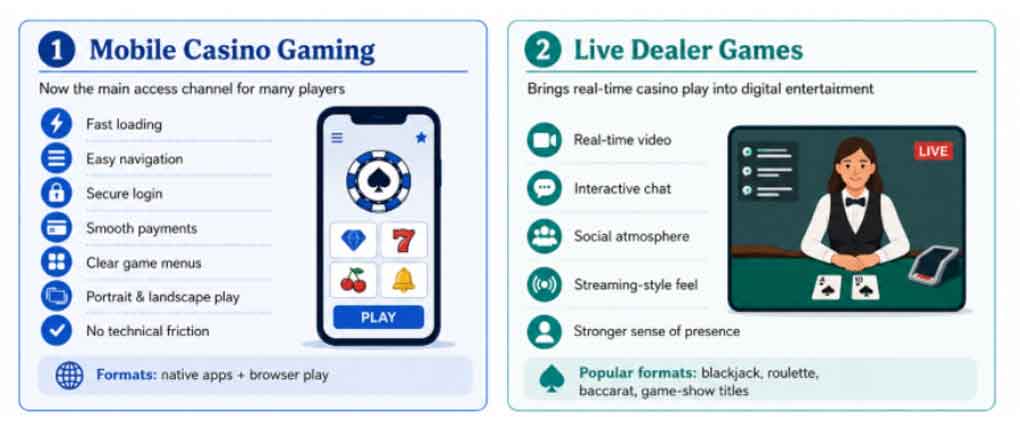
Live dealer games extend this evolution in a different direction. Real human dealers run blackjack, roulette, and baccarat from professional studios or casino-style floors, with every card draw and wheel spin broadcast live. Game-show formats such as wheel-based titles add a television layer on top of classic table play. Several qualities tie these games to the broader digital entertainment industry:
- Real-time video
- Interactive chat
- Social atmosphere
- Streaming-style experience
- Stronger sense of presence
A fair picture shows the trade-offs. Live tables run at the pace of a human dealer, so rounds resolve more slowly than RNG versions, and stable video requires a better internet connection. Convenience itself carries a risk dimension: when games fit into any spare moment and feel as social as a chat app, session limits, reality checks, and other responsible gambling tools become important. Licensed platforms in Ontario build these controls into both mobile and live products.
Online Casino Payments and Player Trust
Money movement defines reputation in the online casino industry. A player rarely reads licence documents, but everyone notices how a deposit clears and how long a cashout takes. Online casino payments therefore function as the most visible trust signal a platform sends. Around deposits and withdrawals, users want:
- Easy deposits
- Clear fees
- Fast withdrawals
- Secure payment methods
- Transparent processing times
- Clear verification requirements
The payment menu itself varies by market. Common categories cover:
- Debit cards
- E-wallets
- Bank transfers
- Instant banking
- Prepaid options
- Crypto in some regulated or offshore markets where legally available
Each category meets a different need. Debit cards are the default for first deposits; e-wallets shorten withdrawal times; instant banking links accounts without card details; and prepaid options cap spending by design. Crypto stays outside the licensed Ontario market, so its presence on a site aimed at Ontarians may indicate an unregulated operator.
Ontario classifies payment standards as part of player protection. Licensed platforms must verify identity before withdrawals, publish processing terms, and keep player funds separate from operating money. These rules make safe online gambling measurable: a user can compare stated timelines against real performance and spot problems early.
Convenience alone tells half the story. Fast, simple payments work best when paired with deposit limits, spending controls, and clear responsible gambling options, so speed serves the player instead of accelerating losses.
Responsible Gambling and Safe Online Gambling
Responsible gambling has turned from a footnote on terms pages into a core part of how iGaming operates. In Ontario and similar regulated markets, safety features are part of the licensing framework itself, so operators have a legal duty, and players gain enforceable rights.
| Tool | What It Helps Control |
| Deposit limits | How much money a player can add over a set period |
| Loss limits | How much a player can lose before play is restricted |
| Session reminders | How long a player has been active on the platform |
| Time-outs | Temporary breaks from gambling access |
| Self-exclusion | Longer-term blocking from gambling platforms |
| Reality checks | On-screen reminders about time, spending, or session activity |
| Support resources | Access to help lines, guidance, and problem gambling support |
Each tool addresses a distinct moment of risk. Deposit and loss limits cap money before play begins, reality checks interrupt long sessions with on-screen summaries, and time-outs or self-exclusion remove access for a chosen period. Platforms can use account data to spot risky behaviour patterns, though the precision of such detection varies by operator, and no system can replace a player’s own awareness.
Safe online gambling starts before registration, with a brief review of the operator. A practical pre-signup checklist looks like this:
- Valid licence
- Clear terms and conditions
- Secure payment methods
- Transparent bonus rules
- Responsible gambling tools
- Customer support
- Privacy and data protection
- Fair game certification
In Ontario, the licence check takes seconds: the AGCO publishes a registry of approved operators, and legal sites display their registration in the footer. Independent testing by the labs mentioned earlier confirms game fairness. The reverse list matters just as much. These warning signs point to an unsafe operator:
- Unclear withdrawal rules
- Unrealistic bonus promises
- No responsible gambling page
- Poor or missing licensing information
- Aggressive pressure to deposit
Any single red flag justifies walking away, and two or more together almost always reveal an unlicensed site. Player habits complete the picture: setting limits at registration, treating losses as the cost of entertainment, and never chasing them with bigger stakes. Protection works as a shared system, where operator standards form one half and player decisions the other, and neither half functions alone.
How iGaming Platforms Compete for Attention
Modern casino gaming platforms measure themselves against streaming apps, short-video platforms, and mobile games as much as against rival casinos. A session spent elsewhere is lost revenue, so product teams borrow retention mechanics from the broader digital entertainment industry. The features doing this work include:
- Loyalty programs
- Tournaments
- Missions
- Achievements
- Personalized recommendations
- Seasonal campaigns
- Live events
These mechanics give play a structure beyond individual spins or hands. Tournaments add leaderboards and time-limited goals, missions reward specific actions, and seasonal campaigns refresh the lobby the way streaming services rotate their catalogues. Personalized recommendations surface titles matching each user’s history, mirroring the logic of music and video apps.
The responsible angle sets a hard boundary. Retention features must never push harmful play, and regulators in Ontario review promotional mechanics with exactly this concern in mind. Strong operators design rewards around variety and entertainment instead of spending volume.
Current iGaming trends point to a quieter form of rivalry: trust now weighs as much as game count. In Ontario and comparable regulated markets, long-term success rests on usability, transparency, and safety, qualities a bonus banner cannot substitute.
The Future of iGaming in Ontario and Beyond
Forecasting the future of iGaming requires no speculation about distant technology, since the direction already shows in current regulatory filings, platform roadmaps, and player data. The likely paths of development run as follows:
- More mobile-first experiences
- Better live dealer formats
- Tighter regulation
- Improved responsible gambling tools
- Faster and safer payments
- More personalization
- Increased focus on transparency and trust
Several of these directions reinforce each other. Improved streaming quality expands what live studios can produce, payment innovation shortens the gap between cash-out request and money received, and online casino technology continues to absorb methods from banking, telecom, and media production. Regulation grows alongside the market: jurisdictions watch each other, and standards proven in one region tend to spread.
Ontario is a working preview of this development. The province built its market around compliance, player protection, and modern platform infrastructure from day one, then backed it with public reporting and an open operator registry. Other Canadian provinces and US states study the Ontario model when drafting their own frameworks, which gives the province influence well beyond its borders.
Bigger bonuses and larger game libraries will not decide the next decade. Whatever specific iGaming trends dominate a given year, the durable winners will be platforms uniting five qualities at once:
- Entertainment
- Safety
- Technology
- Regulatory compliance
- User trust
Operators viewing any one of these as optional will lose ground to those treating all five as the baseline, and regulators in Ontario have already written most of this baseline into licence conditions.
Why iGaming’s Future Depends on Trust and Technology
The iGaming industry has earned its place inside the digital entertainment industry by adopting the same instruments and user habits as streaming, mobile apps, and social platforms: on-demand access, live formats, instant transactions, and tailored content. The threads running through this article confirm it at every level, namely:
- Mobile casino gaming
- Live dealer games
- Online casino payments
- Online casino technology
- Responsible gambling
- Safe online gambling
None of these elements stands apart from the rest. Payments depend on verification systems, live studios depend on streaming infrastructure, and safety tools depend on data the platform collects anyway. The future of iGaming belongs to operators able to hold this whole structure together, where regulated markets such as Ontario supply the template: entertainment built on technology, governed by rules, and sustained by player trust.