Mining Is Northern Ontario’s Economic Opportunity — If Ontario Moves With Purpose
THUNDER BAY — Mining has long been one of Northern Ontario’s economic foundations. In 2026, with gold, silver, copper and critical minerals attracting global attention, the question for Ontario is no longer whether mining matters. It is whether the province can turn mineral wealth into long-term jobs, Indigenous partnerships, processing capacity, infrastructure and regional prosperity.
Precious metals are driving renewed global interest
Gold and silver prices have surged through a period of global uncertainty, rising investor demand and central-bank buying. Gold traded above US$4,300 an ounce this week, while silver futures settled near US$70 an ounce, reflecting the scale of investor interest in precious metals. Reuters reported that more central banks plan to increase gold holdings, with a World Gold Council survey showing a record 45 per cent of surveyed reserve managers expect to add to gold reserves over the next year.
That matters in Northern Ontario because Ontario remains Canada’s leading gold-producing province. The Ontario Mining Association says 18 gold mines in Ontario generated $6.5 billion in value in 2023, while the province’s 36 active mining operations produced gold, base metals, iron, platinum group metals and industrial minerals.
For Northwestern Ontario, the gold price is not an abstract number on a trading screen. Higher prices can increase exploration budgets, improve the economics of marginal deposits, extend mine lives and support service-sector jobs in communities such as Thunder Bay, Red Lake, Geraldton, Marathon, Dryden, Sioux Lookout and surrounding First Nations.
Mining is already a major Ontario employer and wealth creator
The Ontario Mining Association says mining contributed $23.8 billion to Ontario’s GDP in 2023, with capital expenditures of $5.22 billion. The sector directly employed about 22,000 people with an average annual salary of $150,000, and indirectly supported an additional 130,000 jobs.
Those numbers matter in the North because mining jobs are often among the best-paid private-sector positions available outside major urban centres. They support contractors, equipment suppliers, aviation, trucking, engineering, environmental services, training institutions, hotels, restaurants and small businesses.
Thunder Bay’s role is especially important. The city is a regional service hub for mining exploration and development across Northwestern Ontario. Its port, airport, rail connections, trucking sector, educational institutions and professional services give the city a strategic role in moving people, equipment, fuel, concentrates and supplies across the region.
Critical minerals add a second layer of opportunity
Gold is the headline, but critical minerals are the long-term strategic story.
Canada’s critical minerals list includes 34 minerals and metals, including copper, nickel, cobalt, graphite, lithium, platinum group metals, chromium, zinc and rare earth elements. Ottawa says these minerals are essential for electric vehicles, batteries, renewable energy, defence applications, medical devices, mobile phones, data centres and advanced manufacturing.
Ontario has advanced projects, mines, smelters or refineries connected to chromium, graphite, nickel, cobalt and platinum group metals. That places the province in a strong position as North America tries to reduce reliance on supply chains controlled by geopolitical competitors.
Copper is also gaining attention because of electrification, grid expansion and artificial intelligence-driven power demand. Reuters has reported that copper prices have been supported by tight supply, data-centre demand, clean-energy investment and power-grid modernization.
The Ring of Fire remains a test of execution
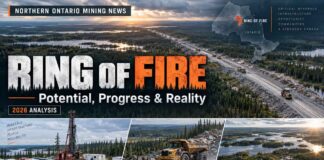
The Ring of Fire in the James Bay lowlands remains one of Ontario’s most watched mining regions, with potential deposits of chromite, nickel, copper and platinum group metals. But its future depends on infrastructure, environmental assessment, Indigenous consent, financing and market conditions.
Ontario has announced plans to accelerate all-season road construction connected to the Ring of Fire, including the Webequie Supply Road, with construction scheduled to begin in June 2026 and opening targeted for November 2030.
For Thunder Bay and Northwestern Ontario, the Ring of Fire is more than a mine-development file. It is a test of whether Ontario can build infrastructure in remote areas while respecting First Nations rights, protecting sensitive watersheds and ensuring that benefits flow to northern communities rather than being exported south or out of province.
Indigenous partnerships must be central, not secondary
Mining development in Northern Ontario cannot be separated from Indigenous rights, land use, treaty relationships and community decision-making.
The Ontario Mining Association says the sector has 142 active agreements with Indigenous communities, including exploration agreements, impact benefit arrangements and resource revenue sharing. It says 35 First Nations receive 40 per cent of annual mining taxes and royalties from operating mines, and 45 per cent from future mines.
Those agreements are important, but they cannot replace meaningful consultation, consent-based project planning, environmental protection and local capacity building. If Ontario wants mining to strengthen the northern economy, Indigenous communities must have real opportunities for ownership, procurement, training, employment, monitoring and long-term revenue.
That is especially important in remote First Nations where mining can bring jobs and infrastructure, but also environmental risk, social pressure and rapid change.
What Ontario should do next
Ontario’s opportunity is significant, but it will not maximize itself. The province should focus on six priorities.
First, it should make permitting faster and more predictable without weakening environmental review or Indigenous consultation. Mining companies need timelines they can finance. Communities need confidence that decisions are transparent, evidence-based and enforceable.
Second, Ontario should invest heavily in northern infrastructure: all-season roads where supported by affected First Nations, reliable power, broadband, rail capacity, housing, port infrastructure and winter-road alternatives. Mines cannot operate efficiently without infrastructure, and communities should benefit from that infrastructure beyond the life of a single project.
Third, the province should push more value-added processing in Ontario. Shipping raw material out of the province leaves money on the table. Smelting, refining, battery materials, recycling and advanced manufacturing can create longer supply chains and more stable jobs.
Fourth, Ontario should expand training for mining trades, engineering, environmental monitoring, heavy equipment, aviation, geology, mine rescue and Indigenous youth employment. A strong mining economy will fail if the labour force is not ready.
Fifth, Ontario should support exploration. The province has committed $10 million through the Ontario Junior Exploration Program for 2025-26, including support for early-stage projects and Indigenous participation. Exploration is the front end of the mine-development pipeline.
Sixth, Ontario should strengthen northern community planning. Mining can place pressure on housing, health care, policing, roads and municipal services. Communities need tools to plan for growth before a boom arrives.
Historical context: mining built much of the North
Northern Ontario’s modern economy was shaped by mining camps, railways, hydroelectric development and industrial towns. Sudbury, Timmins, Red Lake, Kirkland Lake, Hemlo and other regions were built around mineral discovery and production.
Thunder Bay’s role has historically been different but essential. As a transportation, supply and service centre, the city has supported resource development across the Northwest, including forestry, mining, rail, shipping and aviation. That position remains valuable as global demand turns again toward minerals.
The difference in 2026 is that mining is now tied to energy security, defence, electric vehicles, data centres and global supply-chain politics. Minerals are no longer only commodities. They are strategic assets.
The risk of missing the moment
Ontario has the geology, mining history, workforce, Indigenous knowledge, engineering capacity and access to North American markets. But other jurisdictions are moving quickly, and capital is mobile.
If the province moves too slowly, investment will go elsewhere. If it moves too carelessly, projects will face legal challenges, community opposition and environmental harm. The path forward must be fast, fair and credible.
Mining can help Northern Ontario build a stronger economy, but only if the benefits are broader than extraction. The goal should be mines that create jobs, strengthen Indigenous economies, support local suppliers, fund public services, protect the environment and leave communities better positioned for the future.
The current metals cycle gives Ontario a rare opening. The province should use it to build more than mines. It should build a northern economy with staying power.