In ten years, satellites have done more to civilize mining than a century of paperwork ever did. Orbital sensors have become the most reliable tool to inspect the industry that has always made its money where almost nobody could watch. Now mining companies, regulators, and environmental groups can read the ground beneath the surface, measure subsidence down to the millimeter, and find unauthorized digging in corners of the planet no inspector will ever stand in.
Exploration teams today use spectral data to choose their drilling targets and make the whole process ecologically healthier and more safe. Operators rely on open-pit mine monitoring to keep an eye on slope stability and wall movement between site visits. Regulators check reclamation claims against the imagery instead of taking a company at its word. The same tools that map a deposit also record the scar it leaves, and catch the people who make these scars illegally.
Satellite Image in Mineral Exploration
New deposits keep getting harder to find and pricier to chase, which is exactly why orbital data is no longer optional for any exploration team. For instance, the European richest, easiest mines are mostly worked out, and that has pushed geologists into remote country where boots-on-the-ground surveying is both slow and expensive. Satellite reconnaissance is what keeps searching that terrain affordable.
Hyperspectral imaging reads mineral associations straight off the surface – clays, iron oxides, hydrothermal alteration zones, the kinds of signatures that often sit above gold, copper, and critical-metal deposits. The Italian Space Agency’s PRISMA mission has been used to pick out valuable minerals even in the waste dumps of abandoned mines. Landsat and Sentinel-2 add a second layer of multispectral data, letting teams measure groundwater depth and vegetation health across a candidate site. The result is a tighter search area and far fewer wasted trips into the field.
For instance, the EU-funded MultiMiner project has built a toolset for analyzing hyperspectral Earth observation data for mapping surface mineral distributions, proxy minerals, and exploration vectors, all backed by a spectral library built specifically for critical raw materials. The team didn’t stop at theory, they validated it on real ground:
- Weißenstein, Austria — mapping regionally characteristic magnesite
- Kallyntiri, Greece — antimony
- Stratoni, Greece — antimony, gallium, platinum-group metals, and bismuth
Monitoring Active Mining Operations
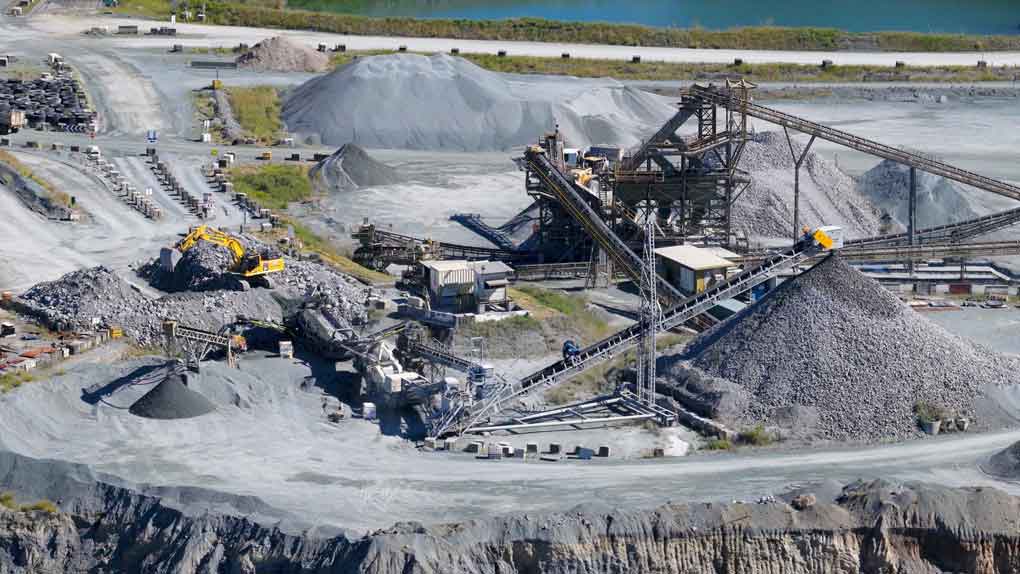
Once a deposit enters production, the satellites don’t go away, they shift from finding ore to watching the ground move. Remote sensing covers an entire mine site at once and works at both local and regional scales, at a fraction of what equivalent ground-based surveying costs.
Ground deformation and InSAR
The best tool here is Interferometric Synthetic Aperture Radar. It tracks surface movement to the millimeter, and that’s why it is chosen to monitor deformation at mining complexes. It can detect movement in three dimensions even across steep displacement gradients.
Tailings dams
Tailings failures are among the deadliest events the industry produces. A review of ten documented collapses, pit wall failures, dam breaches, waste dumps, and heap leach pad failures, found that six of them killed people. InSAR can flag abnormal deformation weeks, sometimes months, before a breach happens.
Tying imagery to production
The next step is combining imagery with GIS and real production figures – how much ore, concentrate, and waste a site actually moves. One study of 15 open-pit copper mines in Chile used this approach to classify six types of infrastructure, feeding into better logistics, smarter mine planning, and a smaller environmental footprint.
Environmental Monitoring and Reclamation
Mining leaves a heavy footprint, and satellites are the cleanest way to measure both the damage and whether the cleanup is real. The advantage is plain objectivity, an index calculated from orbit doesn’t care what a company’s reclamation report says it should show.
Vegetation indices like NDVI and EVI show how quickly plant cover returns to recycled land. It’s a direct, repeatable test of restoration, so that nobody can fake it ahead of an inspector’s visit. Erosion is easily detected on satellite images taken at different times long before it becomes a failure. Water quality shows up from space as well: when contaminants reach a river or lake, the surface’s optical properties shift and satellite sensors can detect them.
Combating Illegal Mining: Space as a Law Enforcement Tool
The single most meaningful use of mining satellite imagery is catching illegal mining operations. They inflict enormous environmental damage, which drains national economies of royalties, and in several regions directly finances armed conflict. Orbit gives regulators reach into places where enforcement on the ground is dangerous, expensive, or simply impossible.
Illegal activity detection today heavily relies on satellites and machine learning. For instance in the Brazilian Amazon, a satellite based monitoring software was used specifically to detect illegal mining fronts, a region where unchecked expansion threatens biodiversity and Indigenous communities, and where rapid, scalable surveillance is the only realistic answer.
The strongest evidence comes from Ghana, where illegal gold mining, galamsey, has become a disaster. By combining multi-temporal satellite data, drones, and detection algorithms, a targeted initiative cut illegal-mining-linked deforestation by 90 percent in the zones it covered – the clearest proof yet that surveillance from orbit changes outcomes on the ground.
The Choice Ahead
All of the cases are not a forecast anymore. Satellites find ore before the drill turns, watch dam walls for the millimeter creep before collapse, and catch the illegal diggers. The capability is mature, the data is cheap, and the archives are continuous.
For as long as mining has existed, it has made its money in places few people could watch, remote concessions, fenced-off tailings ponds, stretches of forest a full day’s drive from the nearest road. That era is ending fast. Today, Peru’s Madre de Dios region is tracked continuously by the MAAP monitoring project, which has documented illegal gold mining eating into the rainforest. In Ghana, the scars of galamsey mining now show up plainly when analysts compare satellite images taken weeks or months apart. And the ground movement that came before the deadly Brumadinho dam collapse in Brazil was already recorded in Sentinel-1 radar data, months before the dam failed and killed 270 people.
So the obstacle is no longer the technology. What remains is a question of will: whether regulators and mining companies actually act on the evidence that is already, quietly, passing overhead every single day.