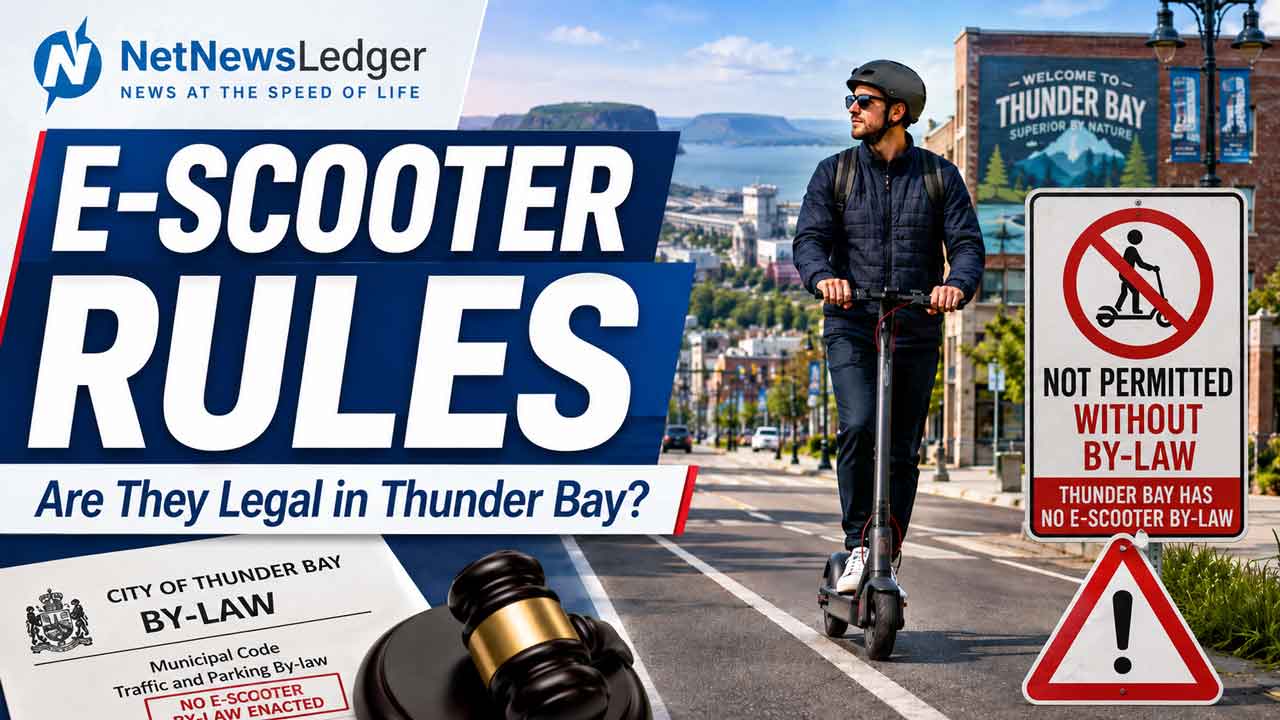
THUNDER BAY — Electric kick-scooters are increasingly common, relatively inexpensive and easy to buy — but purchasing one in Thunder Bay does not mean it is legal to ride on city streets, sidewalks or trails.
Thunder Bay drivers often encounter e-scooters, often riding at up to 50 km/h.
As of Aug. 26, 2026, Ontario continues to regulate electric kick-style scooters through a provincial pilot project. The key rule for Thunder Bay residents is that municipalities must specifically opt into that program by passing a by-law permitting e-scooters.
A review of current City of Thunder Bay material and council records did not identify a Thunder Bay by-law authorizing electric kick-scooters under the provincial pilot.
That means riders should not assume that the provincial e-scooter rules give them permission to ride on Thunder Bay’s municipal roads, sidewalks, trails or parks.
The Key Point: Ontario Allows Municipalities to Decide
Ontario Regulation 389/19 established the province’s electric kick-scooter pilot under the Highway Traffic Act.
The pilot originally had a shorter lifespan but was extended in 2024. It is now scheduled to continue until Nov. 27, 2029.
However, the province did not simply legalize e-scooters everywhere in Ontario.
The regulation states that an electric kick-scooter cannot be operated on a highway, sidewalk, trail, path or walkway, or in a public park or exhibition ground, unless its operation is permitted under the provincial regulation and, where the location is under municipal jurisdiction, permitted through a municipal by-law.
Ontario’s own guidance is equally clear: municipalities that want e-scooters on their roads must pass a by-law allowing them and advise the Ministry of Transportation that they are participating in the pilot.
That municipal opt-in requirement is what matters in Thunder Bay.
So Are E-Scooters Legal on Thunder Bay Streets?
Based on NetNewsLedger’s review of current provincial legislation and available City of Thunder Bay records, Thunder Bay has not enacted an authorizing by-law under Ontario’s electric kick-scooter pilot.
Without that by-law, the provincial pilot does not provide legal authority to ride electric kick-scooters on municipal roads in Thunder Bay.
The same issue applies to municipally controlled sidewalks, trails, paths, walkways and parks because the provincial regulation requires municipal authorization in those locations as well.
Thunder Bay considered the issue when Ontario launched the pilot.
In 2020, then-mayor Bill Mauro sought a report examining whether the city should participate. The proposal contemplated consultation with police, city departments and the Accessibility Advisory Committee, along with a possible draft by-law.
That examination should not be confused with actually joining the pilot.
More recently, Thunder Bay’s Smart Growth Action Plan has identified e-scooters, e-bikes, microtransit and mobility hubs as transportation options the city could explore as alternatives between conventional transit and automobile ownership. That language points toward possible future consideration rather than an existing authorization.
What Exactly Counts as an Electric Kick-Scooter?
Ontario’s pilot applies to a specific type of vehicle.
Under the provincial rules, an electric kick-scooter has:
- two wheels positioned front and rear;
- a standing platform;
- handlebars for steering;
- an electric motor of no more than 500 watts; and
- a maximum speed of 24 km/h on a level surface.
The scooter may weigh no more than 45 kilograms and must have brakes, a horn or bell, front and rear lighting and reflective material. Wheel diameter is limited to 17 inches.
It cannot have pedals, a seat or a basket.
That definition matters because not every small electric vehicle being sold online is legally an “e-scooter.”
A machine capable of higher speeds, fitted with a seat or configured more like a motorcycle may fall into a completely different legal category.
If Thunder Bay Joined the Pilot, What Rules Would Apply?
Even in an Ontario municipality that has opted into the program, riders do not have free rein.
The provincial framework requires riders to be at least 16 years old.
Anyone under 18 must wear a bicycle helmet.
Riders must remain standing, cannot carry passengers and cannot transport cargo.
Where a bicycle lane is provided on a roadway, the provincial regulation requires an e-scooter to use that bicycle lane, subject to limited exceptions set out in the regulation.
The province also says the normal Highway Traffic Act rules of the road generally apply to e-scooter operators in much the same way they apply to cyclists.
Violations of the pilot regulation can result in fines ranging from $250 to $2,500.
Again, those rules describe how e-scooters can operate where a municipality has first authorized them. They do not independently make e-scooters legal on Thunder Bay streets.
Can You Ride an E-Scooter on the Sidewalk?
For practical purposes, riders should not treat sidewalks as an alternative to the roadway.
Ontario’s municipal guidance states that electric kick-scooters are not to be operated on sidewalks.
The provincial regulation contains a narrow provision dealing with sidewalks in tunnels or underpasses where a bicycle lane is present, but municipalities may impose further restrictions.
In Thunder Bay, the larger issue remains that the city has not adopted the enabling by-law required for municipal operation in the first place.
What About Multi-Use Trails and Parks?
The same municipal-authorization rule applies.
Ontario Regulation 389/19 specifically refers to trails, paths, walkways and public parks.
A municipality can decide where e-scooters may be operated when it joins the pilot. It can permit some locations while excluding others.
Thunder Bay has not established such a local framework.
Riders should therefore not assume that because bicycles are permitted on a trail, an electric kick-scooter is automatically permitted there as well.
What About Riding on Private Property?
Ontario’s pilot restrictions focus on highways and public spaces such as sidewalks, trails, paths, parks and exhibition grounds.
Use on genuinely private property is a different matter and would normally depend on the permission of the property owner, along with any other applicable laws, insurance conditions and safety requirements.
A shopping-centre parking lot, condominium property or privately owned trail should not automatically be treated as somewhere a person is entitled to ride simply because it is privately owned.
Property-owner rules still apply.

E-Scooters Are Not the Same as E-Bikes
This is one of the most common sources of confusion.
An Ontario-compliant e-bike, or power-assisted bicycle, is treated differently from an electric kick-scooter.
Ontario says a legal e-bike must have working pedals, an electric motor not exceeding 500 watts, a maximum assisted speed of 32 km/h and other specified equipment.
Riders must be at least 16 and wear an approved helmet. E-bikes may generally be ridden on roads where conventional bicycles are permitted, subject to provincial and municipal restrictions.
An electric kick-scooter has no pedals, is designed to be ridden standing up and falls under the separate municipal pilot.
Removing the pedals from an e-bike can also change its legal classification. Ontario warns that an e-bike without pedals becomes a motor vehicle for Highway Traffic Act purposes, which can trigger licensing, registration and insurance requirements.
Mobility Scooters Are Different Again
A mobility scooter used by a person with limited mobility is not the same legal category as a recreational electric kick-scooter.
Ontario considers people using wheelchairs and medical mobility scooters to be pedestrians under the Highway Traffic Act.
That distinction is particularly important because the word “scooter” is used to describe several completely different products.
A medical mobility scooter, electric kick-scooter, e-bike and small four-wheel electric vehicle may look broadly similar to a consumer but can fall under very different rules.
Thunder Bay Police have also warned residents about another category — low-speed vehicles, which are small four-wheel electric vehicles sometimes marketed as alternatives to conventional cars or even as mobility devices.
TBPS has said those vehicles are not permitted on Thunder Bay public roads because the city has not enacted the municipal by-law required under Ontario’s separate low-speed vehicle pilot.
That is a different pilot program from the one governing two-wheel electric kick-scooters.
Can You Ride After Drinking or Using Cannabis?
No one should treat an e-scooter as a safe or legally risk-free alternative after consuming alcohol or drugs.
Ontario’s e-scooter guidance prohibits operation while impaired by alcohol or drugs and warns that consequences under the Criminal Code of Canada may apply.
Beyond criminal-law questions, an impaired rider creates an obvious collision risk for pedestrians, cyclists and motorists.
A taxi, public transit, designated driver or ride from a sober friend remains the safer choice.
What Happens if an E-Scooter Is Involved in a Collision?
Under Ontario’s pilot regulation, where an electric kick-scooter is involved in a collision with a pedestrian, animal or vehicle resulting in injury or property damage, the operator must report the collision to police and provide the information requested.
There can also be significant civil-liability questions after a collision.
Because e-scooters do not fit neatly into the same insurance framework as conventional automobiles, anyone buying one should understand what — if any — liability coverage is provided through their home, tenant or other insurance policy.
Consumers should not assume they are insured simply because a retailer sells the scooter for transportation use.
Why Would Thunder Bay Consider Allowing Them?
There are arguments on both sides.
Supporters see e-scooters as a relatively inexpensive form of short-distance transportation that could help connect neighbourhoods with transit stops, campuses, downtown areas and employment.
Thunder Bay’s Smart Growth Action Plan specifically recognizes the need to explore transportation choices that could fill the gap between public transit and car ownership, including e-bikes and e-scooters.
That could be relevant in a geographically spread-out city where not every trip requires a car but many trips are too long for convenient walking.
E-scooters can also appeal to students, younger workers and residents looking to reduce transportation costs.
Why Have E-Scooters Been Controversial?
Accessibility and pedestrian safety have been significant concerns since Ontario first introduced the pilot.
Among the concerns raised are riders using sidewalks, collisions with pedestrians and rental scooters being left across sidewalks or curb ramps.
Those issues can create particular hazards for people who are blind or have low vision and for people using wheelchairs, walkers or other mobility aids. Accessibility concerns were part of the discussion when Thunder Bay first considered the provincial pilot in 2020.
A future Thunder Bay e-scooter by-law would therefore likely need to address much more than simply whether scooters are permitted.
Council would have to consider where they could travel, where they could be parked, speed restrictions, enforcement, accessibility, insurance, commercial rental operators and how scooters interact with pedestrians and cyclists.
Bottom Line for Thunder Bay Riders
The important distinction is between what Ontario’s pilot would allow and what Thunder Bay currently permits.
Ontario has created a legal framework for electric kick-scooters through Nov. 27, 2029.
But municipalities have to opt in.
As of Aug. 26, 2026, NetNewsLedger could not identify a City of Thunder Bay by-law authorizing electric kick-scooter use under that program.
For Thunder Bay residents, that means buying an e-scooter does not give the owner permission to ride it on city roads, sidewalks, municipal trails or parks.
Anyone considering purchasing one for transportation should verify the latest rules with the City of Thunder Bay or Thunder Bay Police Service before relying on it for public-road use, particularly because the city’s long-term transportation planning now includes exploring e-scooters and the rules could change if council adopts a future by-law.