Australia and Canada share a lot: a Commonwealth, a resource economy, a public-health argument about gambling, and a habit of measuring themselves against a bigger neighbour. Up close, the gambling part looks nothing alike.
A set of Australian search data — gambling queries broken down by state — makes the difference unusually visible. For a Canadian reader who thinks in provinces, VLTs and the Ontario iGaming market, it works as a mirror, and two of the numbers in it don’t fit what either country’s gambling debate tends to assume.
First, the words
Nothing about Australian gambling makes sense until the vocabulary is sorted out, because Australians call the machine something nobody else does.
| Term | Who says it | What it means |
| Pokies | Australians, New Zealanders | Any slot machine — pub, club, casino or browser. Short for “poker machines”, a name that stuck from the 1950s even though there’s no poker in them |
| Slots | Canadians, Americans | The same machine |
| VLT | Canadians in Alberta, Manitoba, Saskatchewan, Quebec, Atlantic Canada | A lottery-corporation-owned slot in a bar or lounge — the closest Canadian relative of the Australian pub pokie |
| Fruit machine | Britons | Same again, usually with lower stakes |
| Online pokies | Australians searching Google | Offshore-hosted slots, since no Australian-licensed online casino exists |
Hold on to that last row. When an Australian types “online pokies”, they’re not looking at a provincially licensed site the way someone in Ontario would be. Every result is offshore, and that colours everything the rest of the data says.
The map
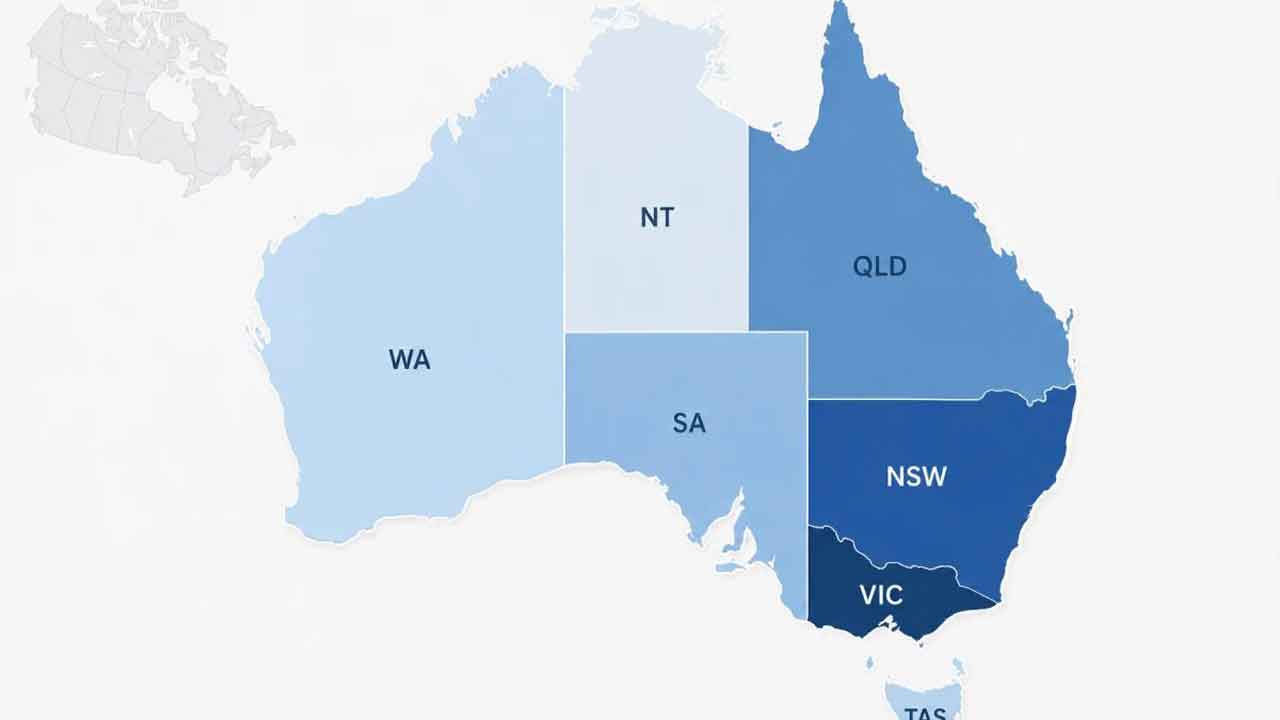
The dataset counts monthly gambling-related searches by state. Two states dominate, and the order is not the one population predicts.
| State / territory | Monthly gambling search volume | Pub and club pokies? | Note |
| Queensland | 23,800 | Yes | Highest volume in the country |
| New South Wales | 22,300 | Yes — the most machines of any state | Second, despite roughly 3 million more people than Queensland |
| Victoria | — | Yes, since 1992 | Not separately reported |
| Western Australia | — | No — casino only | Perth searches for help at five times Sydney’s rate |
| Other states and territories | — | Yes | Smaller volumes, not broken out |
The research reports only the top two states in full, so the table leaves gaps rather than filling them in. Even from two rows, the picture is clear enough to argue about.
One state-specific query stands out on its own: “online pokies qld” runs at about 800 searches a month.
Queensland beats New South Wales, and it isn’t population
New South Wales has roughly 8.5 million people and close to 90,000 pokies — more machines than any jurisdiction on earth outside Nevada. Queensland has about 5.5 million people and fewer machines per head. On size alone, NSW should be googling gambling more. It isn’t.
The data doesn’t say why. A few possibilities suggest themselves. Queensland’s population is spread across Cairns, Townsville, Rockhampton and the Gold Coast rather than concentrated in one capital, and regional players with fewer venues within reach may lean harder on search. Queensland’s pub and club culture also tends to put the gaming room front and centre, where a lot of Sydney venues sell the bistro and the rooftop first. None of that is proven by the numbers; it’s what you’d test next.
What the numbers do show is simple enough. The state with the most machines is not the state searching hardest for them. Any Albertan who has watched a VLT lounge sit empty on a Tuesday will recognise the gap between what’s available and what people actually go looking for.
The Perth paradox — no pub pokies, most help searches
Western Australia is the one state that never allowed pokies in pubs and clubs. The only machines in the state sit inside the casino at Burswood, across the river from Perth’s city centre. On paper it’s the safest gambling environment in the country.
The search data complicates that. Perth generates about 150 gambling-help searches a month — “gambling help”, “problem gambling support”, that family of queries. Sydney, with more than twice the population and tens of thousands of machines within a bus ride of anywhere, generates about 30.
There’s more than one way to read it. Perth’s demand may simply have gone online, where there’s no venue staff, no closing time and no self-exclusion scheme that offshore sites recognise — so the harm surfaces in search rather than at the club. Or help-seeking may carry less stigma in a state without pub pokies, so more people google it. Possibly both. Whichever it is, the Western Australian model doesn’t deliver the clean result its supporters expected, and a Canadian province weighing whether to pull VLTs out of bars would do well to look at Perth before deciding.
How this looks from Toronto or Calgary
Canada’s structure is provincial. Ontario licenses private online operators through iGaming Ontario, so a Toronto resident can play slots on a regulated site with a Canadian complaints process behind it. British Columbia and Quebec run lottery-corporation sites of their own. Alberta is building its model. Rules vary from Vancouver to Halifax, but in every province there is some legal, domestic way to play online.
Australia has none. The Interactive Gambling Act is federal, it bans operators from offering online casino games to Australians, and it applies identically in Brisbane and Hobart. The only online pokies an Australian can play are offshore, which makes 23,800 queries in a single state a measure of demand the law has chosen not to serve.
Put another way, the Canadian debate is about which regulated market works best. Australia hasn’t got as far as having one.
Where the online demand goes
For the Australian searches that do end at a site, the practical questions are the same ones a Canadian would have asked of a grey-market operator before Ontario regulated. Is the account in local currency. Does the local fast-payment rail work in both directions. Are the payout terms written down. In Australia that rail is PayID, the instant bank-to-bank transfer that does the job Interac e-Transfer does in Canada.
OzzyBet is one of the operators built for that market — Australian-dollar balances, PayID for deposits and withdrawals, processing windows stated in the terms rather than the banner. It’s a Curaçao-licensed offshore site, so the Queenslander playing on it has no Australian regulator to call. That’s the condition of the whole market rather than anything particular to one brand.
The pokies library and payment terms: OzzyBet pokies
The nearest Canadian analogy to a site like OzzyBet is the operator an Ontario player used before April 2022: functional, fast, popular, and entirely outside the province’s reach. Australia is still in that phase, and nothing in the search data suggests it’s leaving soon.
What the map says
Two Australian states account for more than 46,000 gambling searches a month between them, and the one with fewer machines searches more. The state with no pub pokies at all searches hardest for help. Neither finding fits the story either side of the Australian gambling debate prefers, and both are worth a look from a country still deciding, province by province, how much of this to regulate and how much to leave to the search bar.
FAQ
Which Australian state searches for gambling the most?
Queensland, at about 23,800 searches a month, ahead of New South Wales at 22,300 — even though NSW has roughly three million more people and far more machines.
What are pokies?
The Australian word for slot machines, short for “poker machines”. The closest Canadian relative of a pub pokie is a VLT in an Alberta or Manitoba lounge.
Are online pokies legal in Australia the way online slots are in Ontario?
No. Australia’s Interactive Gambling Act is federal and bans operators from offering online casino games to Australians. There’s no provincial-style licensed market; every online pokie an Australian plays is offshore.
Why does Perth search for gambling help more than Sydney if it has no pub pokies?
The data shows roughly 150 help searches a month in Perth against 30 in Sydney. It may be that demand went online, where there’s no venue oversight, or that help-seeking is less stigmatised there. The numbers don’t settle which.
What’s the Australian equivalent of Interac e-Transfer?
PayID — an instant bank-to-bank transfer that offshore sites rely on for deposits and withdrawals, much as grey-market operators leaned on Interac before Ontario regulated.