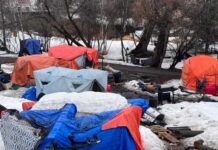
THUNDER BAY — Thunder Bay city council is being asked to approve a new Use of Public Spaces By-law that would set rules for municipal public spaces while creating a human-rights-based framework for responding to encampments.
The proposal, contained in Report 039-2026-Growth-Strategy & Engagement, was heard and debated at the May 6 Committee of the Whole meeting.
Administration recommended the bylaw be approved and that By-law 216-2026 be presented to city council for ratification on May 19.
Issues with homeless encampments have become a serious issue for many property owners and home owners in the past year. This proposed by-law appears a step in the right direction finally.
There needs to be a lot more engagement at the provincial and federal levels of government toward dealing with the mental health and addiction issues often seen in the encampments.
Bylaw tied to Thunder Bay’s encampment response plan
The proposed bylaw is part of the city’s 10-part Enhanced Encampment Response Plan. City administration says it is intended to provide a clear framework for the responsible and equitable use of public spaces while aligning with Thunder Bay’s human-rights-based approach to encampments.
The report says the bylaw is grounded in the Canadian Charter of Rights and Freedoms and informed by court decisions and human-rights guidance.
It would not create an outright ban on encampments. Instead, it would regulate outdoor sheltering where Charter-protected rights are engaged, while setting conditions related to health, safety, accessibility and environmental protection.
What the bylaw would do
The proposed bylaw would regulate the use of municipal public spaces across Thunder Bay. Its stated goals include reducing negative impacts on people experiencing homelessness, protecting persons and property, promoting safe and equitable use of public spaces, and ensuring any limits on public-space use are reasonable and justified when Charter rights are involved.
The report says the bylaw would include restrictions related to damage to public property, environmental harm, unsafe or disruptive behaviour, dumping, unauthorized use of utilities or municipal infrastructure, obstruction of access to properties or city operations, fire safety risks and unsafe storage of materials.
Designated encampment areas could be approved by council
A key feature of the proposed bylaw would give council authority to designate specific public spaces for outdoor sheltering when there are not enough truly accessible indoor shelter options available.
In those designated areas, people experiencing homelessness could set up and live in temporary shelters, subject to bylaw requirements and any site-specific conditions approved by council or administration. Those conditions could include limits on the number of shelters, minimum spacing requirements and other operational measures.
For Thunder Bay, this is a significant shift from ad hoc encampment management toward a more formal system. It would give the city a legal structure for where encampments may be allowed, how they are managed and when relocation may be considered.
Enforcement would not be first response
The report stresses that relocation and enforcement are not intended to be punitive. The city says its approach would be guided by dignity, proportionality, procedural fairness and harm reduction.
Where relocation is required and there is no immediate risk to life or safety, the city would first use a voluntary, engagement-based approach. The Encampment Response Team would provide information, explore options and connect people with services and supports before enforcement is considered.
If voluntary steps do not resolve the issue, the city could use a progressive compliance process through Municipal Enforcement Services. Thunder Bay Police Service involvement would not be a first-line response and would occur only as a last resort, according to the report.
Indoor shelter availability is central to the policy
One of the most important parts of the report is its recognition that municipalities cannot simply remove people from public spaces if truly accessible and appropriate indoor shelter is unavailable.
The report says enforcement actions, including orders under the bylaw, would proceed only where an individual has declined an offer of a truly accessible indoor option. If such an option is not available, or does not reasonably meet a person’s needs, enforcement would not proceed.
That point will be closely watched by service providers, outreach workers and legal advocates. It also places practical pressure on the availability and suitability of shelter spaces in Thunder Bay, including whether they are accessible, safe, culturally appropriate and able to meet individual needs.
Fines included, but not aimed at people experiencing homelessness
The bylaw would include penalties, including monetary fines, as a regulatory backstop.
However, the report states it is not the city’s intent to issue monetary penalties to individuals experiencing homelessness.
Instead, the fines are described as a tool for broader bylaw compliance and for violations by people who are not experiencing homelessness. Administration says enforcement would be assessed case by case, with attention to individual circumstances and fairness.
Consultation found agreement on safety, but differences on supports
The city says consultation took place between late 2025 and early 2026. Phase one involved targeted discussions with people with lived and living experience of homelessness and encampments, front-line outreach workers, service providers and Indigenous leadership. Phase two expanded to include a public and lived-experience survey.
Several themes emerged across the consultation, including support for safe and accessible public spaces, clear and enforceable rules, a compassionate and service-oriented approach, flexible responses based on risk and circumstances, and better co-ordination and communication.
The report also identifies differences. People with lived experience and service providers expressed stronger support for relocation assistance, storage, transportation, followup and culturally appropriate supports.
Public respondents had more varied views, especially on supports tied to enforcement actions and flexibility in timelines.
Why this matters in Thunder Bay and Northwestern Ontario
Thunder Bay is the regional service hub for much of Northwestern Ontario. Decisions about encampments, shelter, public spaces and enforcement affect not only city residents, but also people who come to Thunder Bay from surrounding communities for health care, social services, justice services, education, employment and family support.
The report’s emphasis on Indigenous leadership perspectives is also important. Indigenous people are disproportionately affected by homelessness in Thunder Bay, and any encampment policy that does not include culturally safe supports risks deepening existing harms.
For businesses, neighbourhoods and residents, the proposed bylaw may offer clearer rules around access, fire risk, waste, obstruction and safety. For people living outdoors, the key question will be whether the bylaw is implemented with real housing and shelter options, rather than functioning mainly as a relocation tool.
No direct financial implications identified
The report states there are no direct financial implications associated with approving the bylaw. However, implementation will still depend on staff capacity, outreach work, enforcement resources, shelter availability, designated encampment site management and co-ordination with community agencies.
That means the practical cost of the policy may emerge through related initiatives, including designated encampments, the Temporary Shelter Village, the Encampment Response Team and longer-term housing work.
Historical context: Thunder Bay has been moving toward a formal encampment framework
The proposed bylaw follows a series of council decisions and reports dating back to 2024. The background section notes previous work on designated encampment locations, distance guidelines, the Encampment Response Protocol and the Human Rights-Based Community Action Plan.
In 2024, council considered distance guidelines for encampments near trails, sidewalks, parking lots, bridges, rivers, railway tracks and private non-residential property. In 2026, council approved guiding criteria for identifying potential designated encampment sites and directed administration to conduct site-specific consultation.
The new bylaw is the next step in that policy evolution.
What happens next
Administration is recommending approval of the Use of Public Spaces By-law. If supported at the May 6 Committee of the Whole meeting, By-law 216-2026 would go to city council for ratification on May 19.
The decision will set the legal and operational framework for how Thunder Bay manages public spaces and encampments at a time when homelessness, shelter capacity, neighbourhood concerns and human-rights obligations are all pressing issues.
The central test will be implementation: whether the city can maintain safe, accessible public spaces while ensuring people experiencing homelessness are treated with dignity and connected to truly accessible alternatives.