Wildfires, evacuations, trade tensions and global conflict lead the news Northwestern Ontario should watch
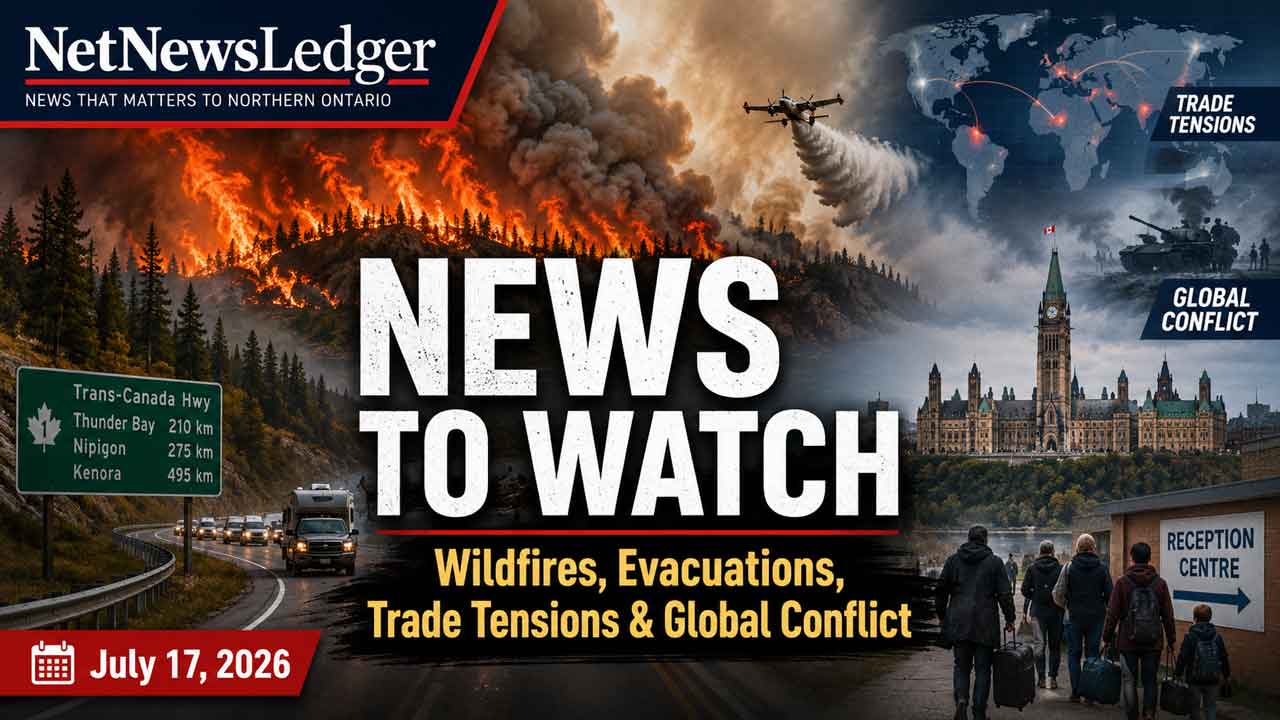
THUNDER BAY — Northwestern Ontario’s wildfire emergency remains the leading story for NetNewsLedger readers Friday, with communities evacuated, major transportation routes vulnerable and Thunder Bay serving as a regional reception centre.
Nationally, attention is turning to the federal response to the fires, First Nations emergency demands and renewed uncertainty surrounding Canada-U.S. trade. Internationally, escalating U.S.-Iran hostilities are pushing oil prices higher, while renewed attacks in Ukraine and preparations for the FIFA World Cup final remain major developments.
This news briefing is current as of approximately 7 a.m. CDT on Friday, July 17. Wildfire, evacuation, highway and air-quality conditions can change quickly.
Northwestern Ontario Wildfire Emergency Remains the Top Story
The latest provincial update listed 129 active wildland fires in the Northwest Fire Region, including 62 that were not under control.
Fire officials are concentrating available crews and aircraft on protecting lives, communities and critical infrastructure while attempting to contain new fires before they expand.
Mandatory evacuation orders have affected Armstrong, Namaygoosisagagun First Nation, Whitesand First Nation, Lac des Mille Lacs First Nation, Cat Lake, Mishkeegogamang First Nation, Fort Hope, McDowell Lake and other areas.
Residents around Ignace, Crystal Lake and the Highway 633 corridor have also been advised to prepare for possible evacuation.
The key developments to watch Friday are changes in wind, new lightning-caused fires, the movement of major fire perimeters and whether evacuation orders or alerts are expanded.
Ontario has requested federal help with evacuations from remote northern communities.
More than 1,600 First Nations residents had been displaced by fires across Canada as of July 15, according to Indigenous Services Canada figures.
Thunder Bay Continues Receiving Evacuees
Thunder Bay remains an important evacuation and emergency-support centre for residents forced from communities across the region.
The city says evacuees from Armstrong, Whitesand First Nation and Namaygoosisagagun First Nation have arrived in Thunder Bay, with the possibility of additional arrivals as the situation develops.
Municipal officials have stressed that there is no current indication Thunder Bay itself is at risk of evacuation. The city is continuing to work with provincial agencies, emergency organizations and host-community partners.
The arrival of more evacuees would increase demand for hotel rooms, temporary accommodation, transportation, health care, food and culturally appropriate support services.
Thunder Bay residents should watch for official information about reception centres, service changes and requests for donations. Unrequested goods can create storage and distribution problems during an emergency, so donations should be directed through recognized organizations.
Matawa Chiefs Demand Direct Federal and Provincial Intervention
The Matawa Chiefs Council has declared a state of emergency and is calling for immediate intervention from Canada and Ontario.
The chiefs are seeking a dedicated government contact and a joint emergency response structure involving Matawa and Ontario’s Provincial Emergency Operations Centre.
They also want governments to prepare for the possible deployment of the Canadian Armed Forces, Canadian Rangers, Canadian Red Cross and additional emergency personnel.
The chiefs have raised concerns about power outages, airports, fuel and grocery supplies, water and wastewater systems, homes, community buildings and local radio communications.
These concerns are particularly serious in remote First Nations, where an airport, power system or communications failure can affect an entire community. Watch for federal announcements on military or Ranger assistance, evacuation aircraft and emergency funding.
Chiefs attending the Assembly of First Nations gathering have also approved an emergency resolution calling for stronger support for northern Ontario First Nations affected by the fires.
Smoke and Air Quality Remain Public-Health Concerns
Wildfire smoke continues to affect Thunder Bay and communities across Northwestern Ontario.
The City of Thunder Bay has suspended some non-critical outdoor work and programming during periods of very poor air quality. Essential services, including transit, emergency response and critical public works, are continuing.
Smoke exposure is especially concerning for children, older adults, pregnant people and anyone with asthma, heart disease or another respiratory condition.
Residents should watch the Air Quality Health Index and adjust outdoor activities as conditions change. Smoke may become heavier or lighter within hours as winds shift.
Thunderstorms are possible in Thunder Bay on Friday, with smoke continuing to reduce air quality. Storms may produce damaging winds, which could affect existing fires, down trees or disrupt electrical service.
Highways, Rail Lines and Supply Chains Need Close Monitoring
Wildfires have affected major Northwestern Ontario transportation corridors, including sections of Highway 11, Highway 527 and Highway 599.
Drivers should check Ontario 511 immediately before travelling. Conditions can change after a trip begins, and unofficial forest-road detours may expose motorists to fire, smoke, fallen trees and emergency vehicles.
Ontario 511’s regional page did not list a reported highway emergency early Friday morning, but the situation remains fluid and travellers should rely on the live map rather than older notices or social-media posts.
Canadian National Railway has also suspended operations in areas affected by fires near Armstrong. Disruptions to rail or highways can delay food, fuel, construction materials and industrial shipments.
This matters for regional mining and forestry operations because Northwestern Ontario has few alternate east-west or north-south routes. A prolonged closure can quickly create delays throughout the supply chain.
Restricted Fire Zone Remains in Effect
A Restricted Fire Zone is in place across the Northwest Fire Region and part of the Northeast Fire Region.
Open-air burning, including campfires, is prohibited inside the restricted zone. Burning permits are suspended until further notice.
Portable gas and propane stoves may be used for cooking or warmth but must be operated cautiously.
The restriction is intended to prevent human-caused fires while crews, helicopters and waterbombers are heavily committed. Watch for changes to municipal fire bans, park restrictions and access to Crown land.
Drone operators must also remain away from every active fire. Unauthorized drones can force firefighting aircraft to stop operating and leave the area.
Federal Wildfire Assistance Is Now a National Story
Ontario’s request for federal assistance places the northern wildfire emergency before the national government.
Prime Minister Mark Carney has said the federal government is co-ordinating assistance, while Ontario is seeking support for remote evacuations and other operations.
The central questions are how quickly federal resources can be deployed, whether the military will provide aircraft or logistical assistance and how evacuated First Nations will be supported during what could become an extended displacement.
Wildfires are also burning at elevated levels in Manitoba and Saskatchewan. Nationally, more active fires and more burned land had been recorded by mid-July than at the same point in the previous two years.
For Northwestern Ontario, national competition for aircraft, firefighters and emergency accommodations could influence how resources are allocated.
Canada-U.S. Trade Negotiations Show Little Progress
Canada’s trade relationship with the United States is another important national story to watch.
U.S. Trade Representative Jamieson Greer said discussions with Canadian officials are continuing but claimed Canada has not offered concessions and formal negotiations have not begun.
Greer said discussions with Mexico over the United States-Mexico-Canada Agreement are progressing more substantially.
The comments do not mean new tariffs are inevitable, but they signal that Canada may face a difficult negotiating environment.
Northwestern Ontario is exposed to cross-border trade uncertainty through forestry, mining, manufacturing, trucking and Great Lakes shipping. Changes to tariffs or continental-content rules could affect lumber, paper products, critical minerals, machinery and fuel prices.
Watch for direct talks between Prime Minister Carney and U.S. President Donald Trump, as well as any proposed tariffs or quotas affecting Canadian exports.
Ottawa Signs Major Armoured-Vehicle Contract
The federal government has signed a four-year contract worth almost $2 billion with General Dynamics Land Systems-Canada for 190 armoured combat-support vehicles.
The purchase will increase the military’s fleet of those vehicles from 360 to 550, according to the federal announcement.
The contract is centred in London, Ont., but it reflects Ottawa’s wider push to expand defence spending and Canadian military production.
U.S.-Iran Conflict Raises Risk of Higher Fuel Costs
The United States intensified its attacks on Iran early Friday, targeting bridges, an airport, energy sites and other infrastructure.
Iran has responded with attacks against U.S. positions in the Middle East, while disruption around the Strait of Hormuz continues to threaten global oil and natural-gas shipments.
Oil prices rose about two per cent Friday morning. Brent crude was trading near $86 US a barrel, with both major benchmarks up sharply for the week.
This is not only a distant foreign-policy story. Higher global oil prices can feed into gasoline, diesel, aviation-fuel and heating costs in Canada.
The International Energy Agency has warned that global energy security could be at risk if shipping through the Strait of Hormuz remains seriously disrupted.
Ukraine Faces New Attacks and Political Turmoil
Russian missile attacks overnight killed at least four people and injured 20 in Ukraine, according to Ukrainian officials. The attacks came as President Volodymyr Zelenskyy faces protests and political criticism following his decision to remove defence minister Mykhailo Fedorov.
The dispute matters because Ukraine is attempting to maintain military operations while managing internal disagreements over leadership, technology, drones and battlefield strategy.
Canada has provided extensive military, financial and humanitarian support to Ukraine.
Further escalation could produce new requests for weapons, air-defence equipment and reconstruction assistance.
World Cup Final Will Put Canadian Wildfire Smoke in the Global Spotlight
Spain and Argentina will meet Sunday, July 19, in the FIFA World Cup final at New York New Jersey Stadium.
The match will conclude the first 48-team men’s World Cup, co-hosted by Canada, Mexico and the United States. More than 80,000 spectators are expected at the final.
Air quality will be watched closely after smoke from Canadian wildfires spread into New York and other parts of the northeastern United States.
Authorities previously issued health warnings as smoke from northern Ontario reached major American cities. Toronto also cancelled outdoor World Cup activities during extremely poor air quality.
The situation underscores how fires burning near communities in Northwestern Ontario can create public-health, transportation and event-planning consequences thousands of kilometres away.
What NetNewsLedger Readers Should Watch Through Friday
The most immediate developments will be new evacuation decisions, changing fire behaviour, highway or rail restrictions and federal announcements on emergency assistance.
Residents should also monitor air-quality alerts, local service changes and information issued by First Nation leadership, municipalities, police and the Ministry of Natural Resources.
Nationally, Canada-U.S. trade discussions and the federal response to the wildfire emergency deserve close attention.
Internationally, the U.S.-Iran conflict presents the greatest immediate economic risk because further attacks or shipping disruptions could push energy prices higher.
All of these stories are evolving. NetNewsLedger will continue updating confirmed information as it becomes available.