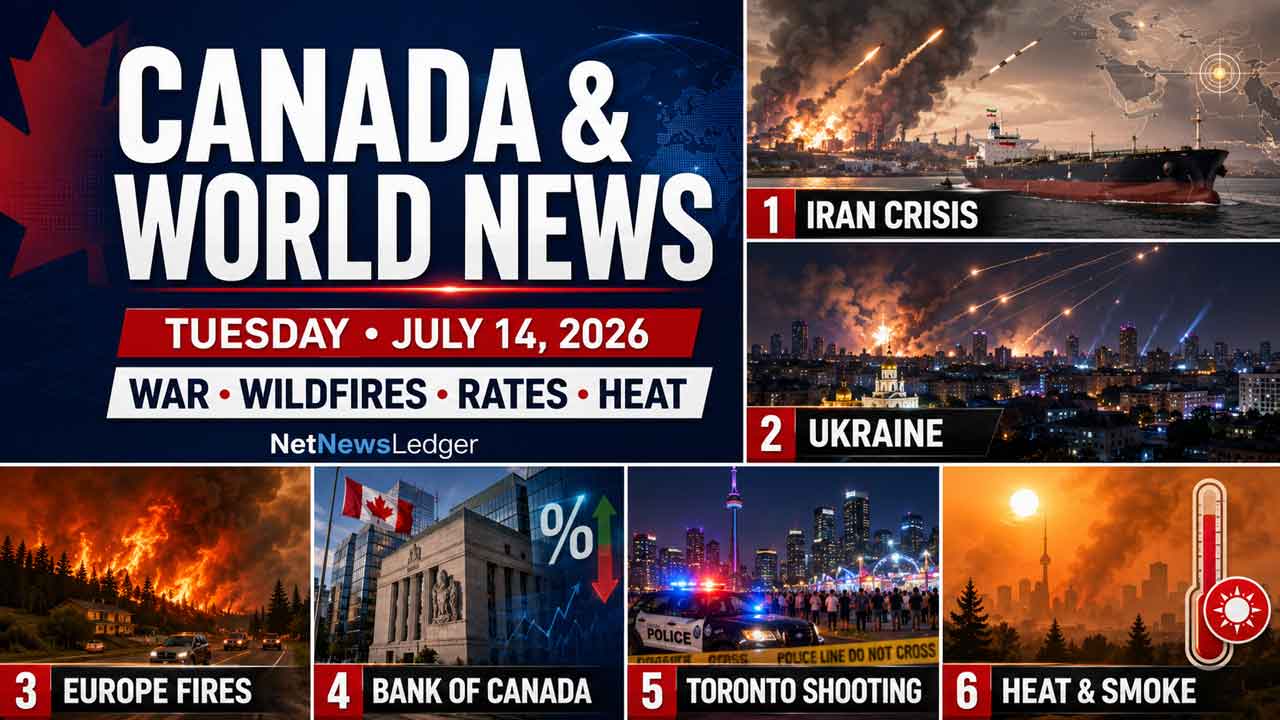
Canada and World News Summary for Tuesday, July 14, 2026
THUNDER BAY — Renewed U.S.-Iran fighting, threats to shipping through the Strait of Hormuz, escalating attacks in Ukraine and deadly European wildfires are leading international news Tuesday.
In Canada, attention is focused on Wednesday’s Bank of Canada interest-rate decision, the continuing Toronto festival shooting investigation, wildfire smoke and extreme heat, an Air Canada labour agreement and major bail reforms taking effect this week.
The situation in the Middle East remains fast-moving, and details could change through the day.
Tuesday’s major stories: War, wildfires, interest rates and public safety
U.S. and Iran exchange new attacks as Strait of Hormuz tensions rise
The United States launched another round of strikes against Iran early Tuesday after President Donald Trump said Washington was reinstating a blockade of Iranian ports and would charge commercial vessels for protected passage through the Strait of Hormuz.
Iran responded with attacks against Israel and countries hosting U.S. forces.
An American airbase in Jordan was among the targets claimed by Iran as the U.S. military carried out several hours of strikes.
Oil prices rose as the fighting intensified and uncertainty increased over whether tankers could safely move through the Strait of Hormuz, one of the world’s most important energy-shipping routes.
For Thunder Bay and Northwestern Ontario, a sustained energy-price increase would likely raise gasoline, diesel and aviation-fuel costs. That would affect trucking, mining, forestry, construction and remote First Nations that depend heavily on air transportation and long supply chains.
Houthi attack on Saudi airport raises risk of wider regional war
Yemen’s Iran-backed Houthi movement says it launched missiles and drones at Abha International Airport in Saudi Arabia following Saudi airstrikes against Sanaa International Airport.
No casualties were reported, but the attack marked a sharp escalation after several years of reduced hostilities between Saudi Arabia and the Houthis. The United Nations Security Council met amid concern that fighting involving Iran, the United States, Israel, Saudi Arabia and Yemen could expand further.
The growing number of regional fronts adds to the risks facing commercial aviation, shipping and global energy markets.
Ukraine intercepts ballistic missiles during major Russian attack
Ukraine says its air defences intercepted five Russian ballistic missiles during an overnight attack that also involved drones and other missiles.
Some weapons reached Kyiv, damaging warehouses and a school, according to Ukrainian officials. The interceptions were Ukraine’s first publicly reported success against Russian ballistic missiles in almost two weeks.
Ukraine and nine European countries have also announced a coalition to develop a shared ballistic-missile defence system. The initiative is intended to use Ukraine’s battlefield experience to develop more affordable interceptors that can be produced in large numbers.
The continuing attacks will keep pressure on Canada and other NATO members to supply Ukraine with air-defence equipment, ammunition and financial support.
Deadly European wildfires spread during third major heat wave
A wildfire in the Fontainebleau forest near Paris had burned about 1,300 hectares by Tuesday, forcing approximately 900 people to evacuate and disrupting road and rail travel.
French authorities said the fire remained uncontrolled and that two people had been arrested in connection with the investigation. Aircraft used the Seine River to collect water during suppression operations.
In Spain, authorities have confirmed 13 deaths from a major wildfire in Almería province.
The blaze burned about 7,000 hectares before officials said the situation had stabilized.
The fires are burning as western Europe experiences its third major heat wave of the summer.
More than 10,000 excess deaths were recorded during the region’s severe late-June heat event, with older adults accounting for most of those deaths.
The European crisis carries lessons for Northwestern Ontario, where extreme heat, smoke, remote geography and limited evacuation routes can place additional pressure on health services, firefighters and First Nation emergency planning.
China’s exports surge on AI demand as domestic economy struggles
China reported that exports increased 27 per cent in June compared with a year earlier, supported by demand for artificial-intelligence chips, electronics and vehicles.
Imports rose 36 per cent, while the monthly trade surplus reached approximately $125.6 billion US.
The strong trade figures contrast with weakness in Chinese household spending, property markets and private investment. Economists expect China’s second-quarter growth rate to slow when new economic data is released Wednesday.
Hungary moves to dismantle parts of Orbán-era political system
Hungary’s Parliament has passed a constitutional amendment allowing lawmakers to remove President Tamás Sulyok and introduce judicial, anti-corruption and parliamentary reforms.
Prime Minister Péter Magyar’s pro-European Tisza party holds the two-thirds majority needed to change the constitution following its April election victory over former prime minister Viktor Orbán’s Fidesz party. Fidesz lawmakers boycotted the vote and accused the government of undermining democracy.
The dispute is being closely watched across the European Union as Hungary attempts to reverse institutions and policies established during Orbán’s years in office.
Bank of Canada decision expected Wednesday
The Bank of Canada will announce its latest interest-rate decision and release a new Monetary Policy Report at 9:45 a.m. ET Wednesday.
The central bank’s overnight-rate target is currently 2.25 per cent, where it has remained since October 2025.
36 economists expected the bank to keep the rate unchanged as improving employment and economic growth are weighed against inflation and renewed pressure on energy prices.
The decision will affect variable-rate loans, mortgage renewals, construction financing and business borrowing. The bank’s new economic forecast may be as important as the rate decision, particularly for households and businesses trying to judge whether borrowing costs will remain steady into 2027.
Toronto festival shooting investigation continues
Toronto police continue to investigate the shooting near the Salsa on St. Clair festival that killed two men and injured four other people Saturday evening.
Police said the incident appeared to involve an exchange of gunfire between individuals targeting one another rather than an indiscriminate active-shooter attack. Two firearms were recovered, but no arrests had been announced in the latest public update.
The shooting caused thousands of festival visitors to flee or seek shelter and led organizers to cancel the remainder of the event. The incident continues to fuel concern over illegal firearms, public-event security and gun violence in Canadian cities.
Air Canada reaches tentative agreement with 11,000 workers
Air Canada has reached a tentative four-year collective agreement with the International Association of Machinists and Aerospace Workers.
The union represents about 11,000 employees working in technical operations, airports, cargo, logistics and supply services. The proposed agreement would run from April 1, 2026, through March 31, 2030, but must still be ratified by union members.
The agreement reduces the immediate risk of a major Air Canada labour disruption during the summer travel season. WestJet is facing separate labour pressure as its flight attendants consider strike action.
New federal bail and sentencing rules take effect Wednesday
More than 80 Criminal Code changes under the federal Bail and Sentencing Reform Act are scheduled to take effect July 15.
The legislation expands reverse-onus bail provisions for some repeat and violent offences, requires courts to consider additional public-safety factors and strengthens sentencing provisions involving serious violence, organized crime, home invasions, vehicle theft and damage to essential infrastructure.
The federal government says the changes are intended to make bail more difficult to obtain for some repeat and high-risk accused people. Provinces and territories remain responsible for courts, prosecutors, jails, bail supervision and much of the legislation’s implementation.
For Thunder Bay and Northwestern Ontario, the changes will be closely watched in cases involving repeat violent offending, weapons, organized drug trafficking and offences committed while an accused person is already subject to court conditions.
Extreme heat and wildfire smoke remain Canadian concerns
The latest federal wildfire briefing reported 796 active fires across Canada, including 60 considered out of control. The government said 3,137 fires had burned approximately 1.4 million hectares during the 2026 season as of the July 10 update.
Smoke forecasts for July 14 show wildfire pollution continuing to move across parts of Canada and the United States. Smoke conditions can change quickly depending on wind direction, fire behaviour and precipitation.
Thunder Bay is forecast to reach 34 C Tuesday, with conditions posing a risk of dehydration and heat illness during strenuous outdoor activity. Cooler conditions are expected Wednesday.
Residents should check on older adults and people without air conditioning, limit strenuous activity during the hottest part of the day and monitor local air-quality information when smoke is present.
France and Spain meet in World Cup semifinal
France faces Spain on Tuesday in the first semifinal of the 2026 FIFA World Cup at Dallas Stadium in Arlington, Texas.
France is seeking a third consecutive appearance in the World Cup final, while Spain is attempting to repeat recent tournament victories over the French. The game will feature two of soccer’s biggest stars, France captain Kylian Mbappé and Spain’s Lamine Yamal.
Argentina and England are scheduled to play the second semifinal Wednesday in Atlanta.
What Northwestern Ontario should watch
The Middle East conflict is the most immediate international economic concern for Northwestern Ontario because of its potential effect on fuel, transportation and food costs.
Closer to home, the Bank of Canada announcement, new bail rules, wildfire smoke and heat will have more direct effects on households, businesses, police, courts, health services and northern transportation.