Canada may be in technical recession, but economists say the broader picture is mixed
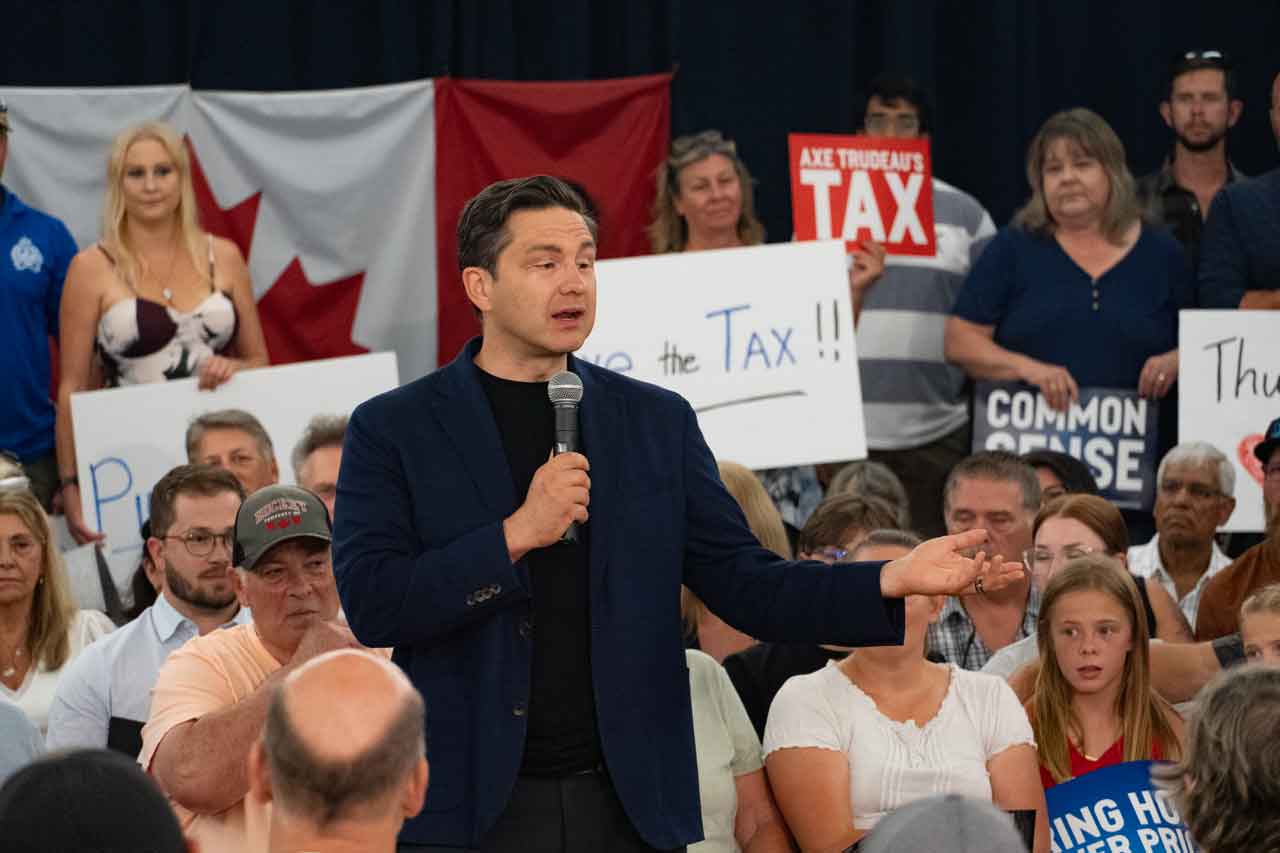
Canada’s latest economic data has opened a political fight over whether the country is in recession. Conservative Leader Pierre Poilievre says Canada is already in what he calls a “Liberal recession.”
The data gives him some support under a narrow technical definition, but economists and recession-dating experts are more cautious.
Canada Meets One Technical Test, but Not Everyone Calls It a Recession
Statistics Canada reported that real gross domestic product was essentially flat in the first quarter of 2026, after declining 0.2 per cent in the fourth quarter of 2025. Unrounded expenditure-based data showed a very small first-quarter decline, which led some analysts to say Canada had met the common “technical recession” test of two consecutive quarters of negative real GDP growth.
That makes Poilievre’s claim partly accurate.
Canada has enough weak GDP data to support the argument that the economy entered “technical recession” territory. But calling it a full recession is more debatable because the decline was shallow, the data are subject to revision and other indicators, including employment and some industry-level GDP figures, point to a more mixed economy.
What Poilievre Is Saying
Poilievre has blamed Prime Minister Mark Carney’s policies for the slowdown, arguing that rising insolvencies, food bank usage, mortgage stress and weak business investment show Canadians are living through a real economic downturn, not just a statistical technicality.
The Conservative leader has called for the government to reverse Liberal economic policies, including the industrial carbon price and federal impact-assessment rules he says are holding back major projects.
Politically, the Conservative argument is straightforward: two weak GDP quarters, high household costs and business uncertainty amount to recession conditions. That message is likely to resonate with families and small businesses already facing higher grocery, fuel, rent and borrowing costs.
Why Economists Are More Cautious
The C.D. Howe Institute’s Business Cycle Council, widely recognized as Canada’s recession-dating authority, does not rely only on the two-quarter GDP rule. Its methodology defines a recession as a pronounced, persistent and pervasive decline in economic activity, meaning the weakness must be deep enough, long enough and broad enough across the economy.
On June 5, the council said it was too early to call the latest slowdown a recession. It noted that the first-quarter decline was very small and that technical recession language does not necessarily capture the broader condition of the economy.
The Bank of Canada has also urged caution. Senior deputy governor Carolyn Rogers told a parliamentary committee that two quarters of annualized contraction meet one definition of recession, but warned against putting too much weight on a single indicator.
She also pointed to Statistics Canada’s advance estimate showing the economy likely rebounded in April.
The Liberal Government’s Position
Carney has acknowledged “some weakness” in the economy but has not directly accepted Poilievre’s recession framing.
The Prime Minister has said recent data are uneven partly because of deliberate government choices, including lower immigration and reduced government spending, while arguing that Ottawa is trying to rebuild the economy for longer-term resilience.
Federal Finance Minister François-Philippe Champagne has defended the government’s approach, saying the Liberals have a plan built around housing, infrastructure, productivity and innovation.
The federal spring economic update also points to global oil-price shocks, Middle East instability and U.S. trade uncertainty as risks weighing on growth.
The NDP Position
New Democrats have taken a different line, arguing that Ottawa’s economic response is not doing enough for households facing high costs. NDP Leader Avi Lewis said the spring economic statement failed to meet the moment and criticized the Liberals for not doing more to address affordability or tax excessive corporate profits.
That gives the NDP space to criticize both major parties: the Liberals for what New Democrats see as insufficient relief, and the Conservatives for focusing on deregulation and tax cuts rather than corporate concentration, food prices and household insecurity.
Other Indicators Tell a Mixed Story
The labour market does not look like a classic recession. Statistics Canada reported employment rose by 88,000 in May and the unemployment rate fell to 6.6 per cent from 6.9 per cent in April. That does not erase economic weakness, but it complicates the argument that Canada is in a broad, deep downturn.
Industry-level GDP also showed some resilience. Statistics Canada said GDP by industry edged up 0.1 per cent in the first quarter, even as goods-producing sectors declined. Transportation and warehousing rose 1.2 per cent, and advance information suggested real GDP increased 0.4 per cent in April.
At the same time, Canadians have reason to feel economic pressure. Inflation rose to 3.2 per cent in May, driven largely by gasoline prices, while food prices rose 3.8 per cent. For Northwestern Ontario, those increases hit especially hard because long driving distances, freight dependence and remote supply chains magnify fuel and food costs.
What It Means for Thunder Bay and Northwestern Ontario
A shallow national slowdown can still have serious local consequences. Thunder Bay’s economy is closely tied to transportation, public-sector spending, construction, mining supply, forestry, port activity and regional retail.
If businesses delay investment or households reduce discretionary spending, the effects can show up in hiring, contracting, housing starts and service-sector sales.
Remote First Nations and northern communities face a sharper affordability challenge. Fuel-cost increases affect air cargo, winter-road planning, construction materials and grocery prices. Even if economists later decide Canada avoided a formal recession, many households may still experience recession-like pressure if incomes do not keep pace with food, rent, fuel and debt costs.
The Bottom Line
Poilievre is on solid ground when he says Canada has entered technical recession territory, based on two weak quarters of expenditure-based GDP data. But it is less accurate to present that as a settled, full national recession. The downturn so far appears shallow, contested and mixed across indicators.
The most balanced conclusion is this: Canada’s economy is weak and may have briefly met a technical recession test, but the evidence does not yet clearly show the pronounced, persistent and pervasive decline normally used to declare a full recession.