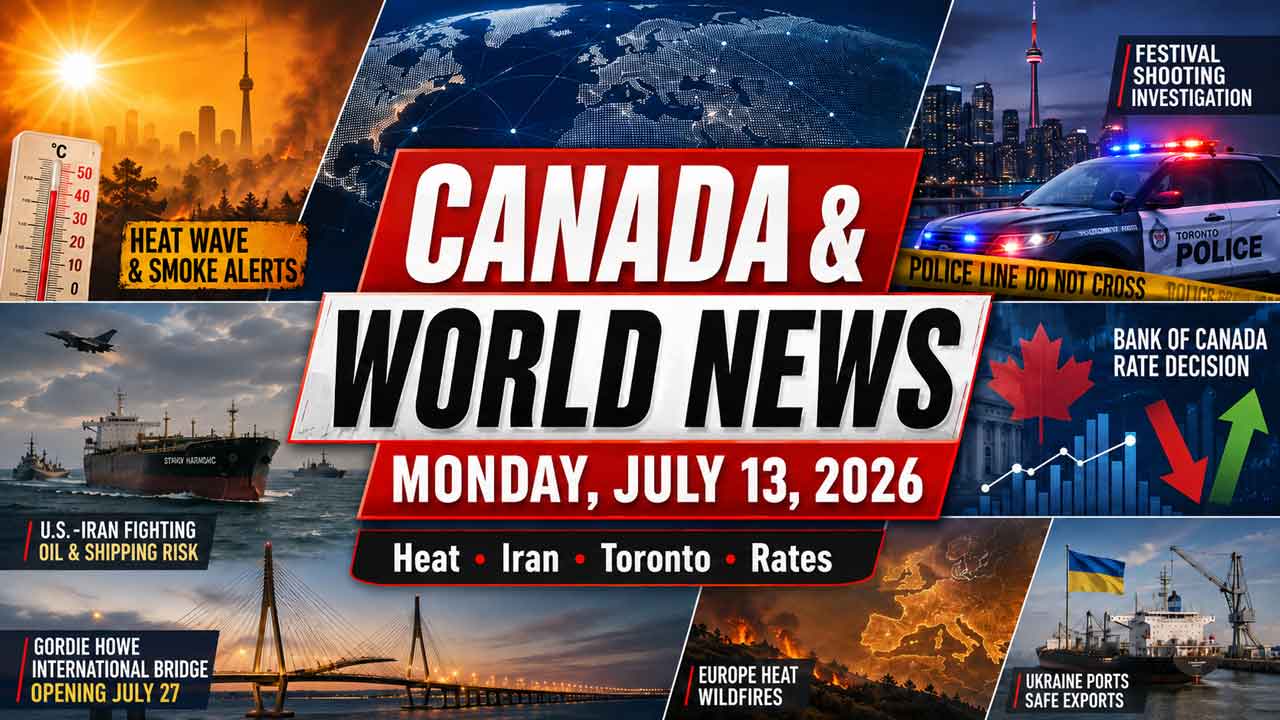
Canada and World News Summary for Monday, July 13, 2026
THUNDER BAY — Renewed fighting between the United States and Iran, threats to shipping through the Strait of Hormuz, a rising earthquake death toll in Venezuela, deadly heat in Europe and an escalating war in Ukraine are leading international news on Monday.
In Canada, attention is focused on the deadly Toronto festival shooting, extreme heat and wildfire smoke, Wednesday’s Bank of Canada decision and the approaching opening of the Gordie Howe International Bridge.
Many of these stories have direct implications for Thunder Bay and Northwestern Ontario through fuel prices, inflation, borrowing costs, air quality, cross-border trade and demand for northern minerals and other resources.
Monday’s major stories: Conflict, heat, public safety and economic uncertainty
Toronto festival shooting investigation continues
Toronto police continue to investigate an exchange of gunfire that killed two men and injured four other people during the Salsa on St. Clair festival Saturday evening.
Police said the shooting occurred near St. Clair Avenue West and Arlington Avenue while thousands of people were attending the annual cultural festival. Investigators recovered two firearms and said the initial concern about an active shooter was later determined to have been an exchange of gunfire between people targeting each other. No arrests had been announced in the latest update.
Organizers cancelled the remainder of the festival following the shooting. The incident has renewed national discussion about gun violence, public-event security and the movement of illegal firearms through Canadian cities.
Heat and air-quality concerns stretch across Canada
Heat and air-quality alerts extended from Saskatchewan and Manitoba through parts of Ontario and Quebec as the new week began. Some of the most serious alerts were issued around Winnipeg and Northwestern Ontario, where high temperatures were combining with wildfire smoke and poor overnight cooling.
Thunder Bay’s Monday forecast called for a high near 36 C, followed by another very hot day Tuesday with a high near 34 C. Extreme heat increases the risk of dehydration and heat-related illness, particularly for seniors, young children, people without air conditioning and those working outdoors.
The heat is also important for Northwestern Ontario’s wildfire situation. Hot, dry and windy conditions can increase fire behaviour while smoke can complicate aviation, outdoor work, medical travel and the movement of emergency crews.
Bank of Canada expected to hold interest rate Wednesday
The Bank of Canada is widely expected to leave its policy interest rate unchanged at 2.25 per cent when it announces its decision Wednesday.
All 36 economists surveyed by Reuters expected the central bank to hold its rate. Canada’s economy returned to growth in April following a technical recession, while unemployment edged down to 6.5 per cent in June. Annual inflation reached 3.2 per cent in May, although underlying inflation measures remained closer to the bank’s target.
For Thunder Bay households and businesses, the decision will affect mortgage renewals, construction financing, consumer loans and municipal infrastructure costs. The renewed increase in oil prices caused by Middle East fighting could also complicate the inflation outlook.
Gordie Howe International Bridge preparing for July 27 opening
Canada and the United States have reached an agreement allowing the Gordie Howe International Bridge between Windsor and Detroit to open July 27.
The $4.7-billion crossing had faced uncertainty because of a dispute over toll revenue and governance. The bridge is expected to ease pressure on existing crossings and improve the movement of commercial traffic through one of North America’s most important trade corridors.
Although the bridge is far from Thunder Bay, its opening matters to Northwestern Ontario manufacturers, mining suppliers, forestry companies and transportation firms that depend on reliable Canada-U.S. supply chains.
U.S.-Iran fighting places Strait of Hormuz and oil shipments at risk
The United States and Iran renewed missile and drone attacks across the Gulf, with both sides claiming control over the Strait of Hormuz.
Iran said it had closed the strategically important waterway, while U.S. officials maintained that commercial shipping could continue under military escort. Vessel traffic had slowed sharply by Monday, increasing concern about global oil and gas shipments.
The escalation pushed oil prices higher and contributed to falling global stock markets and rising bond yields. Brent crude gained almost four per cent during Monday trading.
For Northwestern Ontario, sustained increases in oil prices would raise the cost of gasoline, diesel, aviation fuel, food transportation, mining operations, forestry and construction. Higher fuel costs could also place additional pressure on remote First Nations that depend heavily on air transportation and seasonal supply routes.
Venezuela earthquake death toll rises above 4,400
The death toll from the two major earthquakes that struck Venezuela on June 24 has risen to 4,490, according to the country’s National Assembly president.
Authorities reported more than 16,700 injuries, with thousands of people left without permanent housing. Search, rescue and reconstruction efforts continue in some of the hardest-hit coastal areas.
The scale of the disaster has created a major international humanitarian challenge involving emergency shelter, medical care, food, water and the rebuilding of damaged communities.
Europe records 10,000 excess deaths during heat wave
Europe recorded more than 10,000 excess deaths during its severe late-June heat wave, according to regional mortality data. More than 9,000 of those deaths involved people aged 65 and older.
The extreme conditions have also fuelled wildfires. More than 400 firefighters and two waterbombing aircraft were deployed against a fire in the historic Fontainebleau forest south of Paris. The fire had burned more than 800 hectares and disrupted highway and rail travel.
The European experience carries a warning for Northwestern Ontario, where extreme heat, wildfire smoke and long distances between communities can place added pressure on health services, firefighters and emergency evacuation systems.
Ukraine seeks more air defence as attacks target ports and shipping
A Russian attack on a civilian merchant ship in Ukraine’s Odesa region killed three crew members and injured five others, according to Ukrainian officials. The Togolese-flagged vessel was reportedly carrying mineral fertilizer when it was struck.
Ukrainian President Volodymyr Zelenskyy was also meeting European leaders in Paris to discuss air defence, weapons production and long-term military support. Ukraine has repeatedly called for additional systems capable of intercepting Russian missiles.
Attacks around Black Sea ports remain important to global markets because the region is a major source of grain, fertilizer and energy exports.
European-led group launches $1-billion Gaza aid initiative
The European Commission announced an approximately $1-billion initiative to support early recovery and reconstruction work in Gaza.
The Team Gaza Initiative brings together European countries, Japan, the World Bank and the European Investment Bank. The announcement came as violence continued despite ceasefire negotiations, with Palestinian health officials reporting six deaths in Israeli attacks Sunday.
The situation remains uncertain, with humanitarian needs, reconstruction planning and unresolved political and security issues continuing to shape international diplomacy.
World Cup semifinals set
The 2026 FIFA World Cup has reached its final four, with France facing Spain on Tuesday in Arlington, Texas, followed by Argentina against England on Wednesday in Atlanta.
The Argentina-England game will mark Lionel Messi’s first international appearance against England and renew one of soccer’s most storied rivalries. The final will be played July 19 in New Jersey.
What Northwestern Ontario should watch
The Middle East conflict is the most immediate international economic concern for the region because of its potential effect on fuel prices and inflation. The Bank of Canada’s Wednesday decision will show how policymakers are balancing those pressures against a still-fragile Canadian economy.
Closer to home, extreme heat, wildfire smoke and active forest fires remain the most immediate public-safety concerns. Residents should continue monitoring local weather, air-quality and evacuation information as conditions can change quickly.