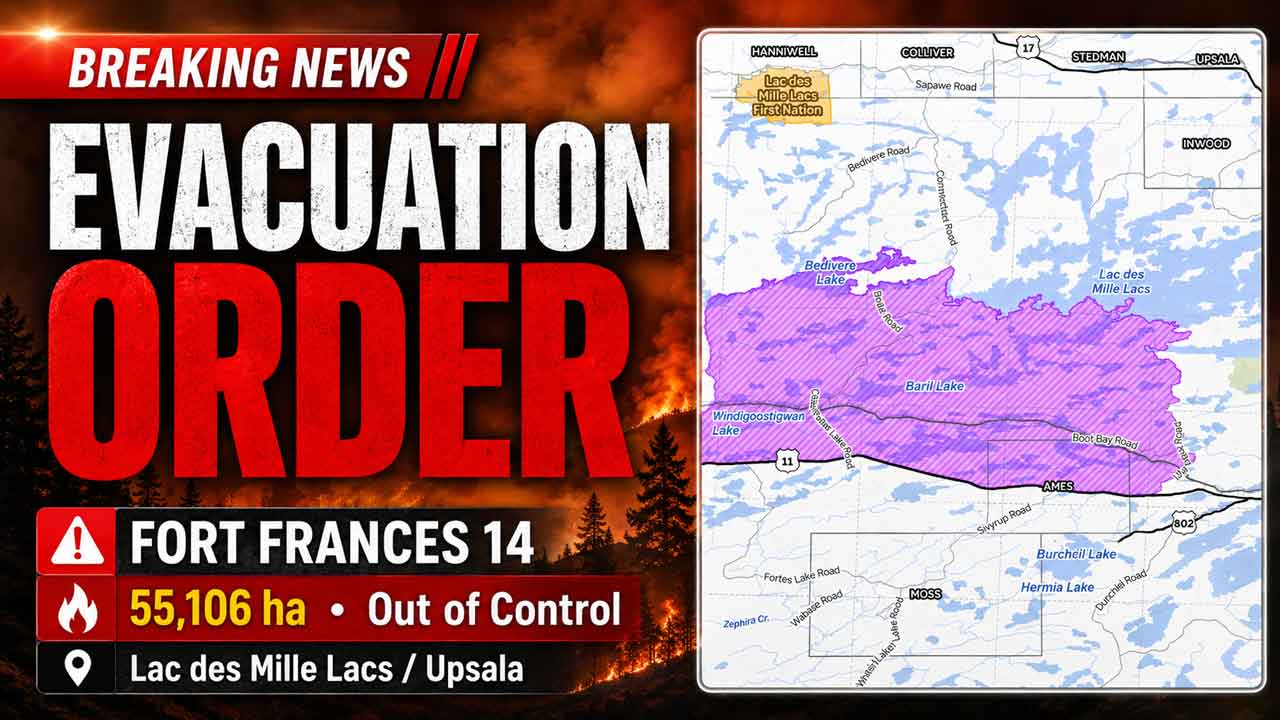
Immediate Evacuation Ordered Near Fort Frances 14 Wildfire
THUNDER BAY — An evacuation order has been issued for an area threatened by Fort Frances 14 and other active wildfires, with everyone inside the designated zone directed to leave immediately.
This order was issued at 07:00 AM EDT today.
The Thunder Bay–Ignace fire management district issued the order as changing conditions and increased fire behaviour continue to pose a threat in the Lac des Mille Lacs and Upsala area.
Fort Frances 14 remains out of control at an estimated 55,106 hectares and is burning close to major transportation routes in Northwestern Ontario.
Evacuation Order Took Effect Friday Morning
The evacuation order took effect at 7 a.m. Eastern Daylight Time on Friday, July 17, 2026, and will remain in place until it is formally revoked.
All people inside the area identified on the Ministry of Natural Resources evacuation map must leave immediately unless they have received a travel permit from the ministry.
People are also prohibited from entering the evacuation area without an authorized MNR travel permit.
Areas Under Evacuation:
Residents, property owners, campers and anyone working in the affected area should follow the evacuation route and instructions provided by emergency officials.
Fort Frances 14 Remains Out of Control
Fort Frances 14 was estimated at 55,106 hectares in the latest provincial update.
The fire’s northern perimeter was estimated to be approximately five kilometres southwest of the Trans-Canada Highway at its closest point.
Its southern edge extended as far as Fork Lake, approximately six kilometres north of Highway 11.
The fire’s location is significant because Highway 11 and the Trans-Canada Highway are essential transportation corridors for residents, emergency services, commercial trucking and northern supply chains.
Travellers should check Ontario 511 and official emergency notices before entering the Lac des Mille Lacs or Upsala area.
Temporary Improvement in Fire Behaviour
Fort Frances 14 and Fort Frances 15 showed significantly less overnight growth than during previous days.
Cloud cover, higher relative humidity and lower wind speeds temporarily reduced fire behaviour.
However, the fire hazard remains high, and conditions can change quickly if temperatures rise, humidity falls or winds strengthen.
Reduced overnight growth does not mean the fire is under control or that the evacuation order can be ignored.
Smoke Limiting Aircraft Operations
Poor visibility caused by heavy smoke is limiting flight operations around the fires.
Smoke can prevent waterbombers, helicopters and other aircraft from operating safely, potentially delaying fire suppression, reconnaissance and the movement of personnel.
Residents should also be prepared for changing air quality and reduced visibility on area roads.
Anyone with respiratory or heart conditions, older adults, pregnant people and families with young children should monitor public-health guidance and limit exposure to heavy smoke.
Residents Must Follow Official Instructions
People in the evacuation area must leave immediately and should not attempt to remain behind to protect private property.
No one should cross barricades or enter closed areas without authorization. Fire behaviour, falling trees, smoke and emergency equipment can make roads and forest access routes extremely dangerous.
Residents should take identification, medications, important documents, clothing, food and supplies for children and pets where possible.
The evacuation order will remain in effect until the Ministry of Natural Resources determines that conditions allow it to be lifted.