Is Thunder Bay City Hall to blame for crime, addiction and homelessness? An evidence-based look at municipal decisions and shared responsibilities
NetNewsLedger Analysis | October 7, 2026
THUNDER BAY — It is fair to hold Thunder Bay City Council and administration accountable for their decisions on homelessness, public spaces and community safety. There are documented delays and legitimate questions about whether the city is delivering results quickly enough.
However, the evidence reviewed does not establish that City Hall’s approach caused the increase in crime or the continuing addiction crisis.
Those are different conclusions. Residents can reasonably demand better municipal leadership without assuming that council controls policing operations, addiction treatment, criminal sentencing or the illegal drug supply.
A fair assessment starts with what the numbers show, what the city actually controls and where its performance deserves scrutiny.
The increase in reported crime is real
Statistics Canada’s July 22, 2026 release shows that the Thunder Bay census metropolitan area recorded a police-reported crime rate of 8,373 incidents per 100,000 people in 2025, up 18 per cent from 2024.
Its Crime Severity Index rose three per cent to 114.1. Across Canada, the crime rate fell two per cent and the severity index declined five per cent. Thunder Bay’s results therefore moved against the national trend.
These figures give residents a sound basis for demanding answers. Concerns about safety cannot simply be dismissed as social-media exaggeration.
But the figures describe the broader metropolitan area and the 2025 calendar year. They are not a complete assessment of crime within city boundaries during 2026.
The crime rate measures the number of reported Criminal Code incidents, excluding traffic offences. The severity index also weighs the seriousness of offences. An 18 per cent increase in the crime rate does not mean every offence category increased by that amount.
Statistics Canada also cautions that reported crime is affected by public reporting, police resources, enforcement activity and recording practices. The data identify a serious problem; they do not, by themselves, identify which municipal decision caused it.
Homelessness, addiction and criminal activity must be examined separately
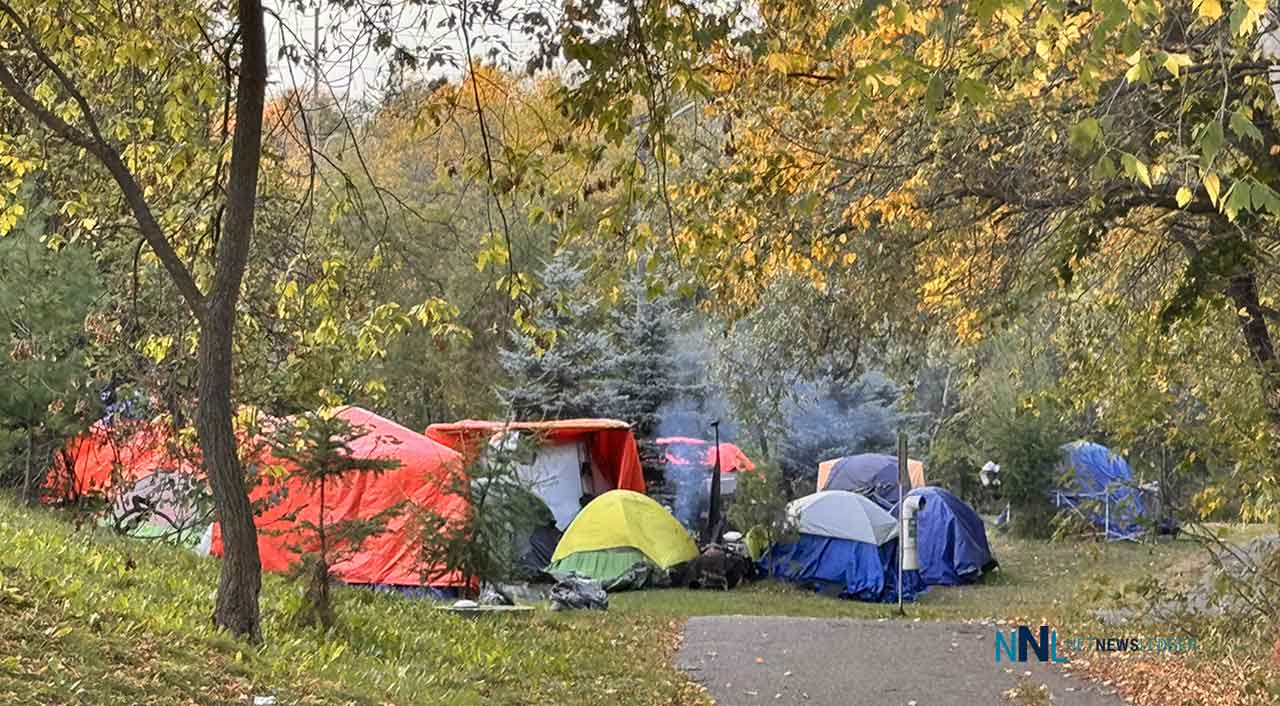
The public debate often combines three different situations: someone living without housing, someone experiencing addiction and someone committing a crime.
They can overlap. They are not interchangeable.
A tent does not establish that its occupant committed a nearby theft. An overdose does not establish a robbery. Equally, a person’s housing situation does not excuse assault, threats or property damage.
For an accurate assessment, police and municipal officials need to distinguish reported criminal offences from complaints about litter, sheltering, public drug use, disturbing behaviour and medical emergencies. All can require a response, but the appropriate response is not always the same.
The distinction also matters when measuring whether conditions are improving.
The Financial Accountability Office of Ontario’s September 2026 report shows Thunder Bay District’s recorded homelessness rate falling from 976 to 604 people per 100,000 population between 2022–23 and 2024–25—a 38.1 per cent decline.
That is a district-wide, population-adjusted measure using By-Name List records. It is not a count of tents in Thunder Bay. The FAO warns that these records can miss people, double-count some people moving between communities and change as collection methods improve.
The finding does not prove that the local crisis has been solved. It does mean a blanket statement that every measure of homelessness is rising would be inaccurate. Visible encampments and the experience of a particular neighbourhood may differ from a district-wide administrative measure.
The addiction crisis is severe—but its growth requires evidence
In its August 2026 overdose-awareness release, the Thunder Bay District Health Unit reported 61 opioid-toxicity deaths in the district in 2025. That is a devastating toll on families and communities.
However, overdose deaths, ambulance calls, treatment requests and the number of people living with addiction measure different things. A change in drug toxicity can change the number of deaths without an equivalent change in the number of people using drugs.
The evidence reviewed for this article does not establish a comparable, city-wide measure showing how much addiction prevalence increased during 2026—or what share could be attributed to municipal policy.
Nor does the continued existence of addiction prove that a particular intervention caused it. Programs should be assessed against their intended purpose and measured results: preventing deaths, connecting people with treatment, sustaining recovery or reducing public disorder.
Where criticism of City Hall is justified
The strongest documented criticism concerns the time taken to deliver the Temporary Shelter Village.
On August 7, 2025, the city said at least 40 units needed to be operational by December 15, 2025, with all 80 completed by February 27, 2026, to meet the provincial funding requirements then identified.
A September 8, 2025 memorandum from City Manager John Collin provides evidence of a political decision affecting that schedule. It said administration had paused further work while council considered a motion to reverse the Hillyard site decision.
The memorandum warned that partial occupancy by the end of 2025 had become unlikely because of the pause and pending council decision. It also reported that Ontario had confirmed a reasonable extension to funding timelines.
The city did not announce the village at 879 Alloy Place as operational until October 1, 2026. Even that announcement said it would begin receiving residents shortly, rather than confirming full occupancy.
That timeline supports questions about decision-making, project management and communication. It does not establish that every month of delay had the same cause, or that the delay produced a specific number of crimes.
Council should explain its decisions and their consequences. Administration should explain procurement, construction, revised schedules, costs and readiness. Residents deserve a clear account of which delays were avoidable.
It would also be premature, less than a week after the operational announcement, to declare the village either a success or a failure at reducing crime.
The city has responsibilities it cannot pass along
Thunder Bay’s own 10-part encampment plan commits it to sanitation, public-space bylaw review, a coordinated response team, communication, temporary shelter and work with housing partners.
These are municipal commitments against which performance can be judged.
Residents can reasonably ask:
- How quickly are hazardous waste and discarded needles removed?
- Who responds when a resident or business reports a recurring problem?
- Are public-space rules clear and applied consistently?
- What safety measures protect both nearby neighbours and people living in encampments?
- How many people move from temporary shelter into stable housing?
- What happens when an intervention is not working?
Calling a problem complex does not answer those questions. Neither does announcing a plan.
Council’s responsibility is to set priorities, approve resources and scrutinize performance. Administration’s responsibility is to implement approved decisions, identify obstacles and report results honestly. Criticism should identify which of those functions failed rather than treating elected officials and staff as one interchangeable body.
Other institutions also carry responsibility
The city is an important participant, but several essential powers sit elsewhere.
| Institution | Principal role relevant to these crises |
|---|---|
| City Council and administration | Municipal priorities, local spending, land-use decisions, municipal property, sanitation and delivery of the city’s encampment initiatives |
| Thunder Bay Police Service Board and police leadership | The board sets strategic direction; the chief and police service carry out operational policing |
| District of Thunder Bay Social Services Administration Board | Community housing, homelessness programs and social-assistance delivery |
| Ontario government and health system | Health-care and addiction-service capacity, provincial housing supports and administration of justice |
| Federal government | Criminal law, including bail provisions, and federal funding and programs |
TBPS’s published strategic plan explicitly separates the board’s governance role from the chief’s operational role. The mayor and city manager do not run individual criminal investigations.
TBDSSAB identifies community housing and Ontario Works among its responsibilities. It is a separate district service organization, not simply a department managed by the city manager.
Justice Canada explains that Parliament establishes criminal law while provinces and territories administer justice. Municipal council does not decide whether an individual accused person receives bail or what sentence a court imposes.
Treatment also requires health-system participation.
NorWest Community Health Centres lists an operating HART Hub at 500 Simpson Street, offering housing, addiction, mental-health and health-care supports through multiple partners. Its existence is evidence of action; whether its capacity meets demand requires further reporting.
Shared responsibility should produce clear assignments and coordinated delivery. It should not become a reason for every organization to point elsewhere.
What the city says it is doing
The city’s published response emphasizes a supported alternative to unmanaged encampments.
Its village plan provides for 80 private, climate-controlled units, basic amenities and round-the-clock staffing. The city says it will measure occupancy, service connections, outdoor homelessness and moves into stable housing.
The October 1 opening announcement also acknowledged $2.8 million in provincial capital funding through TBDSSAB, reducing the city’s original $5 million capital commitment.
These are substantive actions. Describing the city as having done nothing would be inaccurate.
Nevertheless, providing shelter is an intermediate result. The larger questions are whether people become more stable, obtain appropriate care and move into lasting housing—and whether surrounding neighbourhoods experience fewer problems.
This assessment draws on published records and statements. It does not include a new interview response from council or administration.
What would establish whether municipal policy is making things worse?
A credible assessment would compare neighbourhood-level crime and calls for service before and after specific decisions, while accounting for seasonal changes, reporting practices and enforcement activity.
It would distinguish victims from accused people, assess whether problems were displaced to another location and compare affected areas with similar neighbourhoods.
City-wide annual totals cannot establish that a particular encampment policy caused crime. The reverse is also true: officials cannot demonstrate success merely by announcing spending or counting service contacts.
NetNewsLedger’s assessment is that the city and its partners should publish a regular public report covering neighbourhood crime trends, response times, encampment conditions, shelter occupancy, treatment access and sustained housing outcomes. Each measure should identify the responsible organization, its target and the action planned when results fall short.
Is the blame fair?
It is fair to criticize documented delays, unclear communication, weak coordination or failures to deliver municipal services. The shelter-village timeline provides a concrete basis for scrutiny.
It is not supported by the evidence reviewed to assign City Hall sole responsibility for rising crime or continuing addiction. Nor is it justified to blame people experiencing homelessness as a group.
Thunder Bay residents deserve safe streets and reliable public services. People facing addiction and homelessness deserve effective care, protection and a realistic route to stability.
Council and administration should be judged on the decisions they control, the commitments they make and the results they deliver. Police, housing agencies, health providers and senior governments should face the same standard.