The incoming council should neither pretend Thunder Bay is failing at everything nor accept these conditions as inevitable features of northern urban life
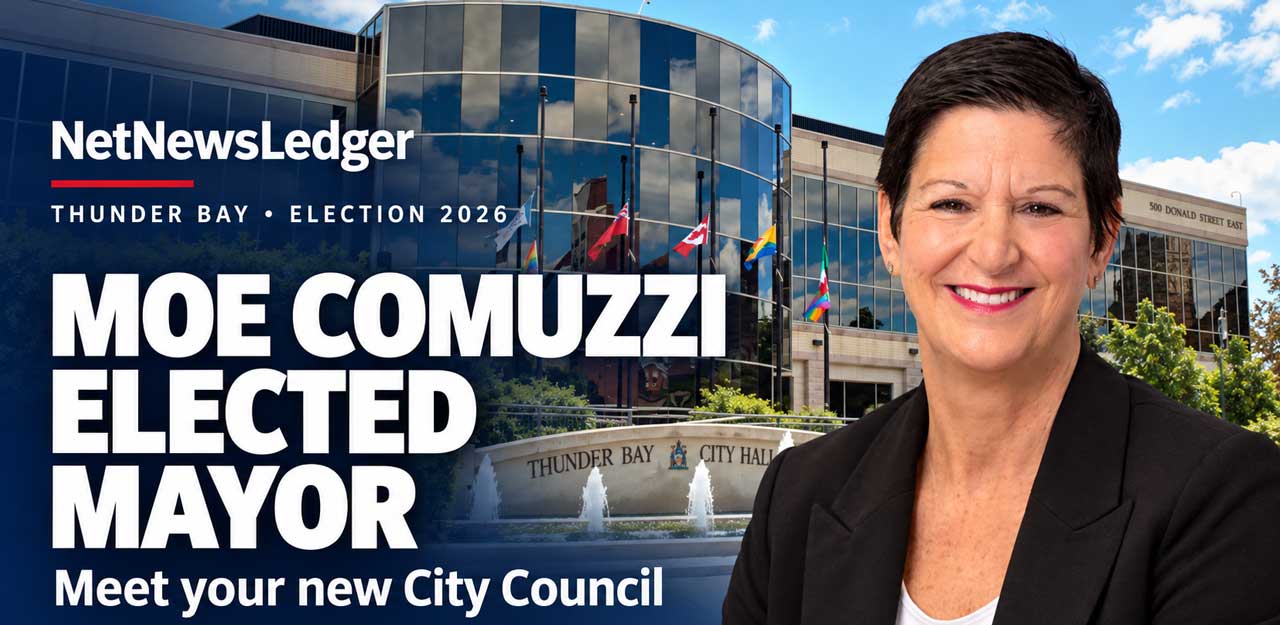
THUNDER BAY — When Mayor-elect Maureen “Moe” Comuzzi and Thunder Bay’s newly elected councillors take their declarations of office, they will inherit a city with considerable economic and geographic advantages — but also problems that have resisted successive councils.
Thunder Bay remains the service, transportation, education and health-care centre of Northwestern Ontario. It has Lake Superior at its doorstep, a strong institutional base, an AA+ municipal credit rating and growing opportunities tied to mining, critical minerals, housing and Indigenous economic development.
At the same time, residents are confronting repeated property-tax increases, decades of weak population growth, visible homelessness, high levels of serious crime, aging infrastructure and a long-running crisis of confidence involving racism and policing.
The City’s new term officially begins Nov. 15. Thunder Bay’s procedural bylaw provides that the inaugural meeting takes place during the first week of December, when elected members take the oath of allegiance and declaration of elected office. The incoming 13-member council was chosen by 37,539 voters, representing 40.8 per cent turnout.
The ceremony will be important. What happens after it will matter far more.
The New Council Inherits a City With Strengths — and Problems That Cannot Be Normalized
Comuzzi will be joined by councillors at large Mark Bentz, Peng You, Kasey Taylor Etreni, Julie-Ann Elizabeth Colquhoun and Jamie Nichols.
Ward representatives are Andrew Foulds in Current River, Jamie Scrimger in Red River, Brian Hamilton in McKellar, Albert Aiello in McIntyre, John Ongaro in Northwood, Stephen Margarit in Westfort and Greg Johnsen in Neebing.
It is a council combining experience and new voices. Six members of the outgoing council return, Peng You returns after previously serving at large, and five incoming councillors are new to the council table.
Comuzzi campaigned on responsible growth, neighbourhoods, housing, infrastructure, economic development and fiscal responsibility. She also endorsed the City’s Smart Growth Action Plan.
Those commitments provide a useful starting point.
The larger question is whether the new council will measure its success by announcements, plans and spending — or by outcomes residents can actually see.
A SWOT Analysis of Thunder Bay in 2026
A SWOT analysis — strengths, weaknesses, opportunities and threats — is not simply a business-school exercise. Ontario’s own municipal councillor guide recommends it as a way of determining a community’s current position before setting strategic priorities.
| Strengths | Weaknesses |
|---|---|
| Northwestern Ontario’s largest urban service centre and a strategic Great Lakes, highway, rail and air transportation hub. | Decades of very limited population growth, leaving fewer new taxpayers to absorb rising municipal costs. |
| Lake Superior, extensive natural assets and a quality of life that can be marketed nationally. | Property-tax pressure and an expensive municipal service/infrastructure footprint. |
| Lakehead University, Confederation College, health-care institutions, research capacity and a skilled public-sector base. | Homelessness, addictions, mental-health gaps and visible disorder have overwhelmed parts of the existing response system. |
| AA+ credit rating, low debt burden and strong liquidity provide financial capacity. | Crime and perceptions of safety remain significant concerns. Thunder Bay’s 2025 Crime Severity Index was 114.1 compared with 75.0 nationally. |
| Development activity accelerated in 2025, with about $368 million in construction value and 377 new homes permitted. | Trust between Indigenous people and important civic institutions, particularly policing, has required years of rebuilding after documented findings of systemic racism. |
| A Smart Growth Action Plan now provides measurable population and tax-base targets. | Aging roads, bridges, pipes and facilities require substantial long-term investment. Transportation assets alone have a replacement value above $1.7 billion and are rated overall as “fair.” |
| Opportunities | Threats |
|---|---|
| Critical minerals, mining services, Indigenous economic partnerships and the Ring of Fire can increase private-sector activity if development proceeds responsibly. | Municipal spending that consistently grows faster than the assessment base risks transferring an ever-larger burden to existing taxpayers. |
| Housing construction, infill and intensification can grow the tax base without proportionately expanding the physical footprint of municipal services. | Failure to resolve homelessness, addiction and public disorder could accelerate business closures, neighbourhood frustration and outward migration. |
| Thunder Bay can retain more graduates, attract newcomers and become the northern base for professionals serving Northwestern Ontario. | Failure to rebuild institutional trust with Indigenous residents could deepen divisions and damage Thunder Bay nationally. |
| Stronger partnerships with Fort William First Nation, Nishnawbe Aski Nation and regional First Nations can make Thunder Bay a centre for Indigenous-led economic development rather than simply a service destination. | Climate-related flooding, wildfire, extreme weather and infrastructure deterioration will increase municipal costs. |
| Better digital services, faster approvals and measurable service standards could improve municipal productivity. | Political micromanagement or repeated senior leadership upheaval could weaken administration instead of improving it. |
| The two downtown cores offer opportunities for housing, redevelopment and commercial revitalization. | If young people, professionals and entrepreneurs do not see Thunder Bay as safe, inclusive and economically dynamic, population growth targets will remain aspirations. |
Population: “Stagnant” Is a Fair Description of the Long-Term Trend
Thunder Bay’s population problem should be discussed with precision.
The city itself did grow between the 2016 and 2021 censuses, but only modestly. Statistics Canada counted 108,843 residents in 2021, up from 107,909 in 2016 — growth of just 0.9 per cent in five years.
The longer-term metropolitan picture is more revealing.
Statistics Canada reports that the Thunder Bay census metropolitan area had 115,564 people in 1971, 123,838 in 1991, 120,773 in 2001 and 121,596 in 2011. In other words, the metropolitan population grew only about five per cent over four decades while many competing Canadian cities expanded dramatically.
That has consequences.
A city can continue raising taxes to pay for existing services, but long-term fiscal sustainability becomes much easier when new homes, businesses and industrial assessment are being added.
Thunder Bay now recognizes that problem directly. Its Smart Growth Action Plan targets annual population growth of one per cent and annual property-tax-base growth of three per cent.
That should become one of the new council’s most important scorecards.
Council should ask every major economic-development decision a simple question: Does this help Thunder Bay add people, private investment or assessment without creating costs that outweigh the benefit?
Taxes: Residents Are Right to Be Concerned, but the Numbers Need Context
The 2025 municipal tax levy rose 3.77 per cent. The 2026 budget followed with a four per cent increase, amounting to roughly $72 for every $100,000 of assessed residential property value.
Thunder Bay’s long-range financial planning also uses a minimum three per cent annual levy increase as its baseline assumption.
That is a serious affordability issue, particularly for people on fixed incomes and households whose wages are not rising at the same pace.
But it would be inaccurate to conclude from those increases that Thunder Bay is simply financially mismanaged.
The City retains an AA+ credit rating. S&P Global has cited its low debt burden and strong liquidity. The City also reports that the average municipal tax on a detached bungalow is approximately $4,248, below the $4,628 average for Ontario municipalities with populations above 100,000, although above the broader average that includes smaller municipalities.
That distinction matters.
The fiscal challenge is not merely to “cut taxes.” It is to stop the cost of government from consistently outrunning growth in the community’s ability to pay for it.
The best long-term tax strategy is therefore a combination of expenditure discipline, service productivity and growth in commercial, industrial and residential assessment.
Thunder Bay’s Smart Growth plan estimates that three per cent annual tax-base growth, against typical inflation of about two per cent, could create new capacity without placing the entire burden on existing taxpayers.
The new council should make achieving that target a core measure of its performance.
Homelessness: Thunder Bay Has Already Declared an Emergency in Everything but Name
In February, council formally declared homelessness a humanitarian crisis, acting in collaboration with Anemki Wajiw — Fort William First Nation — and Nishnawbe Aski Nation.
That declaration was supported by disturbing evidence.
A 2026 report commissioned by The District of Thunder Bay Social Services Administration Board noted that the October 2024 Point-in-Time count identified 557 people experiencing homelessness compared with 221 in 2021.
The report appropriately warns that the two counts used different outreach and enumeration approaches and that a one-night count cannot define the full scale of homelessness. Even with that caution, other service data also showed sustained and growing pressure.
The same review reported that Indigenous people were dramatically overrepresented among people experiencing homelessness, reflecting the effects of colonialism, housing shortages, migration for services and gaps facing people arriving from smaller and remote communities.
This means Thunder Bay cannot solve homelessness solely through municipal enforcement, nor can the issue be separated from the city’s regional role.
The Temporary Shelter Village at 879 Alloy Place is one response. It had 30 residents by Oct. 31, exceeding the City’s first occupancy target. The project provides bridge accommodation and connections to health, addiction and housing services.
It should be judged by outcomes rather than ideology.
How many residents move into permanent housing? How many remain housed six and 12 months later? Does emergency-room use decline? Are encampments reduced? Is neighbourhood disorder reduced? What does each successful housing outcome cost?
Temporary shelter must remain a bridge to housing, not become a permanent substitute for it.
The new council should press Queen’s Park and Ottawa for permanent supportive housing, mental-health and addictions treatment, while developing Indigenous-led solutions with Fort William First Nation, NAN and local Indigenous organizations.
Racism and Policing: Thunder Bay Must Tell the Full Story
The history cannot be minimized.
The 2018 Broken Trust systemic review by Ontario’s Office of the Independent Police Review Director examined Thunder Bay Police Service investigations involving Indigenous deaths.
It found that investigations had been affected by racial discrimination and that systemic racism existed at an institutional level in the police service. It said investigative failures were attributable in part to racist attitudes, racial stereotyping and institutional biases in policies and practices. The report made 44 recommendations.
A separate 2018 investigation led by Murray Sinclair examined the Thunder Bay Police Services Board. It found systemic discrimination against Indigenous people was a key issue within the board and documented distrust and fear arising from Indigenous experiences of racism and violence. That investigation made 45 recommendations.
Those are extraordinary findings for any Canadian city.
There is, however, another part of the story that also deserves to be reported.
In its final update in 2024, the Law Enforcement Complaints Agency reported that Thunder Bay Police had fully implemented 27 Broken Trust recommendations and made significant progress on another eight. The remaining nine were connected to OPP investigations and a review by the Office of the Chief Coroner. The agency concluded TBPS had addressed each recommendation for which it was responsible.
That is progress.
It does not erase the original findings, and checking boxes on recommendations is not the same as rebuilding public trust.
The new council should therefore resist two equally unhelpful narratives: that nothing has changed, or that the problem has been solved.
Thunder Bay Police Service’s own 2026 citizen survey found only 51 per cent of respondents felt safe. Disorder and substance use were concerns for 87 per cent, while homelessness and encampments were identified by 77 per cent. Statistics Canada reported that Thunder Bay’s Crime Severity Index increased three per cent in 2025 to 114.1, substantially higher than the national index of 75.0.
Council cannot order police officers to conduct particular investigations or direct day-to-day police operations. The Police Service Board sets strategic direction and exercises civilian oversight, while the chief is responsible for operationalizing that direction.
What council can do is ensure its appointments to the board are serious about governance, reconciliation, measurable performance and public accountability.
The next Police Service Board should publicly report not just whether historical recommendations have been “completed,” but whether outcomes are improving: public confidence, Indigenous confidence, response times, investigative quality, complaints, recruitment, retention and representation.
One additional point deserves correction.
Broken Trust is the name of the Thunder Bay systemic review, and its findings are severe. However, there is no authoritative basis in the material reviewed for this article to state categorically that Thunder Bay is “the only police service in Canada” ever subjected to a report of that description.
The documented findings are serious enough without exaggeration.
“Superior by Nature”: A Clever Double Meaning — or a Brand That Needs Reconsideration?
Thunder Bay’s corporate tagline has been around long enough that many residents barely notice it.
The City’s official explanation is straightforward.
“Superior by Nature” is intended as a double play on words: Thunder Bay’s location on Lake Superior and what the City describes as its outstanding natural environment. The identity was developed as a marketing device to associate Thunder Bay with its physical setting.
There is no evidence in the City’s explanation — or in the material reviewed for this article — that the slogan was created as a racist statement.
That does not mean perception is irrelevant.
Words change when they enter a community’s lived context.
“Superior” can mean Lake Superior. It can also mean “better than.”
For a city that has been forced through official inquiries to confront systemic racism and strained Indigenous relationships, it is reasonable to ask whether every element of its civic identity still communicates the message Thunder Bay wants to send.
That question should not be answered by declaring the slogan racist without evidence. Nor should concerns about it simply be dismissed.
Council should commission a modest, transparent brand-perception review as part of broader community engagement. Fort William First Nation, the Anishinaabe Elders Council, local Indigenous organizations, newcomers, youth, tourism operators, businesses and long-time residents should all be heard.
The question should be simple: Does “Superior by Nature” still bring Thunder Bay together and help market the city, or has it become an unnecessary distraction?
If research shows the brand remains effective, keep it.
If it shows the phrase alienates significant parts of the community or no longer reflects the city Thunder Bay wants to become, change it gradually as signs, stationery and digital assets naturally come due for replacement.
That would avoid both symbolism without action and an unnecessarily expensive overnight rebranding exercise.
Thunder Bay already has an Indigenous Relations and Inclusion Strategy guided by the Anishinaabe Elders Council and local Indigenous partners. Its commitments include addressing racism, strengthening relationships with Fort William First Nation and other Indigenous partners, improving civic inclusion and creating a more responsive municipal organization.
That substantive work matters far more than a tagline.
Should the New Council Examine City Senior Management?
Yes — but it should be a performance review, not a purge.
There is both a legal and governance basis for doing so.
Ontario’s Municipal Act makes council responsible for accountability and transparency in municipal operations, including the activities of senior management. Provincial guidance says council has a stewardship responsibility to ensure municipal financial and administrative resources are being used efficiently.
At the same time, that guidance stresses the line between council oversight and day-to-day administration.
Thunder Bay’s departments operate under City Manager John Collin, who reports to council and is responsible for implementing council-approved priorities. Collin was hired in June 2024 after an extensive search and previously served as a major-general in the Canadian Armed Forces and as city manager in Saint John, N.B.
Thunder Bay also already restructured its administration in 2023, reducing five departments to four in an effort to improve alignment and find efficiencies.
Those facts argue against walking into office with a conclusion already reached.
They also argue against assuming the existing structure is automatically the right one for the next four years.
Mayor-elect Comuzzi will inherit Ontario’s “strong mayor” powers. Those include authority over appointment or dismissal of the chief administrative officer and certain organizational and employment matters, although those powers can be delegated. Former mayor Ken Boshcoff delegated significant organizational and employment powers to the City Manager.
That gives the incoming mayor an important early governance decision.
The best course would be an independent, time-limited corporate performance and organizational review conducted against objective benchmarks.
It should not ask, “Who should be fired?”
It should ask, “Is this organization delivering the outcomes taxpayers are funding?”
Senior management should be measured on project delivery, permit times, infrastructure performance, procurement, staff vacancies and overtime, citizen response times, service standards, communications, capital projects delivered on time and on budget, tax-base growth, housing approvals and implementation of council priorities.
Results that can legally be made public should be published.
Council should assess the City Manager. The City Manager should be accountable for assessing commissioners and senior administrators. Councillors should not become shadow department managers.
That approach provides accountability without political micromanagement.
Eight Priorities for Thunder Bay’s Incoming Council
The incoming council does not need another collection of broad aspirations. Thunder Bay already has strategic plans.
It needs priorities, deadlines and public measurements.
- Create a four-year council mandate with no more than 10 measurable outcomes. Publish a quarterly dashboard showing population growth, assessment growth, housing construction, tax pressures, infrastructure delivery, homelessness outcomes, public safety measures and customer-service performance.
- Make tax-base growth the centre of fiscal policy. Require administration to explain every budget increase above council’s target by identifying inflation, labour, agencies, boards, service enhancements and discretionary spending separately. Protect core services, but subject programs to periodic value-for-money review.
- Turn Smart Growth from a plan into an operating discipline. The City’s targets of one per cent annual population growth and three per cent annual tax-base growth should be treated as council-level performance measures, not economic-development talking points. Thunder Bay permitted roughly 377 new homes in 2025 and recorded about $368 million in construction value; that momentum should be accelerated.
- Treat homelessness as a housing and health problem with public-safety consequences. Continue bridge shelter where it produces results, but demand permanent housing pathways and greater provincial investment in mental health, addictions treatment and supportive housing. Build Indigenous-led responses into the core strategy rather than consulting Indigenous organizations after plans are designed.
- Make reconciliation and police accountability measurable. Require annual public reporting on the City’s Indigenous Relations and Inclusion Strategy and use municipal Police Service Board appointments to strengthen governance. Track whether trust and service outcomes are actually improving after Broken Trust and the Sinclair report.
- Commission an independent corporate performance review. Benchmark Thunder Bay against comparable municipalities on staffing, compensation, service levels, management layers, procurement, capital delivery and administrative costs. Give the City Manager clear performance objectives and then judge management against evidence. Review the structure where evidence supports change; do not begin with predetermined dismissals.
- Review “Superior by Nature” as part of a wider conversation about Thunder Bay’s identity. Do not presume the slogan is racist and do not dismiss residents who find the language uncomfortable. Test it. Consult broadly. Make a decision from evidence and community sentiment, then move on to the more substantive work of building an inclusive city.
- Make transparency routine rather than defensive. Major capital projects should have public business cases, lifecycle costs and quarterly status reporting. When projects are late or over budget, residents should be told why. When programs work, publish the evidence. When they do not, change them.
The Opportunity: Stop Managing Decline and Start Measuring Progress
Thunder Bay is not a city without strengths.
In fact, that is part of what makes its persistent problems so frustrating.
It has a major freshwater port, rail and highway connections, post-secondary institutions, health-care expertise, established neighbourhoods, abundant natural assets and proximity to some of the most important mineral opportunities in Canada.
Its municipal finances remain fundamentally sound. Development activity has improved. Housing construction is accelerating. Thunder Bay has a formal growth strategy and municipal systems capable of measuring progress.
But potential is not performance.
For decades, Thunder Bay’s population has barely moved. Property taxes continue to rise. Homelessness has reached the point where the City itself calls it a humanitarian crisis. Public-safety concerns are high. Indigenous people continue to live with the legacy of institutional failures documented in some of the most damaging policing reports ever written about the city.
The incoming council should neither pretend Thunder Bay is failing at everything nor accept these conditions as inevitable features of northern urban life.
And that may be the most useful reinterpretation of “Superior by Nature.”
Thunder Bay does not need to declare itself superior to anyone.
It needs to become demonstrably better than it was yesterday.
For Mayor-elect Comuzzi and the new council, the next four years should be judged by whether more people choose to live here, whether the tax base grows faster, whether fewer people sleep outside, whether residents feel safer, whether Indigenous people see measurable change in their relationship with civic institutions, whether infrastructure is delivered on time and whether taxpayers believe they receive value for what they pay.
The swearing-in ceremony gives the new council authority.
Only results will give it credibility.