NAPS launches a border-control pilot to disrupt illegal drugs entering five remote First Nations the goal is stopping the traffickers
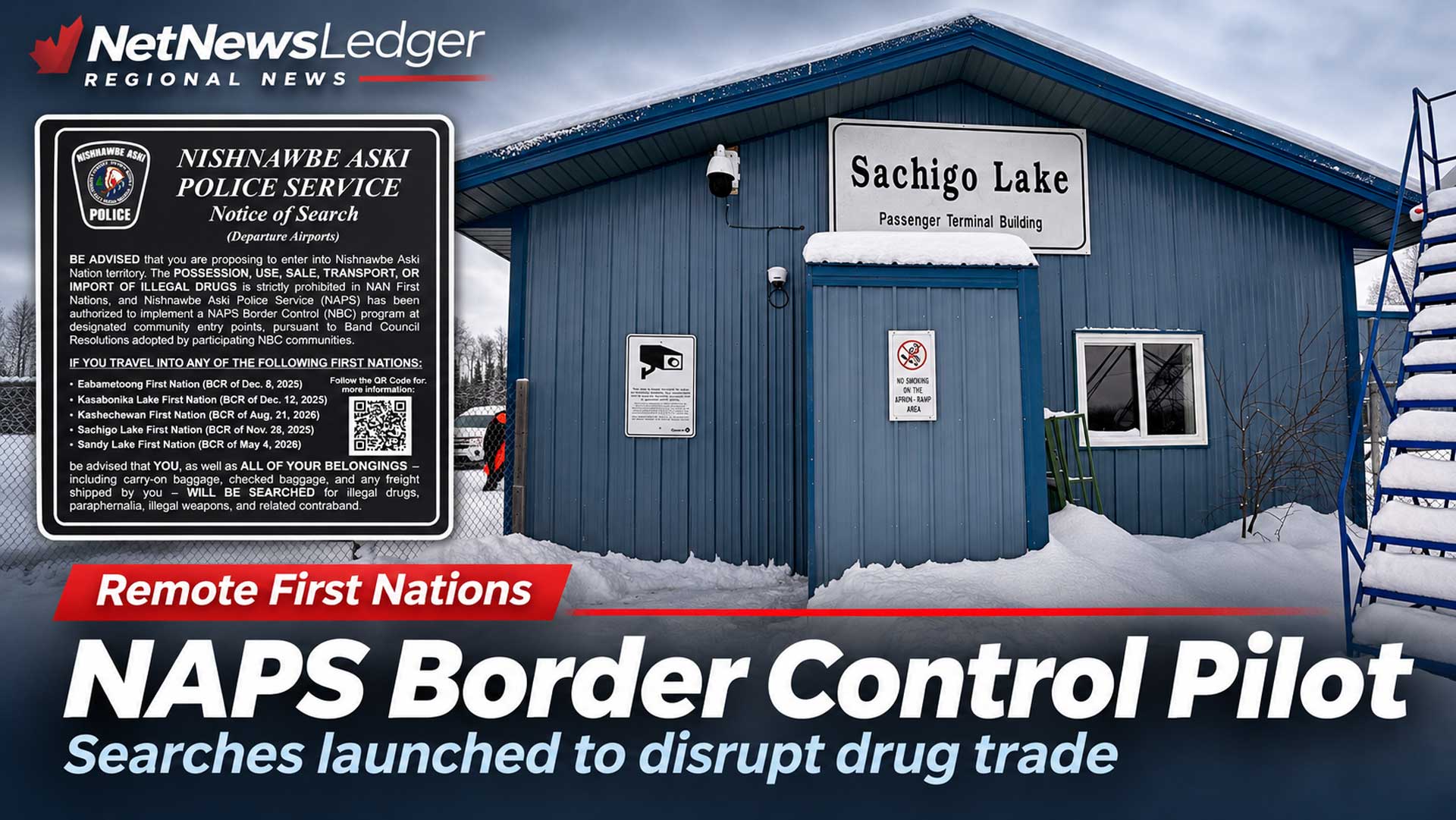
THUNDER BAY — REGIONAL NEWS – The Nishnawbe Aski Police Service has launched a new border-control pilot aimed at disrupting the flow of illegal drugs into five remote First Nations across Nishnawbe Aski Nation territory.
The NAPS Border Control program was formally announced Monday, Nov. 9, at the Thunder Bay International Airport, with representatives from the Ontario Ministry of the Solicitor General, Nishnawbe Aski Nation, the Nishnawbe Aski Police Services Board and NAPS taking part.
The pilot will place locally recruited special constables in participating communities, where they will conduct searches of travellers entering under authority NAPS says is provided through Band Council Resolutions adopted by each community.
Five First Nations Taking Part in Pilot
The initial NAPS Border Control pilot includes:
- Eabametoong First Nation
- Sandy Lake First Nation
- Sachigo Lake First Nation
- Kasabonika Lake First Nation
- Kashechewan First Nation
Signage explaining the program has also been installed at airlines serving participating communities.
The objective is to give First Nations additional tools to intercept illegal drugs before they reach communities where substance use, trafficking and the toxic drug supply can have an outsized impact.
For many remote First Nations, air travel is the principal year-round transportation connection to larger centres such as Thunder Bay, Sioux Lookout and Timmins.
That makes airports and passenger flights an important point of intervention for communities seeking to reduce the movement of illegal drugs into the North.
Special Constables Recruited From Their Own Communities
NAPS says each special constable working in the pilot was recruited directly from the First Nation where they are now deployed.
Nishnawbe Aski Police Services Board Chair Frank McKay said that local connection is an important part of the program.
“We are proud the Special Constables hired and deployed for the NBC program are from the very communities that they will be working in,” McKay said.
“They know their communities and its people and have a vested interest in helping to maintain its safety and security.”
McKay said the special constables want to help build a safer future in their home communities.
The local recruitment model may also help build trust, because searches will be conducted by people who understand the community, its residents and local conditions.
Program Grew From 2022 Direction From NAN Chiefs
The concept dates back to August 2022, when Nishnawbe Aski Nation chiefs directed NAPS to develop a dedicated search strategy to combat the movement of illegal drugs into First Nations.
That direction was formalized through a Chiefs Resolution supporting a NAPS border-control strategy.
The police service subsequently developed the pilot now being rolled out in the five participating First Nations.
NAN Grand Chief Alvin Fiddler said the launch is an important step, but argued the initiative should eventually extend beyond a pilot.
“Today’s launch is a step in the right direction, and we are grateful for Ontario’s investment in this work,” Fiddler said.
“This works because it is built by communities, for communities — our Chiefs mandated it in 2022 because they knew what their communities were facing.”
Fiddler said border control should eventually become available across NAN territory.
“Every First Nation in NAN deserves this protection,” he said.
Why Drug Interdiction Is Different in Remote Communities
Stopping the illegal drug trade presents unique challenges in remote Northwestern and Far North Ontario.
Many communities do not have permanent road access and depend heavily on passenger flights, cargo aircraft and seasonal winter roads.
Those transportation limitations can make the number of entry points into a community smaller than in an urban centre — but they can also make illegal drug trafficking highly profitable.
Small quantities of fentanyl, cocaine and other drugs can be transported by air and sold at significantly higher prices in isolated communities.
The consequences can extend well beyond individual drug offences.
Community leaders across Northern Ontario have repeatedly linked illicit drug trafficking with violence, exploitation, addictions, family disruption and pressure on already limited health, policing and social-service resources.
For smaller First Nations, even a relatively small number of traffickers can create serious community-wide impacts.
The NAPS pilot attempts to address the problem at one of its most important points: before illegal drugs move from the transportation system into the community.
Community Authority Is Central to the Program
NAPS says searches under the pilot will be carried out pursuant to Band Council Resolutions adopted by the participating First Nations.
That distinction is important.
Rather than imposing a single program across NAN territory, the pilot is based on resolutions adopted by the individual communities involved.
The approach reflects the broader principle that First Nations should have a direct role in determining how public-safety initiatives operate within their communities.
The program will likely be closely watched by other NAN First Nations considering similar measures.
Its longer-term future may depend on results, community support, legal and operational experience and continued provincial funding.
Thunder Bay Has a Direct Connection to Northern Drug Trafficking
Although the searches will take place in participating First Nations, the program also has a direct connection to Thunder Bay.
Thunder Bay is one of the principal transportation and service hubs for Northwestern Ontario and is frequently used as a connection point for passengers and freight travelling to remote communities.
That same transportation network can also be exploited by organized criminal groups and individual traffickers attempting to move drugs north.
Police agencies have repeatedly reported trafficking investigations involving drugs moving between southern Ontario, Thunder Bay and smaller Northern communities.
For Thunder Bay residents, the issue reinforces the city’s role as both a regional service centre and a critical transportation gateway.
Efforts to disrupt illegal drugs before they reach remote First Nations will therefore require cooperation not only inside those communities, but throughout the transportation and policing networks connecting Northern Ontario.
Pilot Will Be a Test of Community-Led Enforcement
The ultimate measure of the NAPS Border Control program will be whether it reduces the movement of illegal drugs into participating First Nations while maintaining community confidence.
The fact that special constables are recruited locally gives the pilot a distinctive community-led element.
It also raises important questions that will become clearer as the program develops: how many illegal shipments are intercepted, what substances are being seized, whether trafficking patterns change and whether traffickers simply seek alternative routes.
Those results will help determine whether the program should be expanded.
NAPS says additional information about the border-control initiative, including the NAN Chiefs Resolution and participating Band Council Resolutions, is available at naps.ca/naps-border-control.