July 17 News Briefing: Wildfire Emergency, Ford Visit and U.S. Tariff Threat Lead the Day
THUNDER BAY — Northwestern Ontario’s wildfire emergency remains the leading story for NetNewsLedger readers on Saturday, July 18, 2026, as additional evacuations, hazardous smoke and transportation disruptions place growing pressure on First Nations, municipalities and emergency services.
Ontario Premier Doug Ford is expected in Thunder Bay on Saturday to meet wildfire officials and Indigenous residents evacuated from their communities.
Premier Ford held a provincial briefing in Toronto earlier Friday.
U.S. President Donald Trump has threatened to add the cost of Canadian wildfire smoke to existing tariffs, while Canada-U.S. trade negotiations remain stalled. Internationally, escalating U.S.-Iran fighting is pushing oil prices higher, Britain is preparing for a new prime minister and Ukraine is facing renewed military attacks and political unrest.
Ford visit puts Northwestern Ontario wildfire response under scrutiny
Premier Ford’s planned Thunder Bay visit is expected to include meetings with fire officials and Indigenous evacuees, including people from communities that escaped rapidly advancing fires with little time to prepare.
The visit comes amid criticism from some First Nations leaders who say provincial evacuation orders and assistance were not provided quickly enough. Leaders from Whitesand First Nation and Namaygoosisagagun First Nation, also known as Collins First Nation, said their communities were forced to begin evacuating residents without provincial help.
Ontario Natural Resources Minister Mike Harris said the fire that reached Collins First Nation was spreading at approximately four kilometres an hour and was detected when it was already dangerously close to the community. Harris said the speed left officials with only a few hours to respond.
The competing accounts will make direct conversations between Ford, emergency officials and evacuees important.
The meetings will give displaced residents an opportunity to describe what happened, identify gaps in the response and outline the assistance needed for temporary housing, mental-health care, replacement documents and eventual rebuilding.
The province reported nearly 190 active fires across Northern Ontario Friday, including 81 that were not under control. More than 150 fire crews and over 80 waterbombers and helicopters were involved in suppression operations. Ten communities had been evacuated or were in the process of evacuating, while four others were preparing for the possibility of leaving.
Ford also announced that Ontario would purchase 11 additional firefighting aircraft. The investment could strengthen the province’s long-term ability to respond, but new aircraft will not resolve the immediate shortage of evacuation capacity, accommodations and personnel during the current emergency.
Northwest has 129 active fires as Fort Frances evacuation expands
The latest regional count listed 129 active fires in Northwestern Ontario, including 62 that were not under control. Five new fires were reported in the Northwest Fire Region, while major incidents continued near Wabakimi Provincial Park, Lac des Mille Lacs, Atikokan, Mishkeegogamang First Nation, Cat Lake, Fort Hope, Armstrong and Whitesand First Nation.
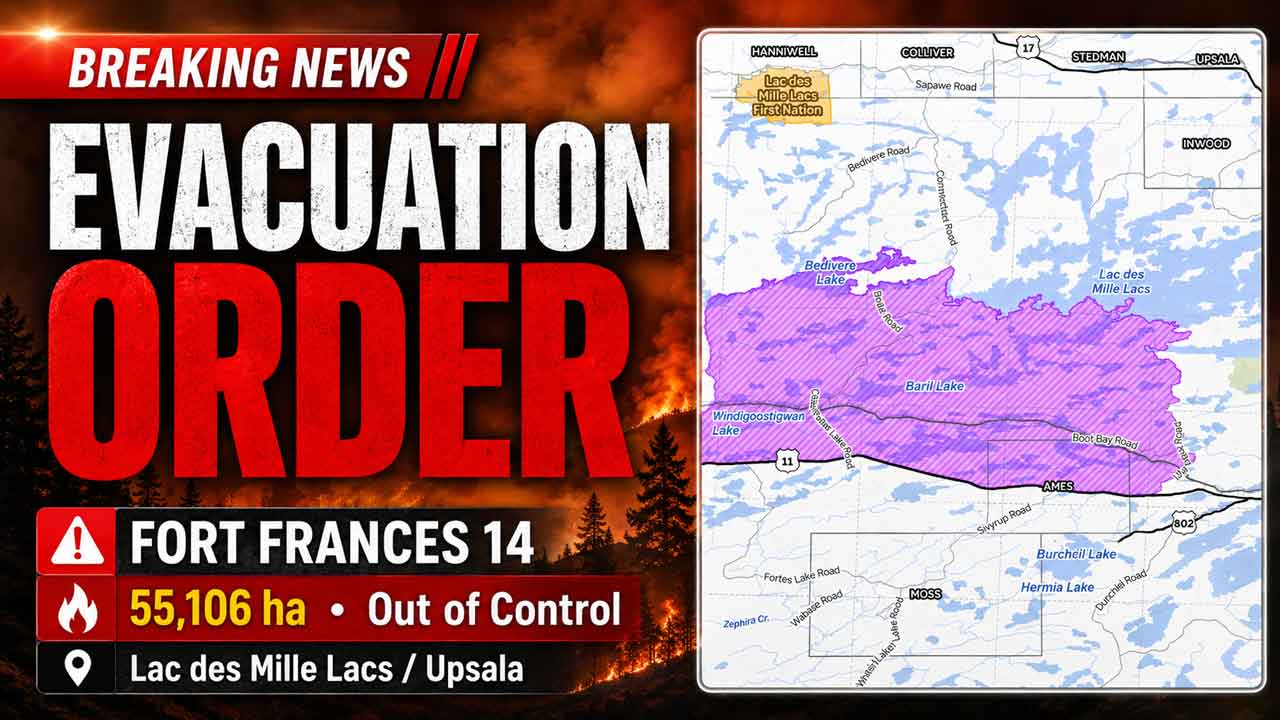
A new evacuation order took effect at 7 a.m. Friday for an area threatened by the Fort Frances 14 wildfire.
The order covered roads and properties in the Lac des Mille Lacs and Upsala area, including Athelstane, Kashabowie, Sapawe, Seine River and Upsala roads. Everyone inside the designated zone was directed to leave unless authorized to remain by the Ministry of Natural Resources.
Fort Frances 14 remained out of control at an estimated 55,106 hectares. Its northern perimeter was approximately five kilometres southwest of the Trans-Canada Highway at its closest point, while its southern edge was about six kilometres north of Highway 11.
The location is significant because Highways 11 and 17 form the main east-west road system across Northwestern Ontario. A closure or extended restriction could affect evacuations, commercial trucking, emergency services and deliveries of food, fuel and medical supplies.
Highways 11, 599 and 527 had already been affected by wildfire closures elsewhere in the region. Travellers should check Ontario 511 immediately before leaving and should not use forest roads as unofficial detours.
A Restricted Fire Zone remains in place across the Northwest Fire Region and part of the Northeast. Campfires and other open-air burning are prohibited, and all burning permits are suspended until further notice.
Thunder Bay activates Emergency Operations Centre
The City of Thunder Bay activated its Emergency Operations Centre Friday as a precaution to improve co-ordination among municipal departments and emergency partners.
The activation allows officials to manage resources, share information and prepare for additional evacuees. It does not mean Thunder Bay is facing an immediate wildfire threat or that city residents should evacuate.
Thunder Bay is already accommodating residents from Armstrong, Whitesand First Nation, Collins First Nation and other affected communities. Mayor Ken Boshcoff told Reuters that the city had reached its current capacity for sheltering evacuees.
That capacity problem is becoming a provincial and federal issue. A prolonged evacuation requires more than hotel rooms. Host communities must provide meals, transportation, health care, translation, child and family services, security and culturally appropriate Indigenous support.
Thunder Bay has repeatedly served as a northern evacuation and transportation hub, but the scale of the current emergency is placing unusual pressure on hotels, municipal services, health-care providers and community organizations.
Poor air quality also continued to affect city operations. Outdoor pools, beaches, splash pads, golf courses, marina services, park washrooms and the Centennial Botanical Conservatory were closed through Friday. Essential services, including transit, emergency response and critical public works, continued operating.
The Thunder Bay District Health Unit suspended routine public-facing appointments Friday because the Air Quality Health Index remained at the very high-risk level. Residents were advised to limit outdoor activity, keep windows closed when practical and use filtered indoor air.
Ottawa prepares to assist with remote evacuations
Ontario has formally asked the federal government to be prepared to support evacuations from remote northern communities, including through possible Canadian Armed Forces assistance.
Prime Minister Mark Carney said Ottawa was communicating with provincial and municipal officials and would provide additional support as required. Indigenous Services Canada reported that approximately 1,600 people from First Nations had been evacuated because of fires as of July 15.
Federal support could include aircraft, logistical planning, emergency accommodations and
personnel. Aircraft are especially important for fly-in First Nations and communities where highways have been closed or threatened.
The request also highlights a longstanding northern reality: communities with one road or no permanent road face evacuation challenges that do not exist in southern urban areas. Smoke can close an airport, fire can block the only highway and poor weather can delay aircraft even when planes are available.
Alberta and Yukon crews were assisting Ontario, and Alberta had sent 13 aircraft, including two waterbombers. However, widespread fires in several provinces mean Ontario is competing for crews and equipment within a strained national system.

Trump threatens new tariffs over Canadian wildfire smoke
Trump said Friday that he intended to add the claimed cost of Canadian wildfire smoke to tariffs already imposed on Canadian goods.
The president accused Canada of failing to manage its forests adequately as smoke spread through the U.S. Midwest and Northeast. Canada’s emergency management minister responded that the federal government had invested $12 billion in forest sustainability and fire prevention since 2020 and pointed to a long history of cross-border wildfire co-operation.
Trump did not provide details explaining which products would face additional tariffs, how the cost would be calculated or what legal authority would be used. Until those details emerge, the statement should be treated as a tariff threat rather than a completed policy change.
The comments nevertheless create additional uncertainty for Northwestern Ontario. Forestry, mining, manufacturing, Great Lakes shipping and trucking all depend on predictable access to the American market.
The regional forest industry could be particularly exposed if wildfire-related tariffs were added to existing disputes over Canadian lumber. Additional costs could affect mills, contractors and communities dependent on forestry employment.
The United States is also experiencing a severe fire season. Approximately 3.7 million acres had burned there by Friday, compared with a 10-year average of 2.7 million acres at the same point in the year.
Wildfire smoke regularly crosses the international border in both directions. That makes shared forecasting, firefighting and climate adaptation more practical than treating smoke as a conventional traded product.
CUSMA talks remain stalled
The wildfire dispute arrives as Canada and the United States are already struggling to make progress on the future of the Canada-United States-Mexico Agreement.
U.S. Trade Representative Jamieson Greer said discussions with Canada had not produced concessions sought by Washington and that formal negotiations had not begun. Greer said talks with Mexico were further advanced.
CUSMA remains in force, but the United States declined to approve a new 16-year extension during the July review. Unless the three countries reach an agreement, annual reviews will continue and the agreement could expire in 2036.
The immediate rules governing cross-border trade have not disappeared. The risk is that recurring negotiations will make it harder for businesses to plan major investments.
That uncertainty matters to Thunder Bay because regional lumber, paper, minerals, machinery and agricultural products move through Canadian and American supply chains.
The city’s port, railway connections and proximity to the U.S. border make continental trade policy a local economic issue.
U.S.-Iran conflict pushes oil prices sharply higher
The United States and Iran intensified attacks against military, energy and transportation infrastructure Friday as commercial shipping in and around the Strait of Hormuz faced additional threats.
The United States carried out another night of strikes, while Iran attacked U.S.-allied facilities and vessels in the Gulf region. Civilian infrastructure was also damaged, increasing the risk of a broader conflict and extended disruption to oil shipments.
Oil prices rose by more than four per cent Friday. Brent crude settled at $88.10 US a barrel, while West Texas Intermediate closed at $82.49 US. Both benchmarks gained approximately 16 per cent over the week.
For Northwestern Ontario, the primary concern is fuel. Higher oil prices can increase the cost of gasoline, diesel, aviation fuel and heating oil.
Those increases would affect trucking companies, airlines, mines, forestry contractors and remote-community resupply operations. Consumers could also face higher grocery and construction costs as businesses pass on part of their increased transportation expenses.
A prolonged energy-price increase could also complicate future Bank of Canada interest-rate decisions by keeping headline inflation above the central bank’s target.
Britain prepares for a new prime minister
Andy Burnham was confirmed Friday as leader of Britain’s governing Labour Party and is expected to become prime minister Monday, succeeding Keir Starmer.
Burnham, the former mayor of Greater Manchester, has promised greater regional control, increased domestic production and a stronger public role in housing, transportation, water and energy.
The leadership change matters to Canada because Britain is an important trade, defence and diplomatic partner. Burnham’s emphasis on reindustrialization and defence production could create opportunities for Canadian minerals, energy and manufactured goods.
Ukraine faces military attacks and political protests
Thousands of Ukrainians demonstrated in Kyiv for a second day Friday, demanding changes in the country’s military leadership following President Volodymyr Zelenskyy’s decision to remove defence minister Mykhailo Fedorov.
Protesters called for the dismissal of armed forces commander Oleksandr Syrskyi and argued that Ukraine needs a faster transition to drone warfare and other modern battlefield technology.
Zelenskyy appointed an acting defence minister and made changes to the national security council as he attempted to contain the dispute.
The protests occurred as Russian attacks continued against Ukrainian cities and Black Sea infrastructure.
Canada has made extensive military and financial commitments to Ukraine. Continued fighting and internal political instability could generate new requests for air-defence systems, armoured vehicles, drones and reconstruction assistance.
For Northwestern Ontario, the effects are mainly economic. Black Sea disruptions can affect grain, fertilizer and energy prices, while expanded Canadian defence production may create indirect opportunities for mining and industrial supply companies.
World Cup final brings wildfire smoke into global focus
Spain and Argentina are scheduled to meet Sunday in the FIFA World Cup final at New York New Jersey Stadium. The match will conclude the first 48-team men’s World Cup, co-hosted by Canada, Mexico and the United States.
Air quality around New York and New Jersey will be closely watched after smoke from Canadian wildfires reached the northeastern United States.
The connection is striking: fires threatening First Nations and transportation corridors in Northwestern Ontario are now affecting public health and event planning more than 1,500 kilometres away.
Carney and Trump are also expected to attend the final, creating a possible opportunity for direct discussion about tariffs, wildfires and the stalled continental trade relationship.
What NetNewsLedger readers should watch next
The most urgent developments remain evacuation orders, changes in fire behaviour and the status of Highways 11, 17, 527 and 599. Travellers should use Ontario 511 and follow instructions from First Nation leadership, municipalities, police and provincial fire officials.
Premier Ford’s meetings in Thunder Bay should be watched for commitments on emergency funding, accommodation capacity, firefighting personnel, aircraft and rebuilding assistance. The response from evacuated First Nation leaders will be equally important.
Nationally, readers should watch whether Trump’s wildfire-tariff statement becomes a formal proposal and whether Carney raises the matter during the World Cup final.
Internationally, tanker traffic through the Strait of Hormuz will be the clearest indicator of whether the Iran conflict will produce a sustained energy shock.
The day’s major stories are connected by distance and transportation. Northwestern Ontario fires are closing roads and displacing communities, smoke is crossing international borders, and fighting overseas is threatening fuel shipments.
For Thunder Bay and the Northwest, disruptions thousands of kilometres away can quickly become local problems involving fuel prices, supply chains, public health and emergency capacity.