July 15 News Briefing: Wildfires, Dangerous Smoke and Bank of Canada Rate Hold Lead the Day
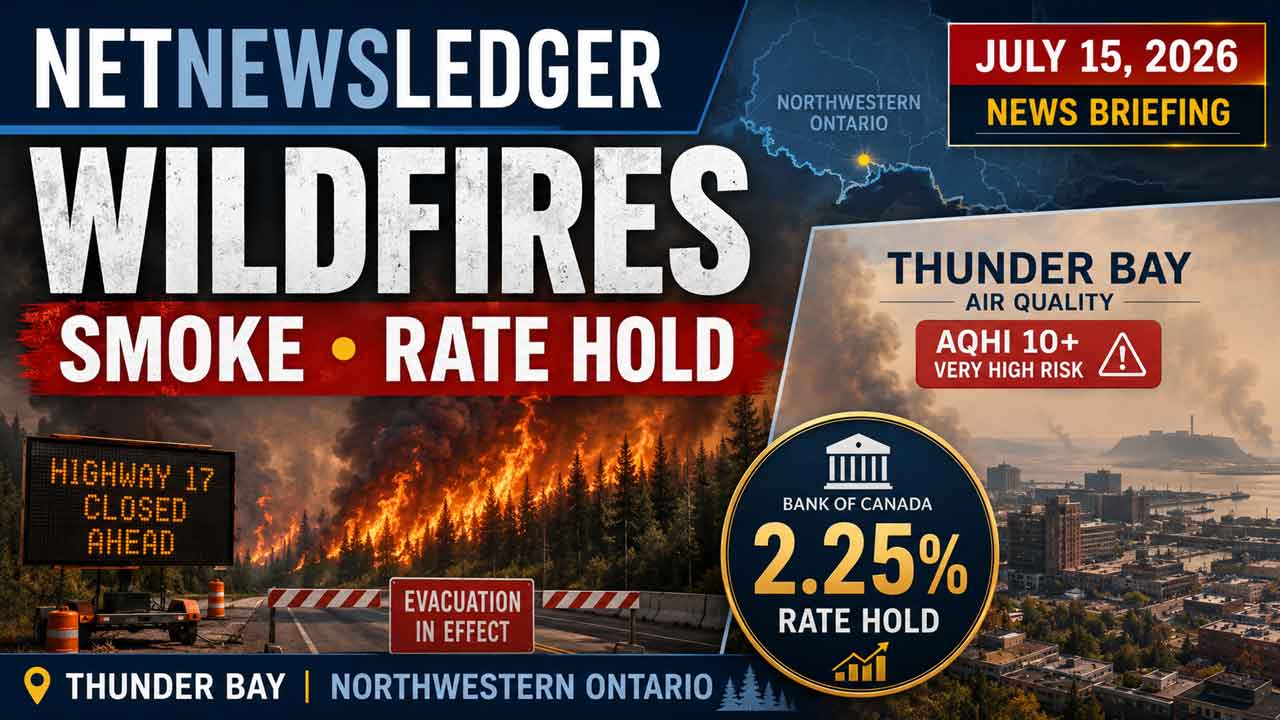
THUNDER BAY — Northwestern Ontario’s wildfire emergency remains the most urgent story for regional readers on Wednesday, July 15, 2026, as evacuations, highway closures and hazardous smoke affect communities across the Northwest.
Nationally, the Bank of Canada has held its policy interest rate at 2.25 per cent while warning that war-driven energy costs and continuing U.S. trade uncertainty remain significant risks.
Internationally, renewed U.S. strikes against Iran and attacks on Ukraine’s Black Sea ports are threatening major energy and agricultural transportation corridors.
Wildfires and smoke disrupt life across Northwestern Ontario
The Northwest Fire Region had 148 active wildland fires as of 9:18 p.m. CDT Tuesday. Sixty-nine were not under control, seven were being held, five were under control and 67 were being observed. Ontario fire officials reported 26 new fires Tuesday as crews concentrated resources on protecting communities, transportation routes and critical infrastructure.
Mandatory evacuation orders were reported for Armstrong, Namaygoosisagagun First Nation, also known as Collins First Nation, Cushing Lake, Lac des Mille Lacs First Nation and nearby communities, and Whitesand First Nation. Residents in Ignace, Crystal Lake and the Highway 633 area were advised to prepare for a possible evacuation. Reports also listed Lac La Croix First Nation among affected communities, although evacuation information can change quickly.
Wildfire conditions closed Highway 11 between Highway 633 and Highway 623, Highway 599 between Highway 516 and Mishkeegogamang First Nation, and Highway 527 between Gull Bay First Nation and Armstrong. Travellers should check Ontario 511 before leaving and should not attempt to enter a closed highway.
The closures can complicate evacuations, emergency responses, freight transportation and the delivery of food, fuel and other essential supplies. Those consequences are particularly serious for remote and First Nations communities with limited road access and few alternative transportation routes.
A Restricted Fire Zone came into effect across the Northwest Fire Region at 12:01 a.m. Wednesday. Open-air burning, including campfires, is prohibited, and existing burning permits are suspended. Portable gas and propane stoves may be used cautiously for cooking and warmth.
Thunder Bay is not under an immediate evacuation threat, according to the city’s latest information.
The city is, however, receiving residents displaced from Armstrong, Whitesand First Nation and Collins First Nation, reinforcing Thunder Bay’s role as a regional transportation, accommodation, health-care and emergency-support centre.
The arrival of evacuees may place additional pressure on hotels, transportation providers, social-service agencies and medical services.
It also highlights the need for culturally appropriate support for Indigenous residents who may be separated from their families and home communities for an extended period.
Ontario Premier Doug Ford tells NetNewsLedger, “I want to thank Ontario’s world-class fire and emergency response crews who are tirelessly working to respond to wildfires across Northwestern Ontario.
“We continue to dedicate the necessary resources, including hundreds of highly trained Ontario wildland firefighters 40 aircrafts, to control these fires. We are also working closely with communities to ensure safe evacuation.”
Thunder Bay air quality reaches very high-risk level
Environment and Climate Change Canada placed Thunder Bay under an orange air-quality warning, with the Air Quality Health Index reaching 10-plus, classified as very high risk.
Very high-risk conditions were forecast to continue through Thursday night and into Friday.
People with heart or lung conditions, children and older adults should avoid strenuous outdoor activity. The general population should reduce or reschedule strenuous activity, particularly when experiencing coughing, throat irritation or other smoke-related symptoms.
The City of Thunder Bay temporarily closed outdoor pools and beaches and cancelled or moved several outdoor activities because of the smoke.
Live on the Waterfront at Marina Park was cancelled, although a limited-seating indoor performance was arranged at the Thunder Bay Community Auditorium. Some playground programs and Youth Move activities were also closed.
The closures demonstrate that wildfire smoke is no longer only a concern near the fire line. It is affecting recreation, municipal operations, workplaces and public health throughout Thunder Bay.
Residents should keep windows and doors closed when practical, use filtered indoor air where available and wear a properly fitted N95-style respirator when extended outdoor exposure cannot be avoided. Anyone experiencing severe breathing difficulty or chest pain should seek urgent medical assistance.
Bank of Canada holds policy rate at 2.25 per cent
The Bank of Canada held its target for the overnight rate at 2.25 per cent Wednesday. The Bank Rate remains at 2.5 per cent and the deposit rate remains at 2.20 per cent.
The central bank said the Canadian economy is showing signs of improvement, with growth estimated at an annualized 2.5 per cent during the second quarter. Consumer spending remains solid, housing activity appears to be stabilizing and exports have resumed growing, although labour-market conditions remain soft.
The Bank now projects Canadian economic growth of 0.7 per cent in 2026, followed by growth of 1.8 per cent in both 2027 and 2028. The unemployment rate was 6.5 per cent in June and has remained between approximately 6.5 and seven per cent since the end of 2024.
Inflation rose to 3.2 per cent in May, largely because of higher gasoline prices connected to the Middle East conflict. Inflation excluding gasoline was 2.2 per cent, while measures of core inflation remained close to two per cent. The Bank expects inflation to remain elevated in the near term before gradually returning to approximately two per cent in early 2027.
For Thunder Bay households, the decision means there is no immediate change in borrowing costs directly tied to the policy rate. Variable-rate mortgages, home-equity lines of credit and other floating-rate loans should not see a rate-driven adjustment resulting from Wednesday’s decision.
For Northwestern Ontario businesses, the rate hold provides some stability for financing equipment, construction and expansion. However, high fuel prices remain a concern for trucking, aviation, forestry, mining, tourism and remote-community resupply operations.
The regional outlook reflects the competing pressures facing the Bank. Weak economic growth and excess capacity can support lower rates, while higher gasoline and transportation costs can push inflation upward.
The Bank said the current rate remains appropriate but stressed that it is prepared to change policy as economic conditions evolve.
The next scheduled interest-rate announcement is Sept. 2. The next Monetary Policy Report is scheduled for Oct. 28.
CUSMA remains in force, but annual reviews create uncertainty
The Canada-United States-Mexico Agreement remains fully in force until 2036, despite the United States declining to approve a new 16-year extension during the agreement’s July 1 joint review.
The three countries can still agree to renew the agreement at any time.
Without a renewal agreement, CUSMA will face annual reviews as the three governments continue negotiations. Canada is seeking discussions on U.S. tariffs affecting Canadian steel, aluminum, automobiles and lumber.
The agreement has not ended, and existing CUSMA trade rules remain in effect. The risk is longer-term uncertainty, which can discourage investment when businesses cannot confidently predict future tariffs, rules of origin or market-access requirements.
That uncertainty matters to Northwestern Ontario because forestry products, minerals, machinery and manufactured goods move through integrated Canadian and U.S. supply chains. The Port of Thunder Bay, regional railways, trucking corridors and border crossings could all be affected by changes in continental trade patterns.
The Bank of Canada has also identified U.S. trade policy as an important economic risk. It noted that companies are finding ways to operate under the uncertainty, but projected Canadian exports along a lower path than before the recent trade disruptions.
U.S.-Iran conflict threatens oil and shipping routes
The United States launched a new wave of strikes against Iran Wednesday, targeting military capabilities that U.S. Central Command said had been used to attack commercial vessels in the Strait of Hormuz.
The strikes followed the reimposition of a U.S. naval blockade of Iranian ports. Iran threatened to disrupt additional regional energy-export routes as the collapse of a fragile truce raised the risk of renewed, sustained conflict.
The Strait of Hormuz is one of the world’s most important oil and natural-gas transportation corridors. Even limited disruption can increase global energy prices because traders and shipping companies factor the risk of damaged vessels, delayed deliveries and higher insurance costs into the price of fuel.
The Bank of Canada directly linked the Middle East conflict to higher Canadian gasoline prices and the May increase in inflation. It said the global inflation outlook will depend heavily on how the conflict and oil prices develop.
For Northwestern Ontario, the effects could appear at gasoline stations and in the operating costs of trucking companies, airlines, mines, forestry contractors and construction firms. Remote communities are especially exposed because fuel and essential goods must travel long distances by road or air.
Attacks reduce Ukraine’s Black Sea grain-export capacity
Ukraine has lost approximately one-third of its grain-export capacity through its Black Sea ports following intensified Russian missile and drone attacks, according to the Ukrainian farmers’ union. Export capacity has reportedly fallen from approximately six million tonnes to four million tonnes a month.
More than 90 per cent of Ukraine’s grain and vegetable-oil exports normally move through ports in the Odesa region. Several terminals have suspended purchases or operations because of damaged infrastructure and continuing attacks.
A Russian strike on a residential building in Odesa killed three people Wednesday as Russia and Ukraine intensified attacks on economic and transportation infrastructure around the Black Sea and Sea of Azov.
Ukraine and Russia are major participants in global grain markets. Extended port disruptions could affect wheat, corn, vegetable-oil, fertilizer and shipping prices.
Wildfire smoke becomes a national and cross-border emergency
Smoke from Northwestern Ontario’s fires spread across southern Ontario and into the northeastern United States Wednesday. Toronto recorded very high-risk air quality, while smoke also affected cities including New York.
The wider smoke emergency demonstrates that fires in remote northern areas can have consequences thousands of kilometres away. Smoke can disrupt major events, air travel, outdoor employment and health-care systems even where flames pose no direct threat.
Wildfires were also burning across Europe and parts of the United States amid extreme heat and dry conditions. Simultaneous emergencies can increase international demand for specialized firefighters, aircraft and equipment, making it more difficult for jurisdictions to share resources.
For Northwestern Ontario, the lesson is that emergency preparedness cannot depend entirely on outside assistance. Long-term planning will require sufficient regional firefighting capacity, reliable evacuation routes, resilient telecommunications and stronger support for First Nations managing repeated evacuations.
What NetNewsLedger readers should watch next
The wildfire emergency remains the story most likely to change quickly. Readers should monitor evacuation instructions, community notices, Ontario fire updates and Ontario 511 before travelling.
Thunder Bay residents should continue checking the Air Quality Health Index and municipal service notices. Outdoor programs, workplaces and sporting events may face further cancellations or modifications while the AQHI remains at very high-risk levels.
Economically, gasoline and oil prices will be an important measure of how the U.S.-Iran conflict is affecting Canadian inflation. A prolonged energy shock could make it more difficult for the Bank of Canada to reduce interest rates, even if economic growth remains weak.
The common thread connecting the day’s leading stories is transportation. Fires are closing Northwestern Ontario highways, conflict is threatening oil shipments through the Strait of Hormuz, attacks are damaging Black Sea grain terminals and CUSMA uncertainty is affecting continental supply chains.
For Thunder Bay and Northwestern Ontario — a region dependent on long-distance highways, railways, aircraft and shipping — disruptions elsewhere can quickly become higher local costs, delayed supplies and increased pressure on essential services.