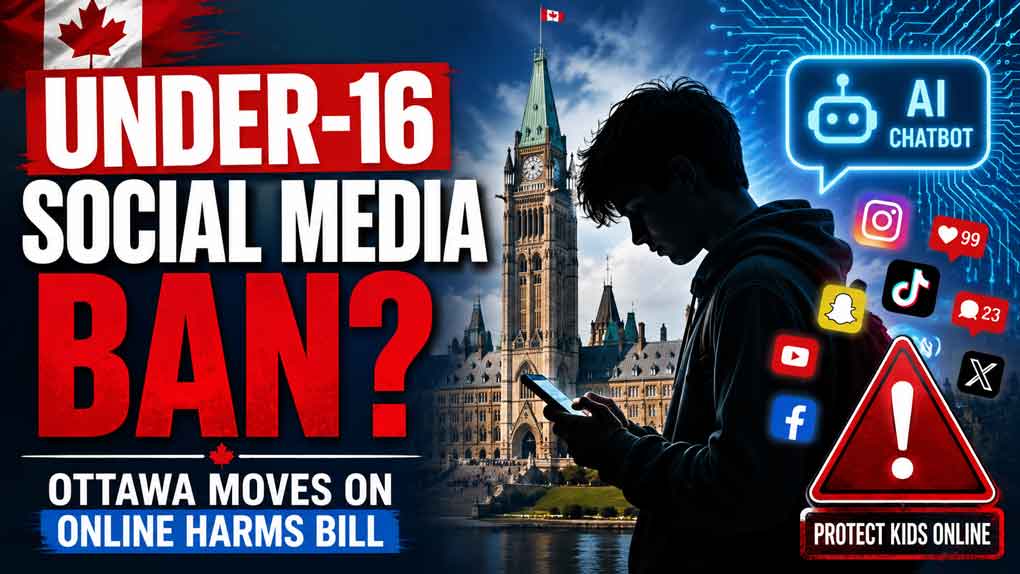
OTTAWA — TECH / Family – The Mark Carney Liberals are preparing online harms legislation that could ban children under 16 from social media, while allowing platforms that meet new safety standards to regain access to that youth market, according to a source familiar with the forthcoming bill.
The bill, expected Wednesday, would also require companies to mitigate harmful content and address the risks posed by artificial intelligence chatbots.
For families, schools and service providers in Thunder Bay and Northwestern Ontario, the proposal raises immediate questions about youth mental health, cyberbullying, sextortion, privacy, enforcement, and whether a ban would protect young people or simply push them onto less visible parts of the internet.
Bill would shift responsibility from families to platforms
The proposed approach appears to follow a “social media delay” model rather than a simple criminal-style prohibition. Under that model, the primary legal duty would fall on platforms, not children or parents.
Companies would have to prove they can keep children under 16 safe, verify or estimate age responsibly, reduce harmful design features and respond to dangerous content before being allowed to serve younger users.
Prime Minister Mark Carney said earlier this year that the question of an age threshold for social media should be part of the broader online harms debate.
An earlier Liberal online harms bill, Bill C-63, did not become law before the previous Parliament ended. That bill would have created a new Online Harms Act, a Digital Safety Commission and transparency duties for social media services. It was aimed at reducing online harms such as child sexual exploitation, intimate images shared without consent, child bullying, content inducing self-harm, hatred, incitement to violence and violent extremism.
Why Ottawa is moving now
The political argument for the bill is straightforward: many parents believe platforms have become too powerful, too addictive and too slow to protect children from harms that can follow them home from school and into their bedrooms.
Canadian evidence points to real concern, though not always simple cause and effect. Statistics Canada found that different forms of online digital media use were associated with different adolescent mental health outcomes, and that links between social media or messaging and mental ill health may be partly explained by cybervictimization and sleep.
A Public Health Agency of Canada study also found that youth who met the recommended limit of two hours or less per day of recreational screen time were more likely to report positive mental health indicators and less likely to report stress and psychosocial difficulties.
International evidence is also mixed. The World Health Organization’s European office reported that problematic social media use among adolescents rose from seven per cent in 2018 to 11 per cent in 2022.
But a large University of Manchester study reported in 2026 found no evidence that heavier social media or gaming use by itself increased anxiety or depression symptoms over the following year, while warning that hurtful messages, online pressure and extreme content can still be harmful.
That distinction matters. The strongest case for regulation is not simply that young people spend too much time online. It is that platforms can amplify cyberbullying, self-harm content, eating disorder material, sexual extortion, violent content, hate, addictive scrolling, targeted advertising and manipulative recommendation systems.
What other countries have done
Australia is the world’s most important test case. Since Dec. 10, 2025, many social media platforms have been required to take reasonable steps to prevent Australians under 16 from having accounts. The Australian model does not fine children or parents. It places responsibility on platforms and allows court-imposed penalties of up to A$49.5 million for companies that fail to take reasonable steps.
Its early results are mixed. Australian officials initially pointed to millions of suspected underage accounts being deactivated, but the regulator has also investigated Meta’s Instagram and Facebook, Google’s YouTube, Snapchat and TikTok for possible non-compliance.
Many teenagers have evaded restrictions, and that nearly one-third of parents surveyed said their under-16 child still had at least one social media account after the law took effect.
France has moved in the same direction, but implementation has been uneven. A 2023 French law set a “digital majority” at 15 and required parental consent for younger users, but European Parliament research says the law has not been applied in practice because the required decree was not enacted. France’s National Assembly approved a new under-15 social media bill in January 2026, but it still required further parliamentary steps.
The United Kingdom has not enacted a full under-16 social media ban, but its Online Safety Act requires social media companies to enforce age limits consistently and protect child users. Ofcom has also issued guidance on “highly effective age assurance” to prevent children from accessing pornography and other harmful content. The British government is now looking at stronger rules for AI chatbots and harmful platform features.
The European Union has taken a platform-duty approach rather than a blanket ban. Under the Digital Services Act, platforms accessible to minors must maintain a high level of privacy, safety and security, and targeted advertising to minors is banned. The European Commission has also released guidance on protecting minors and is preparing further action on addictive and harmful design practices through a planned Digital Fairness Act.
Other countries are moving quickly. Denmark has said it would ban social media for children under 15 with limited parental exceptions; Malaysia has begun barring under-16 users from registering accounts; Turkey has passed legislation banning children under 15 from social media; and Spain, Poland, Slovenia, Sweden, Greece and Norway are considering or preparing different age-limit models.
How successful has this been?
The honest answer is that it is too early to claim success.
Australia has shown that governments can force major platforms to act, but it has also exposed the core enforcement problem: young people can lie about their age, use a parent’s account, move to platforms outside the law, use VPNs or find less regulated online spaces. France shows another challenge: laws can be passed but remain ineffective if technical standards, privacy rules and regulators are not ready.
The most successful models so far appear to be those that combine age rules with enforceable platform duties. A ban by itself may be easy to announce and hard to enforce. A platform-duty model can be more complex, but it targets the companies that design recommendation systems, collect data, set default privacy rules and profit from youth engagement.
How could a Canadian law be enforced?
A Canadian law could be enforced through a national regulator with powers to audit platforms, demand risk assessments, order compliance plans, require transparency reports and seek major administrative monetary penalties.
The practical tools could include age assurance, age estimation, third-party verification, device-level age signals, app-store controls, privacy-preserving digital credentials and stronger reporting systems. The key privacy question is whether companies would be allowed to collect sensitive identification data, or whether Canada would require a “prove age without revealing identity” approach.
A credible enforcement model would likely need several safeguards: no fines for children or parents, clear appeal rights for users wrongly blocked, strong privacy protections, independent audits, public reporting, and penalties large enough that global platforms cannot treat them as a cost of doing business.
For platforms seeking to “opt back in,” Ottawa could require safer default settings for minors, no targeted advertising to children, limits on autoplay and infinite scroll, stronger anti-bullying systems, rapid takedown of child sexual abuse material, transparent complaint tools, human review for high-risk cases and independent testing of recommendation algorithms.
AI chatbots add a new layer of risk
AI chatbots complicate online harms legislation because they are not simply places where users post content. They can generate responses, simulate relationships, provide advice, create images, reinforce harmful thoughts or be embedded inside search, games, homework tools and productivity software.
Some advisers to Ottawa have argued that future online safety laws should include AI chatbots. Others warn that targeting chatbots too narrowly could miss the broader problem as AI features spread across common software.
One member of Ottawa’s expert advisory process, Vivek Krishnamurthy, argued that government should focus on harmful design features such as algorithmic curation designed to maximize engagement, and warned that young people can often get around age restrictions.
The United Kingdom is also moving to close gaps around AI-generated harmful content. British ministers have argued that existing online safety rules did not fully cover chatbot-generated material, especially where a chatbot creates harmful content rather than merely retrieving it from the internet.
Local implications for Thunder Bay and Northwestern Ontario
For Thunder Bay, the legislation would land in an environment where schools, families, police, mental health workers and youth agencies already deal with online conflict that becomes real-world harm.
Cyberbullying, image-based abuse, threats, sextortion and harassment do not stop at school doors. They can affect classroom learning, family relationships, youth mental health and police workload. In smaller communities, including First Nations and remote northern communities, online conflict can spread quickly and have serious social consequences.
Ontario has already moved to restrict cellphone use and social media access in schools, including a provincewide ban on social media sites on school networks and school devices. A federal online harms bill would go further by applying to platforms outside school hours and beyond school property.
The Northwestern Ontario context also requires caution. For many young people in remote communities, social media is not only entertainment.
It can be a connection to family, culture, language, peer support, education, crisis help and community news. A poorly designed ban could isolate some youth or push them toward less moderated services.
Any Canadian framework should include Indigenous consultation, rural and remote connectivity realities, and support for culturally safe online spaces.
The privacy and Charter test
Enforcement will be the hardest part politically and legally.
Age verification can protect children, but it can also create privacy risks if every user must upload government ID, biometric data or face scans to private platforms. A system meant to protect children could create new risks if sensitive data is breached, misused or collected unnecessarily.
There will also be Charter questions around freedom of expression and access to information. Children have rights, not just vulnerabilities. The challenge for Ottawa is to design a law that protects young people from exploitation and dangerous design without cutting them off from legitimate information, peer support and civic participation.
What should Ottawa avoid?
Ottawa should avoid making children or parents the enforcement target. It should also avoid relying only on self-declared birthdays, which are easy to evade, or creating a national system that requires every Canadian to identify themselves to use the internet.
The legislation should not treat all online activity as equal. Messaging a cousin, watching a public educational video, joining a moderated mental health forum, using an Indigenous language resource and doom-scrolling an algorithmic feed are very different activities.
The better test is whether a platform’s design exposes children to foreseeable harm and whether the company has taken meaningful steps to reduce that risk.
Bottom line
Politics is moving faster than the evidence. Parents are frustrated, governments are responding, and platforms are under pressure after years of promises that safety tools and terms of service would be enough.
A Canadian under-16 social media ban could reduce exposure to some harms if it is backed by strong platform accountability, privacy-preserving age assurance and real enforcement. It could fail if it becomes a symbolic ban that children easily bypass.
For Thunder Bay and Northwestern Ontario, the most useful outcome would not be a headline-grabbing prohibition alone.
It would be a practical safety regime that holds platforms accountable, supports parents and schools, protects privacy, respects Indigenous and remote-community realities, and gives young people safer digital spaces rather than simply telling them to disappear from the ones they already use.