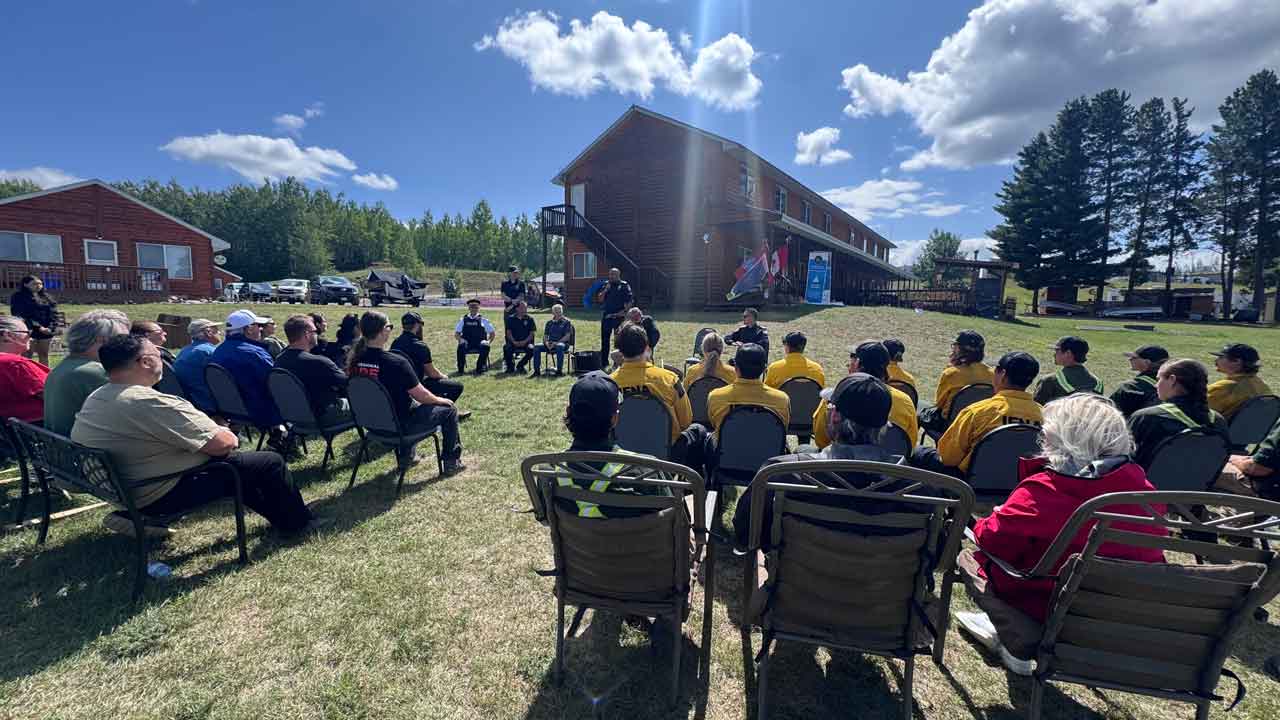
THUNDER BAY — Less than a year after receiving specialized wildland firefighting training through the Indigenous Police Chiefs of Ontario, Indigenous firefighters from First Nations across Ontario have put those skills into action in Northwestern Ontario, deploying to help protect Whitesand First Nation and support operations around the Thunder Bay 059 wildland fire.
The deployment brings together firefighters from Lac Seul First Nation, Saugeen First Nation, Walpole Island First Nation and Nipissing First Nation — people who left their own communities to help another First Nation facing a wildfire emergency.
For IPCO, the deployment represents the practical result of an effort to build a pool of Indigenous firefighters who can be trained, certified and ready to respond when First Nations need additional help. For communities across Northern Ontario, it also provides an example of what Indigenous-led emergency-response capacity can look like when training moves from the classroom to the fireline.
Training Indigenous Firefighters — Then Putting Those Skills to Work
IPCO says it used federal wildfire-preparedness funding in 2025 to establish a training program aimed at developing a provincial roster of Indigenous wildland firefighters who could be deployed to support First Nations.
The organization says a cohort of 75 people received training to nationally and internationally recognized standards.
Indigenous Services Canada says 73 participants have completed the program and are certified at all levels required through the initiative, giving them qualifications that can allow them to be deployed elsewhere in Ontario and across Canada.
Normand Roy, emergency management manager for Indigenous Services Canada’s Ontario Region, said the federal department has provided more than $1 million, in partnership with IPCO, to support Indigenous wildland firefighter training.
The significance of that investment became clear during the 2026 wildfire season.
Several of those recently trained firefighters were deployed to Northwestern Ontario to support the response involving Whitesand First Nation and Thunder Bay 059 (THU059).
The fire was first reported July 13 near the northern shore of Lake Nipigon, about 35 kilometres east of Armstrong. At that point, it was listed as not under control. Whitesand First Nation and Armstrong were among communities affected by the severe wildfire conditions that led to evacuations during July.
Indigenous People Supporting Indigenous Communities
The deployment has a significance that extends beyond additional firefighting personnel.
The firefighters arriving to assist Whitesand came from other First Nations.
They brought skills developed through Indigenous-focused training and were deployed as part of a response intended to increase the ability of First Nations organizations and communities to participate directly in wildfire protection.
In practical terms, it is Indigenous people helping Indigenous people during an emergency.
That matters in a region where First Nations have repeatedly faced evacuations because of wildfire, sometimes requiring residents to travel hundreds of kilometres from their homes.
Indigenous Services Canada reported earlier this year that Indigenous communities have accounted for 42 per cent of wildland fire evacuations in Canada over the past four decades. In 2025 alone, more than 45,000 people from 73 First Nations were displaced by wildfire nationally.
Those numbers demonstrate why building firefighting and emergency-management capacity within First Nations is increasingly being viewed as a long-term public-safety priority rather than simply a response to individual fire seasons.
IPCO Asked to Help at Whitesand
The Independent First Nations Alliance asked IPCO for support in providing fire-mitigation resources within Whitesand First Nation and assisting with the response to Thunder Bay 059 outside the community.
IPCO worked with the International Wildfire Alliance, or IWA, and other agencies to assemble personnel and resources.
The resulting deployment included IPCO’s Response-Ready Wildland Firefighter Unit crews and its Incident Management Assistance and Training Team, known as IMATT.
The eight-member IMATT is made up of senior leaders who provide mentorship, resources and operational assistance to First Nation incident-management teams.
IPCO says the team helped strengthen co-ordination between agencies while supporting community-protection priorities.
“Our objective is simple: we are here to support Independent First Nation Alliance’s teams and their response efforts,” IPCO chief operating officer Ashley Russell-Taylor said in an Aug. 14 statement.
The firefighters themselves have also been gaining field experience under the mentorship of Carmanah Wildfire Ltd.and wildfire specialists from the United States working with the International Wildfire Alliance.
That operational experience is important because training creates qualifications, but time on an active wildfire builds the experience needed to develop future crew leaders, supervisors and incident-management personnel.
IPCO Says Deployment Shows Indigenous-Led Model Can Work
IPCO executive director Kai Liu described the deployment as the first of its kind in Ontario for the organization.
“This deployment is the first of its kind in Ontario and demonstrates the true effectiveness of a coordinated Indigenous-led model that safeguards community members, critical infrastructure, and traditional territories while advancing long-term wildfire capability for First Nations in Ontario,” Liu said.
The larger objective is to create capacity that remains available after the immediate emergency ends.
Rather than having communities depend entirely on outside responders arriving after a wildfire becomes threatening, trained Indigenous personnel could increasingly become part of prevention, mitigation, initial response and larger interagency deployments.
That does not eliminate the role of Ontario’s Aviation, Forest Fire and Emergency Services or other provincial and federal emergency agencies. Large wildfires require aircraft, specialized equipment, incident-management structures and personnel that can come from multiple jurisdictions.
But developing Indigenous crews adds another layer of capacity — one with direct connections to the communities and territories being protected.
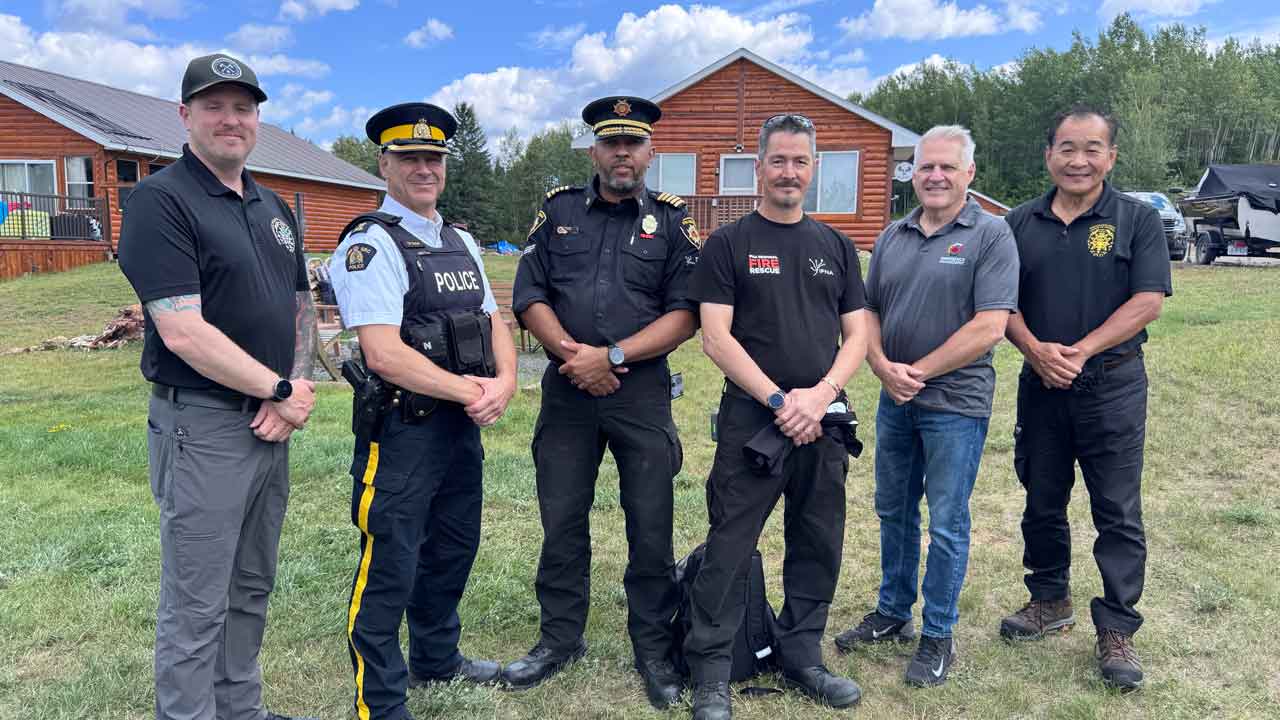
From Police Leadership to Wildfire Preparedness
IPCO was established in 2019 and represents Ontario’s nine self-administered First Nation police services.
Its involvement in wildfire preparedness reflects the realities facing police and emergency personnel in many First Nations.
IPCO says officers from its member services can be among the first responders to fire-related emergencies because of the vast geographic areas they serve and the limited emergency infrastructure available in some communities.
IPCO’s role in emergency preparedness has expanded beyond firefighter training.
Indigenous Services Canada says it has funded two capacity positions within IPCO since 2024 to help Ontario First Nations with wildfire-preparedness mapping, flood mapping and 911 planning. IPCO can provide advice or manage projects for communities that lack their own technical capacity.
Ontario has also worked with IPCO on Indigenous emergency-management training, including exercises designed to introduce First Nations youth to emergency response and public-safety careers.
Federal Government Looking at Another 100 Firefighters
The 2026 deployment may be only the beginning of a larger Indigenous wildfire workforce.
Roy says Indigenous Services Canada’s Ontario Region is looking to provide funding, again in partnership with IPCO, to train another 100 Indigenous participants ahead of the 2027 wildland fire season.
If completed, that expansion would significantly increase the number of Indigenous firefighters available for deployment.
The potential extends beyond Ontario.
Because participants are being trained to recognized standards, qualified firefighters could eventually respond to incidents elsewhere in Canada when resources are needed, while firefighters from other regions could support Ontario First Nations during severe seasons.
The federal government has increasingly invested in this approach nationally. Natural Resources Canada’s wildfire training programs have supported thousands of training opportunities, with a significant focus on Indigenous and remote communities. In Ontario, federally supported programs have included firefighter training through IFNA, Bimose Tribal Council, Keewaytinook Okimakanak and other Indigenous organizations.
Wildfire Capacity Is Also About Self-Determination
There is a larger question behind the firefighting program: Who has the skills, equipment and authority to protect a First Nation when wildfire threatens?
For decades, many First Nations have relied heavily on outside governments and agencies during evacuations and wildfire emergencies.
Building Indigenous firefighting and incident-management capacity does not mean communities must respond alone. It means First Nations can have a larger operational role in decisions affecting their people, infrastructure and traditional territories.
That is consistent with a broader shift in federal emergency-management policy toward First Nations-led preparedness and response. Indigenous Services Canada has said its goal is to develop more Indigenous-led teams and partnerships capable of supporting communities before, during and after emergencies.
For the firefighters deployed near Whitesand, however, that policy discussion became something much more concrete.
People who received training less than a year ago were standing on the ground in Northwestern Ontario, using those skills to help another First Nation confront a real wildfire threat.
Experience Gained at Whitesand Can Travel Home
When the deployment ends, the knowledge does not disappear.
Firefighters returning to Lac Seul, Saugeen, Walpole Island and Nipissing take operational experience back to their own communities.
That can strengthen local preparedness before the next emergency — whether through fire prevention, community protection planning, equipment preparation or mentoring additional firefighters.
The same principle applies as more people are trained.
A province-wide network of qualified Indigenous responders could allow First Nations to help one another when a community’s local capacity is overwhelmed.
IPCO says the Whitesand deployment demonstrates what can happen when First Nations, Indigenous organizations and outside partners organize around that objective.
Among the agencies and organizations supporting the operation were IFNA’s Emergency Operations Centre, Indigenous Services Canada, UCCM Anishnaabe Police Service, Anishinabek Police Service, Lac Seul Police Service, Nishnawbe Aski Police Service, Ontario Provincial Police, RCMP and wildfire specialists from Canada and the United States.
But at the centre of the story are the firefighters themselves.
They were trained with the expectation that their skills might one day be needed.
During one of Northwestern Ontario’s most challenging wildfire seasons, that call came.
And Indigenous firefighters from communities elsewhere in Ontario answered it.