Thunder Bay faces rising shoplifting, property crime and visible encampments. This analysis examines addiction, public safety, and the City’s response
THUNDER BAY – ANALYSIS – Addiction, homelessness and property crime are now part of the same daily conversation for many Thunder Bay residents and business owners. Shoplifting, vehicle break-ins, discarded needles, panhandling and encampments along public trails and waterways have created a sense that the city is losing control of shared spaces.
Thunder Bay Police Service (TBPS) figures cited for this year show 934 reported shoplifting incidents in 2026. That is a serious public-safety signal.
Social media reports of incident have increased in frequency, with many people expressing concern over police response to their calls. In cases, according to the Thunder Bay Police where there is no immediate threat to life, for property crime and similar theft incidents, people are directed to the online reporting webpage.
The level of frustration is an issue. The question might be that eventually someone will simply take matters into their own hands, and put a situation into greater danger.
The larger question should be whether Thunder Bay is building a system that can protect residents and businesses while helping people move from street homelessness and untreated illness into stable housing and recovery.
The answer, based on the public record, is mixed.
The city now has a clearer plan than it did several years ago. But plans, pilot projects and proposed sites have not yet produced results at the scale residents need to see.
What the crime numbers do – and do not – tell us
Retail theft is not a victimless problem. Employees can face threats, stores spend more on security and insurance, and some businesses reduce hours or remove products from shelves. Vehicle smash-and-grab incidents impose costs on families and workers who may already be struggling.
TBPS has shown that enforcement can make a difference when it is focused. Project Eclipse, an investigation into thefts and robberies from September 2025 to February 2026, led to the seizure of more than $39,000 in stolen property and 256 charges. In September 2026, Project Support reported more than 9,100 business and public engagements, 343 service referrals, 89 accepted referrals, 78 arrests and 74 provincial offence notices.
Those results show why police visibility, business liaison work and investigations matter. They do not show that arrests alone can solve addiction or homelessness. A person may be arrested, released and returned to the same unsafe housing and treatment conditions. Without a housing and health pathway, enforcement can become a revolving door.
Thunder Bay Police demonstrated that their foot patrols – a program that ended on September 1st was very effective. It is difficult to understand why that program simply ended.
There is also a risk in treating all public disorder as one category.
Organized retail theft, a person taking food because they are hungry, a vehicle break-in, a person panhandling and a person in a mental-health crisis require different interventions. A useful local dashboard should separate these issues instead of placing them under a single label such as “homeless crime.”
McVicar Creek shows the pressure on public space
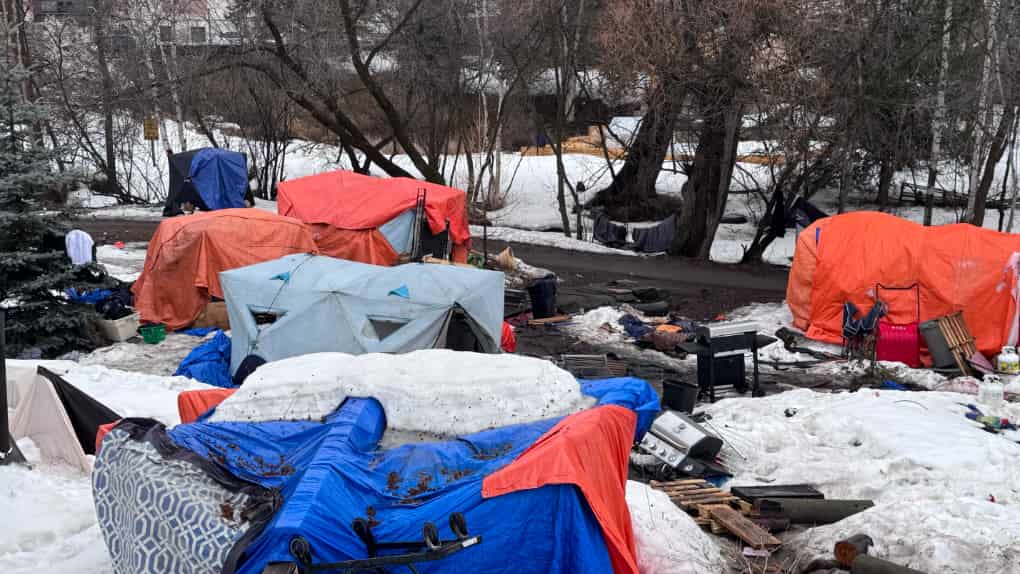
Along McVicar Creek between Algoma Street and Cumberland Street, people living outside have formed a growing encampment. Residents and nearby property owners have raised concerns about garbage, sanitation, environmental damage and safety.
Reports that people are beginning to build structures raise additional questions about fire risk, emergency access, weather exposure and whether outreach workers can reach everyone safely.
These concerns deserve a prompt, transparent response.
They should not be used to erase the humanity of people living there. A tent is not a home, and an encampment beside a creek is not a substitute for housing, washrooms, treatment or security. At the same time, residents and businesses have a legitimate right to safe trails, clean public land and timely action when structures, fires, violence or hazardous waste create an immediate risk.
The District of Thunder Bay Social Services Administration Board (TBDSSAB) is the district’s service-system manager for homelessness programs, community housing and Ontario Works. The board has now issued a statement from CEO Ken Ranta during the municipal election period, saying some candidates have made “false and misleading claims” about TBDSSAB, its work, its tenants and its properties.
TBDSSAB CEO responds to election claims
Ranta’s statement says TBDSSAB is an independent organization and is not part of any municipal government. Its operations, he says, are not changed by the election results.
“TBDSSAB is an independent organization and is not part of any municipal government; TBDSSAB operations are unaffected by the results of an election,” Ranta writes.
The statement also explains that TBDSSAB housing operations, including eligibility and tenant rights, are guided by Ontario’s Housing Services Act and Residential Tenancies Act. That means a mayor or city council cannot simply rewrite tenant eligibility rules or direct the board to remove tenants outside the legal process.
Ranta says the board has more than 2,700 properties and that its Housing Operations team works directly with tenants to understand how best to support them. He acknowledges that housing properties are not exempt from criminal activity, but says the board must act within the legal limits of a landlord.
Examples cited in the statement include the Special Constables housing unit launched with Thunder Bay Police Service, direct conversations with tenants about personal safety and reporting crimes, and advocacy with decision-makers when provincial policies or legislation limit the support that tenants need.
“We take the safety and comfort of all our tenants very seriously, and strive to deliver the best service and support possible,” Ranta writes.
Ranta also says that no candidate in the current election had contacted TBDSSAB to obtain information or discuss concerns before making public claims. He asks residents to treat social-media posts about TBDSSAB cautiously because the information may not have been supplied or verified by the board.
The statement does not mean TBDSSAB is beyond criticism.
An independent board should still answer questions about safety, maintenance, tenant supports, enforcement and outcomes. It does mean those questions should be based on verified information and on the legal division between the City, the board and the Province.
That clarification matters because the City and TBDSSAB have different responsibilities.
The City manages municipal land, parks, sanitation, bylaws and local emergency coordination. TBDSSAB administers homelessness services, community housing and Ontario Works. Ontario funds many health, addiction and supportive-housing programs. Police enforce criminal law and respond to immediate safety threats.
Residents are right to ask who is responsible. They are also entitled to a clear answer when responsibility is shared. A public incident at McVicar Creek should result in a named lead agency, a written safety plan, a timeline and a report on what happened next. Election candidates should identify which level of government has the power to make each change they propose.
That clarification matters because the City and TBDSSAB have different responsibilities. The City manages municipal land, parks, sanitation, bylaws and local emergency coordination. TBDSSAB coordinates homelessness services and housing programs. Ontario funds many health, addiction and supportive-housing programs. Police enforce criminal law and respond to immediate safety threats.
Residents are right to ask who is responsible.
They are also entitled to a clear answer when responsibility is shared. A public incident at McVicar Creek should result in a named lead agency, a written safety plan, a timeline and a report on what happened next.
The City’s response: real initiatives, slow results
Thunder Bay’s 10-Part Enhanced Encampment Response Plan describes encampments as a symptom of unaffordable housing, limited mental-health services and inadequate income supports. The plan calls for improved sanitation, a dedicated response team, lived-experience advice, stronger Indigenous partnerships, a Temporary Shelter Village, possible designated encampment areas, public-space bylaw changes and long-term housing solutions.
The City says the Temporary Shelter Village will provide 80 temporary indoor units with wrap-around services, including hygiene, health care, mental-health support and employment assistance.
In March 2026, the City said it was evaluating six potential designated encampment sites and consulting the public. It described the sites as managed outdoor spaces with basic services and coordinated outreach, not permanent housing.
This is a more coherent framework than simply clearing camps whenever complaints rise. However, the public record still leaves important questions unanswered:
- How many people have moved from encampments into shelter, transitional housing and permanent housing?
- How many remain housed after six and 12 months?
- How often are people offered a realistic indoor option before a site is closed?
- What sanitation, fire, water and emergency-access standards apply at each site?
- What will happen when a designated site reaches capacity?
- What is the cost per placement, and how will the City report outcomes publicly?
Without those measures, a designated site can become a holding area that makes homelessness less visible without making people safer.
The City has said it wants a human-rights-based approach. That commitment must be tested by results, not only by language. To many residents and business owners, the city’s approach seems to put the rights of homeless over the rights of others. That kind of approach, true or not, is simply not the right approach.
There are signs of a stronger local health response
Thunder Bay is not starting from zero.
NorWest Community Health Centres opened a Homelessness and Addiction Recovery Treatment Hub, or HART Hub, on Simpson Street in September 2026. The hub brings together housing navigation, primary health care, addiction support, mental-health services, Indigenous health and cultural supports, and system navigation. It is intended to provide a low-barrier front door for people who often cannot manage a series of separate appointments.
The HART Hub model addresses one of the main gaps in the old system: people were expected to move between shelters, emergency rooms, detox programs, income offices and housing applications while in crisis. A connected service team can reduce those handoffs. It will still need enough treatment beds, supportive-housing units and follow-up staff to prevent the hub from becoming another referral point with nowhere to refer people.
Ontario has also announced funding for 66 supportive homes and 120 emergency shelter spaces in Thunder Bay. Those investments are important, but shelter beds are not the same as permanent homes, and supportive housing is not the same as addiction treatment. Thunder Bay needs all three, with clear pathways between them.
What other Canadian communities are doing differently
Medicine Hat: a measurable Housing First system
Medicine Hat, Alberta, became the first Canadian community to reach functional zero chronic homelessness in 2021. Functional zero means three or fewer people experiencing chronic homelessness for three consecutive months, with a system able to house people faster than new chronic homelessness is occurring.
Medicine Hat did not achieve that result through one shelter or one police initiative. Since 2009, more than 1,323 people have secured housing, including 358 people who had experienced chronic homelessness. The community used real-time, person-specific data, shared responsibility among agencies, a defined housing goal and people with lived experience at the table.
The lesson for Thunder Bay is not that the two cities are identical. It is that a city needs a measurable end state. “We are responding” is not enough. The question is whether the number of people entering homelessness is falling and whether people are being housed and remaining housed.
Toronto: outreach, housing and public-space management together
Toronto’s Streets to Homes teams conduct daily outreach and help people obtain identification, income supports, housing applications, viewings and lease signings. The city also uses an Encampment Office that brings together shelter staff, parks, bylaw, waste, security, fire and transportation divisions. Its stated approach combines Housing First with clean-up and public-space management.
Toronto continues to face a major homelessness crisis, so it should not be presented as a complete success. Its useful lesson is operational: one team must coordinate outreach, health, housing, sanitation and public access instead of sending residents and encampment occupants from office to office.
Vancouver: supportive housing at scale
Vancouver reports approximately 8,000 supportive-housing units, including permanent, modular, single-room-occupancy and repurposed-hotel housing. Supportive housing includes on-site or connected life-skills, health, mental-health and substance-use supports. The city and BC Housing continue to add and upgrade units, although Vancouver’s drug-poisoning and homelessness crisis remains severe.
Thunder Bay cannot copy Vancouver’s scale. It can copy the principle that a person with complex needs needs a place where housing and support are available together. A scattered set of emergency beds will not replace a durable supportive-housing network.
Hamilton: a dedicated encampment response team
Hamilton’s Encampment Response Team works with residents to move them to safer legal accommodations, assists with belongings and cleans abandoned sites. The model makes the city responsible for both the human transition and the public-space restoration. Thunder Bay’s planned response team should have the same clarity of role and should publish its service standards.
Is Thunder Bay on the right path?
Partly. The direction is more promising than the public debate often suggests: a 10-part plan, a proposed shelter village, designated-site criteria, a HART Hub, new supportive homes, outreach and a police project that combines enforcement with referrals. These are the right building blocks.
The weakness is implementation.
Residents see structures growing along a creek while governments debate sites, bylaws and funding. Businesses see repeated theft and vehicle damage. People living outside face exposure, illness, violence and displacement.
Each group experiences delay as a failure.
Thunder Bay should set a 12-month public scorecard.
It should report the number of people living unsheltered; offers of shelter and housing; accepted placements; housing retention; treatment access; repeat emergency calls; shoplifting and vehicle-theft trends; sanitation response times; and the number of people connected to Indigenous-led services.
Such a scorecard should be reviewed by City Council, TBDSSAB, health partners, police, businesses and people with lived experience.
Designated encampments should be temporary, voluntary wherever possible and clearly safer than unmanaged sites. They need toilets, water, garbage collection, fire prevention, storage, lighting, outreach, transportation and a direct route to housing. Sites beside waterways require special environmental and emergency-access rules. A camp cannot be treated as solved because it has moved behind a fence.
Public safety also requires targeted enforcement. Police should investigate organized theft, violence, weapons and trafficking, while crisis and outreach teams respond to health and housing needs. Businesses should have a single reporting and liaison channel, and residents should receive timely information about what is being done with complaints.
The bottom line
Thunder Bay does not have a choice between compassion and public safety. It needs both. Addiction is a health and social issue, but theft, violence, fire risk and intimidation still require lawful responses. Homelessness is not a crime, but unsafe conditions in public spaces cannot be ignored.
The City is moving toward a better model, but it has not yet demonstrated that the model is working. The next test is not another announcement. It is whether a person at McVicar Creek can receive a safe place to stay, treatment when wanted, a housing plan and follow-up support – while residents and businesses see cleaner, safer and more usable public spaces.
Sources checked
- City of Thunder Bay – Enhanced Encampment Response Plan
- City of Thunder Bay – March 2, 2026 public input notice
- City engagement page – designated encampment sites
- Thunder Bay Police Service – Project Support results, September 8, 2026
- Thunder Bay Police Service – Project Eclipse
- TBDSSAB – statement on homelessness and shelter capacity
- NorWest Community Health Centres – HART Hub
- Ontario – supportive and emergency housing in Thunder Bay
- Community Solutions – Medicine Hat functional zero case study
- Medicine Hat Community Housing Society – plan and progress
- City of Toronto – encampment outreach and response
- City of Vancouver – supportive housing
- City of Hamilton – encampment response