THUNDER BAY – MINING NEWS – The mining world is seeing increased prices for commodities as well as rising demand.
Copper reached a record on the London Metal Exchange Tuesday as concerns about mine supply collided with rising demand from power networks, artificial intelligence infrastructure, electric vehicles and data centres.
At the same time, governments are moving more aggressively to secure critical-mineral supply chains, Canadian mines are advancing toward production, and Northern Ontario explorers are using electromagnetic, gravity and geological data to sharpen their drill targets.
Here are the international, Canadian and regional stories NetNewsLedger Mining and Geophysical readers need to know for Tuesday, September 8, 2026.
Mining Commodity Price Snapshot
| Commodity | Latest price used in this briefing | Market context and timing |
|---|---|---|
| Copper | US$14,510 per tonne | London Metal Exchange three-month contract on September 8; the contract touched US$14,533. |
| Gold | US$4,410.55 per ounce | Spot indication reported September 7. |
| Silver | US$66.24 per ounce | Spot indication reported September 7. |
| Platinum | US$1,827 per ounce | Spot indication reported September 7. |
| Palladium | US$1,389.72 per ounce | Spot indication reported September 7. |
| Nickel | US$7.57 per pound | September 6 indication supplied in the September 8 mining-market feed. |
| Zinc | US$1.85 per pound | September 6 indication supplied in the September 8 mining-market feed. |
| Aluminum | US$1.50 per pound | September 6 indication supplied in the September 8 mining-market feed. |
| Lithium carbonate | US$21,980.03 per tonne | September 6 feed indication; reported down 5.64 per cent. Lithium benchmarks vary by market, grade and delivery basis. |
| Cobalt | US$22 per pound | September 6 feed indication; reported down 4.46 per cent. |
| Iron ore | US$90.75 per tonne | September 6 indication supplied in the September 8 mining-market feed. |
| Uranium | US$89.50 per pound U3O8 | Latest cited spot indication was September 4; September futures were quoted near US$89.65. |
Price note: These are U.S.-dollar market snapshots from different reporting times and trading bases. They are not directly interchangeable and can move rapidly. Prices are provided as industry information, not investment advice.
International Mining News
Copper Reaches a New London Record
Benchmark three-month copper rose to US$14,510 per tonne on the London Metal Exchange after touching US$14,533, surpassing the previous record set in January.
The market is reacting to weak mine supply and concerns that possible new U.S. tariffs on refined copper could pull more metal into American warehouses. Global copper-mine output fell 1.1 per cent during the first half of 2026, while concentrate production declined 2.6 per cent, according to figures cited by The Wall Street Journal.
There is an important qualification: refined production remained ahead of consumption, producing a reported 131,000-tonne surplus. The immediate market tension is therefore not simply the world has run out of copper. It reflects a mix of mine disruptions, regional inventory movements, tariff risk and expectations for strong long-term demand.
For explorers and geophysicists, sustained copper prices at this level improve interest in deposits that may previously have appeared marginal. They do not remove the need for sound geology, recoveries, infrastructure, permitting and capital discipline.
United States Takes More Copper from the Democratic Republic of Congo
U.S. imports of refined copper from the Democratic Republic of Congo reached a record 53,290 tonnes in July. Congo supplied 23.9 per cent of total American copper imports during the month, while overall U.S. imports exceeded 220,000 tonnes for the first time.
The shift matters because Congolese copper brands are not currently approved for delivery against COMEX contracts. American industrial consumers are nevertheless accepting more of the metal, reportedly at discounts to copper carrying the high U.S. premium.
The trend shows how tariffs and regional price differences can redirect physical metal. It also underlines why Canada and the United States are treating copper supply as a strategic industrial issue rather than only a commodity-market question.
Brazilian Court Order Creates Uncertainty at Sigma Lithium
A Brazilian judge ordered the suspension of environmental licences and operations at Sigma Lithiums Grota do Cirilo mine in Minas Gerais. The case was brought by a federation representing Quilombola communities and centres on whether the nearby Bau community was entitled to prior consultation.
Sigma said its operations remained unaffected, that it had not been formally notified when it issued its response and that it intended to defend its position. The different positions should be kept clear: the court issued an order, while the company disputes the process and says the mine continues to operate.
The case is another reminder that community consultation, land rights and impact-zone definitions can become material project risks even after a mine enters production.
European Union Deepens Its Greenland Partnership
The European Union announced a €200-million partnership with Greenland covering 2026 and 2027. Sustainable mining is one of the areas identified, alongside energy, digital connectivity, education, fisheries, tourism and housing.
The agreement is broader than direct mine financing. However, its inclusion of mining reinforces Greenland’s strategic position in critical-mineral and Arctic policy.
National Mining News
McIlvenna Bay Moves Toward Commercial Production
Eldorado Gold’s McIlvenna Bay mine in Saskatchewan’s Flin Flon Greenstone Belt produced its first copper concentrate in June and its first zinc and pyrite concentrates in July. Commercial production is expected during the third quarter of 2026.
More than 400,000 tonnes of material had been prepared for processing. Approximately 14,000 metres of drilling is planned during 2026, while Eldorado is evaluating a possible mill expansion from 4,900 tonnes to approximately 7,000 tonnes per day and a silver-lead recovery circuit.
The federal government says the mine currently supports 380 full-time jobs and is expected to employ about 450 people at commercial production. Indigenous workers represent 34 per cent of the workforce.
Forecast 2026 output includes five million to 10 million pounds of copper, 3,000 to 6,000 tonnes of zinc, 5,000 to 10,000 ounces of gold and 100,000 to 200,000 ounces of silver. The March 2025 feasibility study projected an operating life of at least 18 years. Natural Resources Canada published the production and employment details.
Ottawa Puts Up to $1.5 Billion Behind Mine-to-Market Infrastructure
Canada’s First and Last Mile Fund will provide up to $1.5 billion through 2030 for strategic mining and infrastructure projects. It expands on the Critical Minerals Infrastructure Fund and can support upstream and midstream supply-chain development.
The central issue for projects is often not the mineral deposit itself but the road, power connection, processing capacity or transportation link needed to reach a customer. The fund is designed to address some of those barriers. Program information is available from Natural Resources Canada.
Federal support does not replace environmental assessment, Indigenous consultation, engineering or private financing. It can, however, change the timing and economics of projects facing large infrastructure gaps.
Equinox – Orla Combination Puts More Canadian Gold Under One Company
Equinox Gold completed its business combination with Orla Mining on July 31. The company expects approximately 1.1 million ounces of annual gold production, with more than 60 per cent coming from three long-life Canadian mines.
Updated consolidated guidance for 2026 is 870,000 to 920,000 ounces. That includes five months of production from Musselwhite in Northwestern Ontario and Camino Rojo in Mexico following completion of the transaction. Equinox’s completion announcement outlines the combined portfolio.
Northern Ontario and Regional Mining News
Marten Falls Community Access Road Clears Federal Assessment
The federal environment minister issued a decision statement for the Marten Falls Community Access Road on August 31, determining that effects within federal jurisdiction are justified when weighed against the project’s benefits.
The proposed all-season road would connect the northern end of the Painter Lake forestry road with Marten Falls First Nation. Seventeen Indigenous groups participated in the federal assessment, which resulted in legally binding mitigation and follow-up requirements.
The road could eventually form part of a broader transportation network associated with access to the Ring of Fire. However, the Marten Falls road is legally separate from the Northern Road Link, the Webequie Supply Road and any proposed mine. Approval of the community road is not approval of a mine. The Impact Assessment Agency of Canada explains the decision and conditions.
Greenstone and Musselwhite Become Key Equinox Assets
Equinox has set 2026 production guidance of 250,000 to 275,000 ounces for the Greenstone Gold Mine near Geraldton. Greenstone produced 64,656 ounces during the second quarter.
Musselwhite, north of Pickle Lake, is expected to contribute 100,000 to 110,000 ounces during the five months from August through December included in Equinox’s updated consolidated guidance.
Regional communities, First Nations, contractors and exploration-service companies will be watching how the enlarged producer allocates capital, procurement and exploration work between the two Northern Ontario operations.
CEN-CAN Resource Expo Opens in Thunder Bay
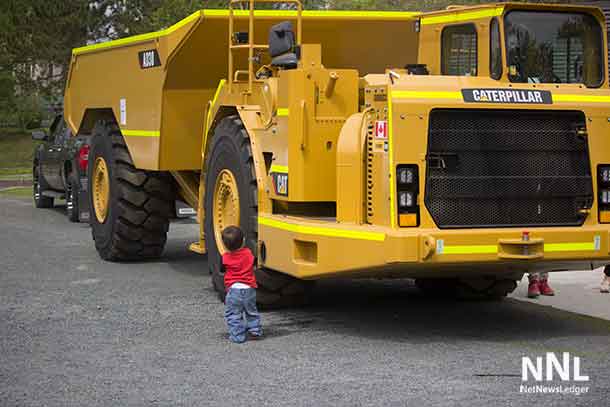
The Central Canada Resource Expo runs September 9 and 10 at Fort William Gardens in Thunder Bay. The event brings together mining, energy, exploration, geoscience, equipment and service-sector participants.
The event includes presentations, a job fair, live equipment demonstrations and more than 300 exhibits. For regional operators, the expo is a practical opportunity to compare exploration technology, discuss workforce needs and connect projects with Northern Ontario suppliers.
Geophysics and Drilling Watch
| Company and project | Location | Update | Why geophysical readers should care |
|---|---|---|---|
| Terra Metals – Southwest, Dante Project | Western Australia | The September 8 market feed highlighted company-reported intersections of 14 metres at 3.13 g/t 3E and approximately 80 metres at 1.30 g/t 3E. | Terra is testing a large layered-intrusion PGM–copper“ nickel system. The company says five rigs are operating and that more than 38,000 metres of RC and diamond drilling have already been completed across Dante. Project information |
| Chalice Mining – Deep Blue | Western Australia | First-pass drilling reportedly intersected broad, low-grade copper-silver-gold mineralization across approximately 1.2 kilometres of strike. The system remains open. | The target was developed from a 2.5-kilometre copper-molybdenum-silver soil anomaly supported by coincident magnetic and gravity features. Further sampling, geophysics and drilling will test whether the large footprint contains higher-grade centres. Exploration overview |
| Aruma Resources – Tillex | Timmins district, Ontario | Phase 2 consists of approximately 3,600 metres of diamond drilling aimed at southwest strike and depth extensions of the copper-silver mineralized trend. | The holes are testing a strong, shallow-plunging electromagnetic conductor identified through downhole EM. Selected holes will also provide platforms for additional DHEM surveys to refine geometry and vector later drilling. Company announcement PDF |
| ONGold Resources – TPK | Near Pickle Lake, Northern Ontario | ONGold says its fall drill program is ready following mapping, prospecting, 17.8 line-kilometres of electromagnetic surveying and 15 line-kilometres of gravity surveying. Selective Rowlandson Lake grab samples returned 2.64 to 17.96 g/t gold; one Sidewinder sample returned 10.69 g/t. | The surveys are being integrated with geology and geochemistry to prioritize drill targets. Grab samples are selective and do not establish the grade of a deposit; some float samples may have moved from their bedrock source. Company release |
| New Break Resources – Moray | South of Timmins, Ontario | Hole NBR-26-27 returned 5.28 g/t gold over 11.2 metres, including 26.5 g/t over 0.7 metres. Hole NBR-26-28 returned 3.95 g/t over 14 metres. | The company expects drilling to resume in September and says four completed holes are awaiting assays. Reported intervals are core lengths rather than confirmed true widths. Company release |
Technical caution: The drilling and sampling figures above were reported by the companies. Readers should review the complete releases for collar locations, azimuths, quality-assurance procedures, recovery assumptions and full assay tables. Core or downhole lengths are not automatically true widths. Selective grab samples are not representative of an entire mineralized zone. Metal-equivalent grades depend on the prices and recovery assumptions selected by the reporting company.
Exploration results do not establish a mineral resource, mineral reserve or economically viable mine.
What to Watch Next
- Copper inventories and tariffs: Watch whether the record London price holds and whether more refined metal continues moving toward the United States.
- McIlvenna Bay ramp-up: Commercial-production timing, recoveries and mill performance will determine how quickly the Saskatchewan operation reaches steady-state output.
- Ring of Fire infrastructure: The Marten Falls road decision moves one project forward, but permits, conditions, consultation and separate assessments remain important.
- Northern Ontario drill targeting: Results from Tillex, TPK and Moray will test whether current EM, gravity, structural and geochemical interpretations translate into continuous mineralized zones.
- Battery-metal volatility: The supplied feed showed sharp daily declines in lithium carbonate and cobalt, illustrating why price assumptions must be stress-tested in development studies.
- CEN-CAN discussions: Watch for project, equipment, workforce and financing announcements emerging from the September 9–10 Thunder Bay expo.
NetNewsLedger Mining News will continue following commodity markets, critical-mineral policy, Indigenous partnerships, geophysical programs, drilling results and mine development affecting Northern Ontario and Canada.