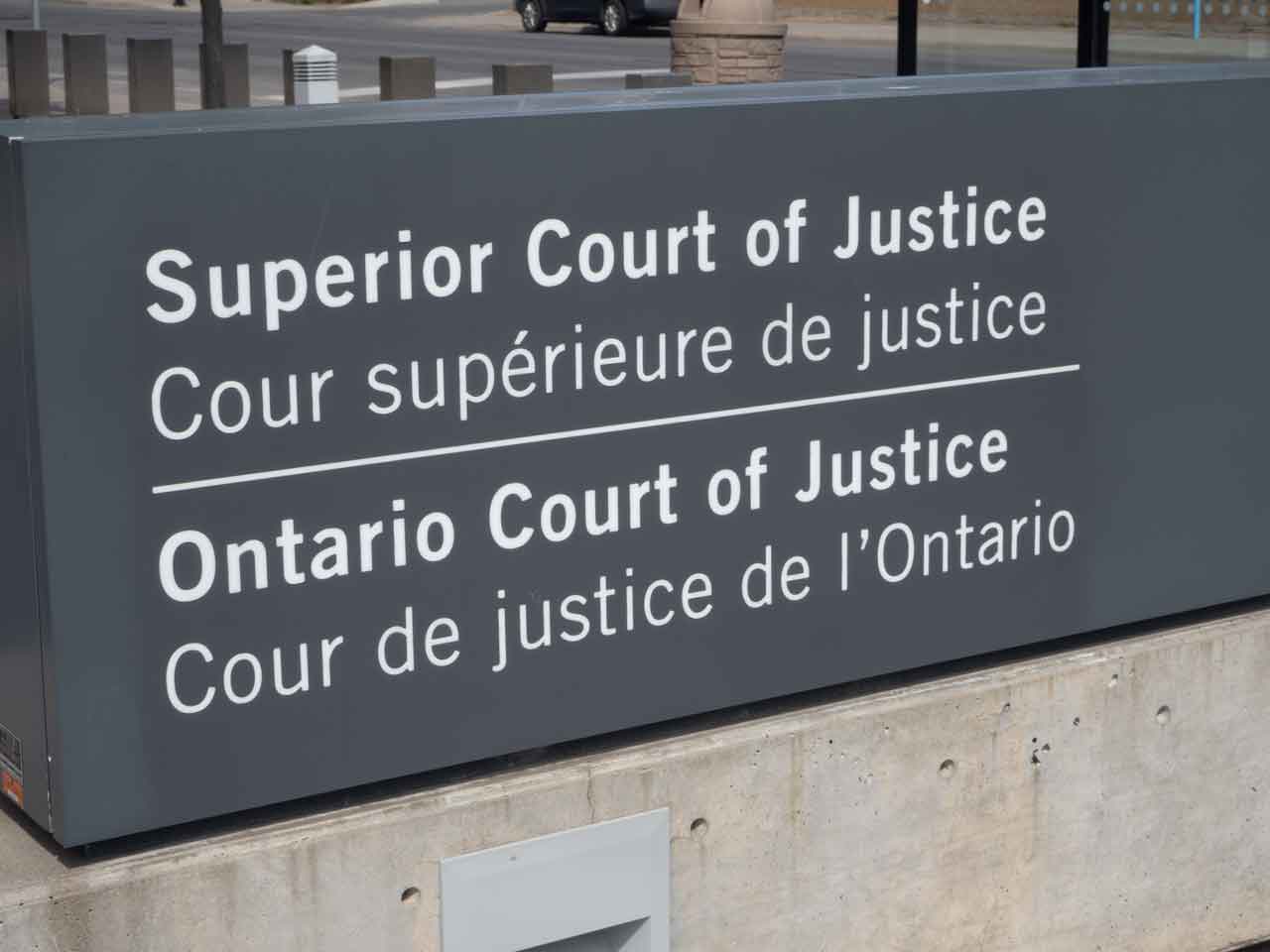
THUNDER BAY – LEGAL – Ontario’s attempt to require cash security deposits from people released on bail has been temporarily stopped by the Ontario Superior Court of Justice, less than two weeks after the new system took effect.
The ruling is important to Thunder Bay and Northwestern Ontario because bail courts routinely deal with accused people who have limited incomes, difficulty finding sureties and, in many northern and remote communities, fewer legal and social supports. A requirement to produce thousands of dollars in cash could have practical consequences for whether someone who has already been ordered released can actually leave custody.
It is important, however, to describe the court ruling precisely. The Ford government’s cash bail law has not yet been finally struck down as unconstitutional. On Aug. 31, Justice William Chalmers granted an interlocutory injunction suspending key provisions while he considers the underlying constitutional challenge.
What Ontario changed — and why the court intervened
The controversy centres on amendments to Ontario’s Bail Act contained in Bill 75, the Keeping Criminals Behind Bars Act, 2026.
The legislation received royal assent June 2. The provincial government subsequently brought the bail provisions into force on Aug. 17. Ontario Regulation 278/26 required an accused person or surety who had made a promise to pay under a release order to deposit the full pledged amount within two business days of the accused person’s release.
That represented a significant practical change.
Under the traditional Canadian bail model, a surety can promise to pay a specified amount if the accused violates the terms of release. The money does not ordinarily have to be deposited in advance. If conditions are breached and a court orders forfeiture, the Crown can then pursue collection.
Ontario wanted the money up front.
Attorney General Doug Downey said the change would make bail more “real and consequential,” improve compliance and make it easier to collect forfeited bail money. The province argued that the existing promise-to-pay system could require considerable time and resources to recover money after a breach.
The regulation required payment by cash, money order or bank draft within two business days.
But the Canadian Civil Liberties Association and Criminal Lawyers’ Association challenged the legislation almost immediately, arguing Ontario had crossed a constitutional line.
Why bail is primarily a federal criminal-law issue
The dispute illustrates an important division of powers in Canada.
Parliament has constitutional authority over criminal law and criminal procedure under section 91(27) of the Constitution Act, 1867. Provinces, meanwhile, have authority over the administration of justice under section 92(14).
Ontario argues its law falls on the provincial side of that boundary because the cash deposit is an administrative mechanism applying only after a justice has already decided to release an accused person.
In court, Ontario maintained that the provincial law does not tell a justice whether to grant bail, nor does it dictate the conditions imposed in the release order. Instead, the province said it simply regulates how a financial promise contained in that order is administered.
The challengers see the law very differently.
They argue Parliament deliberately created a national bail structure in which cash deposits are among the most restrictive forms of release and should normally be avoided when a promise to pay will suffice.
Their constitutional argument is that Ontario cannot effectively convert a federal promise-to-pay release into mandatory cash bail after the judge has already selected the less restrictive option.
That central question — whether Ontario was merely administering bail or substantively changing federal bail law — has not yet been finally decided.
Canada deliberately moved away from routine cash bail
Modern Canadian bail law dates largely to the federal Bail Reform Act of the early 1970s.
The legislation moved Canada toward a system favouring release before trial and created what became known as the “ladder principle.” Courts are expected to begin with the least restrictive form of release and move to more onerous conditions only when necessary.
The Supreme Court of Canada reinforced that principle in its landmark 2017 decision in R. v. Antic.
The court said an unconditional release is generally the starting point and that each more restrictive “rung” must be justified before a court moves higher. It specifically characterized cash bail as an exceptional measure and warned that requiring cash can make freedom depend on an accused person’s access to money.
The Supreme Court noted that a pledge and a cash deposit can serve the same financial purpose. A person who promises money risks losing it following a breach, even if the funds were not deposited in advance.
That history is crucial to the present Ontario challenge.
The legal organizations challenging Ontario’s legislation argue the province effectively reversed that federal policy by requiring cash even where a court had chosen a promise to pay.
The Ford government’s rationale
The cash requirement was part of a broader Ontario campaign to tighten the bail system amid repeated public concern about violent crime committed by people awaiting trial.
In April 2025, the province announced a broader strategy that included stronger collection of forfeited bail, specialized prosecution teams and a comprehensive review of the bail system. By November 2025, Ontario was publicly committing to mandatory cash security deposits.
The government’s position has consistently been that financial consequences should be enforceable.
Previously, someone could pledge a substantial amount — $5,000, $10,000 or more — without immediately putting that money into government hands. Ontario argued that when forfeiture was later ordered, recovering the debt could become difficult.
Bill 75 expanded the province’s collection tools as well, including mechanisms connected to garnishment, liens and property enforcement.
The political argument is straightforward: a pledge has less value, the government says, if collecting it following a breach is slow or uncertain.
The legal issue is whether Ontario’s solution changes the nature of bail itself.
Why Justice Chalmers suspended the system
To obtain an interlocutory injunction, the challengers had to satisfy the three-part test established in RJR-MacDonald Inc. v. Canada: there must be a serious issue to be tried, the applicants must demonstrate the prospect of irreparable harm and the balance of convenience must favour temporarily suspending the law.
Ontario did not dispute that there was a serious constitutional issue to be determined.
The critical question became harm.
Criminal lawyer Marianne Salih provided evidence based on her experience representing hundreds of accused people in bail proceedings. She told the court that many accused people and proposed sureties have limited financial means and that requiring an immediate deposit could discourage otherwise suitable people from becoming sureties.
Justice Chalmers accepted that evidence as factual evidence about bail practice.
He found that a cash requirement could make it more difficult to find willing sureties. It could also delay release while an accused person, family member or surety tries to assemble the money.
That matters constitutionally because accused people are presumed innocent.
If somebody who has already been granted bail remains jailed because the cash cannot quickly be found, the lost liberty cannot subsequently be restored.
Chalmers cited the Supreme Court’s observation that lost liberty can never be fully regained or compensated.
That finding satisfied the irreparable-harm branch of the injunction test.
Why the judge rejected Ontario’s argument about timing
Ontario made an important distinction.
The province said the cash payment was not technically a condition of release because payment was due only after the accused had been released. A person who failed to pay would not automatically have bail cancelled; instead, non-payment could result in a provincial offence.
Ontario therefore argued that the legislation itself did not keep anyone in jail.
Justice Chalmers was not persuaded that the practical consequences could be dismissed so easily.
The law had been operating for less than two weeks, meaning there was little evidence yet showing actual cases of delayed release. The judge said the court did not have to wait for irreparable harm to occur before intervening.
He concluded that potential sureties could decline to participate once they learned they would have to produce the full pledged amount in cash. In practical terms, that could affect whether a workable release plan could be assembled at all.
The distinction between what happens formally after release and what happens practically during bail planning is therefore at the heart of the case.
The balance of convenience favoured the existing system
Courts normally presume that legislation enacted by a government serves the public interest, and Chalmers expressly acknowledged that principle.
But he also noted that Parliament’s existing bail regime was enacted in the public interest.
He found greater potential harm in allowing the cash system to continue while the constitutional case remained undecided.
If the injunction were refused, people who otherwise qualified for release could potentially spend additional time in custody.
If the injunction were granted, by contrast, Ontario would simply return temporarily to the bail system that had operated for more than 50 years.
Chalmers therefore suspended section 8.0.1 of Ontario’s Bail Act and section 2(1) of Ontario Regulation 278/26 until the constitutional application is finally decided.
Why this matters in Thunder Bay and Northwestern Ontario
The practical implications could be particularly significant in Northern Ontario.
Bail proceedings in Thunder Bay serve a region where accused people can face poverty, unstable housing, limited access to lawyers and substantial distances between home communities, courts and correctional institutions.
For Indigenous accused people from remote First Nations, financial barriers may intersect with geography and limited access to conventional banking services. A rule requiring thousands of dollars to be assembled within two business days could therefore have consequences different from those faced by a higher-income accused person in southern Ontario.
The broader public-safety concern remains real as well.
Thunder Bay police, Nishnawbe Aski Police Service, Ontario Provincial Police and regional communities have repeatedly faced cases involving repeat offenders, violent crime and alleged breaches of release conditions. Governments therefore face legitimate pressure to ensure bail orders are enforceable.
The legal question is not whether public safety matters. It is whether mandatory cash deposits are constitutionally permissible and whether wealth should influence a person’s ability to benefit from a judicial release order.
What happens next?
The Aug. 31 ruling is a pause, not the final word.
Justice Chalmers must still decide the underlying constitutional application: whether Ontario’s legislation intrudes into Parliament’s exclusive criminal-law jurisdiction, conflicts with the federal Criminal Code, or violates Charter protections including the right under section 11(e) not to be denied reasonable bail without just cause.
That final ruling could uphold Ontario’s approach, invalidate all or part of it, or find the provincial provisions inoperative where they conflict with federal law.
An appeal is also possible.
Until that happens, Ontario’s mandatory cash-deposit requirement remains suspended and the established federal bail framework continues to operate.
The case ultimately raises a question much larger than the mechanics of collecting bail debts: whether governments can make pretrial release more financially consequential without making liberty more dependent on wealth.
Under Canadian law, every person charged with an offence is presumed innocent unless and until proven guilty in a court of law.