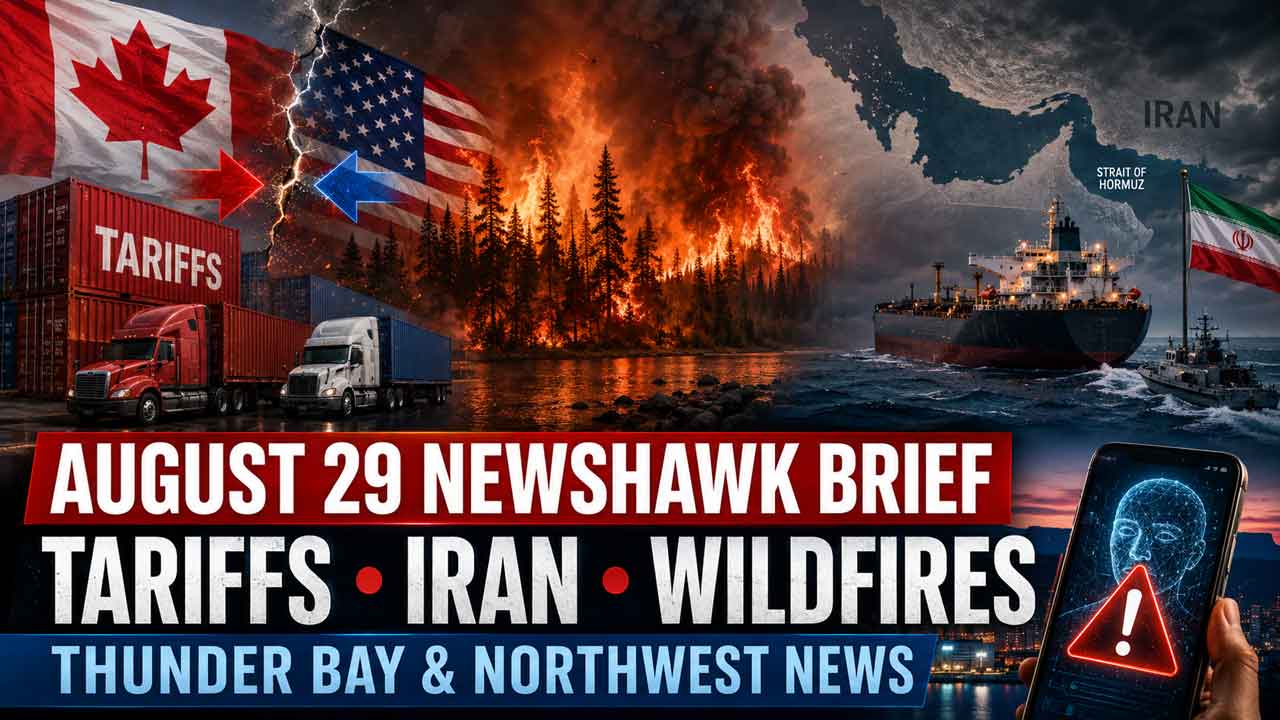
Canada-U.S. tariffs, Iran, wildfires, Ring of Fire and Thunder Bay headlines
THUNDER BAY — NEWS — The Canada-U.S. trade confrontation remains the story with the greatest direct economic consequences for Thunder Bay and Northwestern Ontario on Saturday, Aug. 29, while the six-month Iran war, catastrophic flooding in Nepal and Tibet, another deadly Russian strike in Ukraine and instability in Niger lead the international file.
Closer to home, Northwestern Ontario still has 59 active wildland fires, Ring of Fire road development remains one of the region’s most important longer-term economic and Indigenous-relations stories, and Thunder Bay Police are warning residents about increasingly convincing AI-generated investment scams.
This NewsHawk briefing reflects information available at approximately 8:15 a.m. EDT Saturday, Aug. 29. Several international stories are developing rapidly.
NATIONAL — Canada-U.S. Trade War Remains Northwestern Ontario’s No. 1 Economic Story
Canada’s confrontation with Washington should remain the lead Canadian story for NetNewsLedger.
The United States has imposed 50 per cent tariffs on roughly $20 billion worth of Canadian goods following the collapse of another attempt at a trade agreement. Ottawa has announced retaliatory tariffs, with another round scheduled to take effect Sept. 8. U.S. President Donald Trump has separately threatened 50 per cent tariffs on Canadian cars, trucks and automotive parts beginning Jan. 1, 2027.
The Northwestern Ontario angle is substantial. Forestry products, mining machinery, steel, transportation equipment and industrial supplies frequently move through integrated Canadian-U.S. supply chains. Thunder Bay also sits on an important east-west transportation corridor while being only a short drive from the U.S. border.
Even companies that never export directly can encounter higher equipment, material or freight costs.
NATIONAL — Canada’s Economy Just Delivered a Significant Surprise
There is an important counterpoint to the tariff story.
Statistics Canada’s latest figures show the Canadian economy expanded at an annualized 3.3 per cent in the second quarter, its fastest pace since 2023, according to Reuters. Exports rose 3.6 per cent while domestic demand, consumer spending and business investment also strengthened.
That performance means Canada avoided a technical recession.
But the numbers describe what has already happened. The renewed tariff escalation is the risk looking forward.
For Northwestern Ontario, stronger national investment and consumer demand are positive signals for construction, mining services and retail. A worsening trade war could reverse part of that momentum.
NATIONAL — Bank of Canada Decision Comes Wednesday
The Bank of Canada’s next interest-rate announcement is scheduled for Sept. 2.
A Reuters survey of 35 economists found unanimous expectations that the central bank will leave its overnight rate at 2.25 per cent. Economists are balancing relatively firm inflation against weak demand and unusually high trade uncertainty.
For Thunder Bay households, the decision matters through mortgages, lines of credit, business borrowing and housing affordability.
INTERNATIONAL — Six Months Into Iran War, Hormuz Remains the Economic Pressure Point
The conflict involving Iran, the United States and Israel has now reached the six-month mark.
Iran’s economy is under enormous pressure from war, sanctions and disruption to international commerce. Reuters reports Iranian leaders are confronting severe inflation and sharply reduced foreign trade while maintaining that Iran controls the strategically vital Strait of Hormuz. Commercial shipping through the waterway remains significantly disrupted.
The Strait of Hormuz has become one of the central objectives of U.S. strategy because of its importance to international oil and energy markets.
This is where an international conflict becomes a Northwestern Ontario story.
Diesel fuels virtually every part of the northern economy: forestry equipment, mine haulage, highway trucking, construction machinery and generators. Remote First Nations also rely heavily on aviation, winter-road supply chains and diesel-generated electricity.
Reuters reports crude prices have remained below US$90 despite the conflict, but refined products — particularly diesel — are showing tighter supply conditions.
NewsHawk watch: Global diesel prices may prove more relevant to Northwestern Ontario readers than the daily headline price for crude oil.
INTERNATIONAL — Nepal Disaster Is Becoming One of 2026’s Major Humanitarian Stories
The scale of the Himalayan disaster continues to grow.
A glacier collapse on Aug. 26 triggered catastrophic flooding affecting Nepal and Tibet. Reuters reported Saturday that at least 626 people had died in Nepal and another seven in Tibet, with approximately 3,000 people still missing. Bad weather has complicated rescue operations.
Nepal estimates reconstruction could require US$4 billion to US$5 billion and is seeking specialized international assistance.
This story deserves continued prominent international coverage because it connects a dramatic human tragedy with the growing global discussion around glaciers, extreme weather and climate adaptation.
For Northwestern Ontario, that discussion has relevance. Northern communities already face climate-related changes involving wildfire intensity, winter-road reliability, permafrost, water conditions and emergency evacuation planning.
INTERNATIONAL — Deadly Russian Strike Near Kyiv
A Russian drone strike on a warehouse in the Kyiv-area community of Myla caused a large secondary explosion, killing at least 37 people, Reuters reported Saturday. Hundreds of people were evacuated and Ukrainian authorities are investigating whether ammunition had been improperly stored close to residential areas.
The Ukraine war remains locally relevant because Thunder Bay and Northwestern Ontario have a substantial Ukrainian-Canadian community.
There are broader economic connections as well. Ukraine is a major agricultural exporter, and continued warfare can affect grain, fertilizer, energy and shipping markets.
INTERNATIONAL — Military Mutiny Challenges Niger Government
Another developing international file deserves attention.
Mutinous soldiers attacked several strategic locations in Niger’s capital, Niamey, early Saturday, including the airport, a military airbase and the area around the presidential palace. Reuters described the situation as volatile, with parts of the security apparatus appearing to remain loyal to President Abdourahamane Tiani.
Niger matters beyond West African geopolitics because it is a significant uranium producer.
The country has also shifted away from traditional relationships with Western governments and strengthened relationships with Russia since the 2023 coup.
INTERNATIONAL — Venezuela Oil Announcement Could Reshape Energy Markets
U.S. President Donald Trump announced Friday what he described as an agreement giving the United States control over 65 billion barrels of Venezuelan oil reserves. Details and the practical implementation of the arrangement require continued scrutiny.
This merits watching rather than immediately drawing conclusions about gasoline prices.
If substantial Venezuelan production eventually reaches international markets, it could influence global crude supply. Actual production increases, however, would depend on investment, infrastructure, political stability and the precise terms of any agreement.
REGIONAL — Northwestern Ontario Still Has 59 Active Wildfires
Wildfire activity remains one of Northwestern Ontario’s most consequential public-safety files.
Ontario’s Aviation, Forest Fire and Emergency Services reported 59 active wildland fires in the Northwest Region Friday evening.
Of those:
- six were not under control;
- three were being held;
- 12 were under control; and
- 38 were being observed.
Three new fires were confirmed Aug. 28 in the Fort Frances, Dryden and Sioux Lookout fire-management areas.
The wildfire count has fallen considerably from earlier in August, when the Northwest had more than 100 active fires, but the season is not over.
For First Nations and remote northern communities, continuing fire activity can affect aviation, medical travel, traditional land use, hunting, resource roads and emergency preparedness.
REGIONAL — Ring of Fire Story Is Moving From Promises Toward Construction
The Ring of Fire remains the region’s biggest long-term economic development story.
Work is underway on upgrades to the Anaconda and Painter Lake roads, covering roughly 97 kilometres north of Aroland First Nation. The project includes culverts, drainage, bridges, widening and road realignment.
Other proposed all-season roads involving Marten Falls and Webequie First Nations are central to Ontario’s strategy for reaching mineral deposits in the Ring of Fire.
But the Indigenous story cannot be presented as unanimous support.
Ontario’s own environmental-review documents record concerns from several First Nations about Treaty rights, hunting and harvesting, cumulative environmental impacts and the connection between community roads and future industrial development.
That distinction is essential for balanced reporting.
Aroland, Marten Falls and Webequie First Nations are advancing particular infrastructure initiatives. Other First Nations have expressed significant concerns about the pace and cumulative consequences of development.
For Thunder Bay, the potential economic opportunities include engineering, transportation, aviation, construction, environmental services, training, mine supply and potentially mineral processing.
REGIONAL — Critical Minerals Are Becoming a National-Security Story
Ontario continues to connect Ring of Fire development with its wider critical-minerals strategy.
The province says it has committed close to $1 billion toward infrastructure and community supports associated with the Ring of Fire and wants Northern minerals connected with Ontario manufacturing supply chains.
That means the Ring of Fire should increasingly be covered through three lenses simultaneously:
Indigenous rights and jurisdiction + regional infrastructure + global economic security.
International competition over uranium in Niger, oil in Venezuela and Iranian energy exports demonstrates why governments are putting more strategic importance on domestic resources.
Northern Ontario sits directly inside that changing global economy.
LOCAL — Thunder Bay Police Warn About AI-Generated Investment Scams
Thunder Bay Police issued a timely public-warning story Friday.
Police say fraudsters are increasingly using AI-generated videos featuring fabricated spokespeople, altered public figures or realistic-looking presenters to promote cryptocurrency, investments and quick-profit schemes.
Police advise people to independently verify investment offers rather than trusting the contact information contained in an advertisement.
LOCAL — Thunder Bay Municipal Election Is Moving Into Campaign Mode
The city’s 2026 municipal election is increasingly becoming a daily reporting file.
The mayoral field includes former city licensing manager Doug Vincent, among candidates now campaigning for the city’s top elected position.
NetNewsLedger should start shifting election reporting from candidate announcements toward issue-based comparisons.
The strongest themes for reader engagement are likely to include housing and homelessness, public safety, taxation, roads, infrastructure, economic development, policing, downtown renewal and Thunder Bay’s relationship with neighbouring First Nations.
What NewsHawks Should Be Watching Through Saturday
The first breaking-news priority is the Northwest wildfire file. Any new large starts, evacuations or threats to communities should immediately move up the homepage.
The second priority is Canada-U.S. trade. Watch for new statements from Ottawa or Washington and, more importantly, begin converting the national dispute into interviews with Northwestern Ontario employers.
The third priority is the Iran-Hormuz file. Watch shipping movements, diplomacy and diesel rather than simply following military rhetoric.
The fourth priority is the Himalayan flood disaster. Casualty figures are changing quickly, so every update needs a fresh timestamp and attribution.
And the strongest enterprise opportunity is the Ring of Fire: Who is actually getting the contracts, jobs and business opportunities now that road construction is becoming tangible?