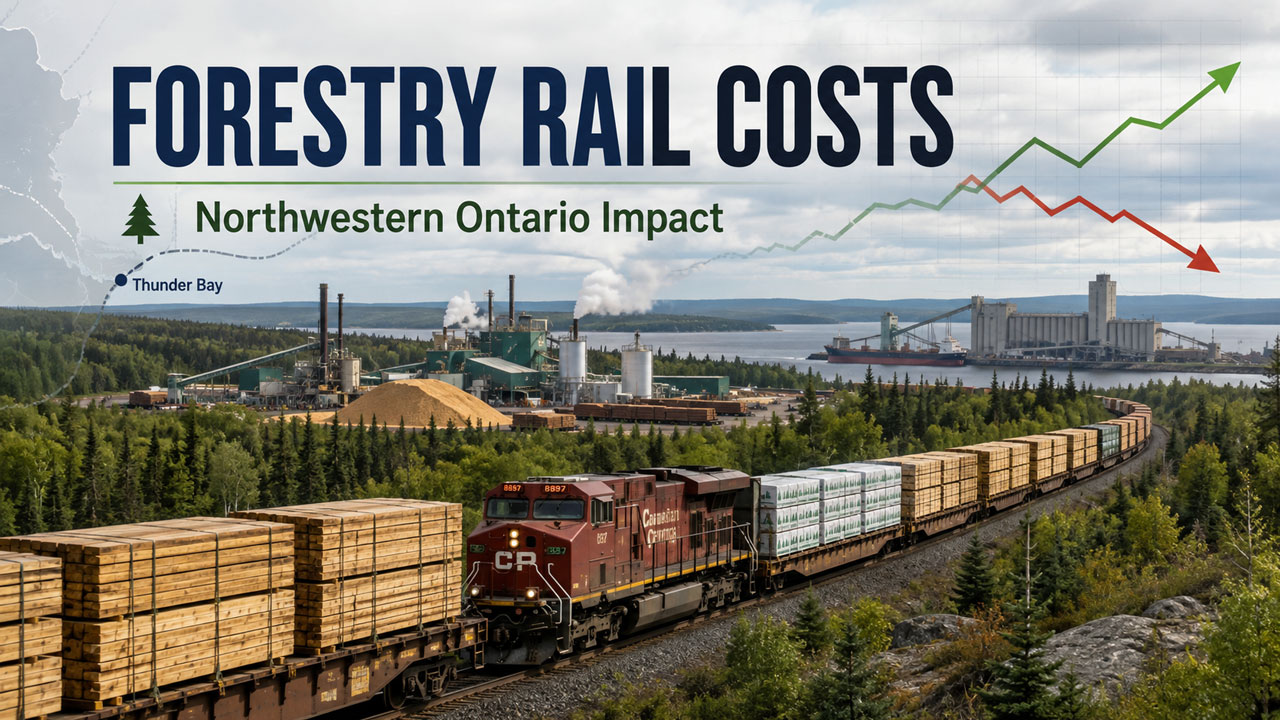
OTTAWA — Canada’s forest-products industry is urging the federal government to develop a forestry-specific approach to rail transportation costs and reliability, arguing that the sector faces different competitive pressures than steel and other heavy industries.
The Forest Products Association of Canada says Ottawa’s decision to move ahead with rail-freight support measures for Canadian steel is a positive sign that transportation costs are being recognized as a national competitiveness issue. However, FPAC says forestry requires its own long-term solution.
For Northwestern Ontario, where forestry remains an important employer and exporter, the issue is particularly significant. Mills are often located hundreds of kilometres from major markets, ports and border crossings, making reliable and competitively priced rail service critical to maintaining production and jobs.
Rail Costs a Major Issue for Canada’s Forest Sector
FPAC represents Canadian wood, pulp and paper producers and says the sector supports nearly 200,000 direct jobs in communities across the country.
The association argues that transportation costs are becoming increasingly important as Canada looks to expand domestic wood use, build more housing and infrastructure, and diversify export markets beyond traditional destinations.
According to FPAC, the average shipment of Canadian forest products travels roughly 1,200 kilometres over land before reaching its destination.
Nearly 90 per cent of mills represented by FPAC are served by only one railway, according to the association, leaving many producers with few practical alternatives for moving large volumes of lumber, pulp and paper over long distances.
FPAC Estimates Rail Costs at $2 Billion to $3 Billion Annually
FPAC estimates rail transportation costs can account for 20 to 25 per cent of the delivered value of a typical forest product.
Across the industry, the association estimates those costs amount to between $2 billion and $3 billion annually.
FPAC says that figure is roughly equivalent to 15 per cent of the forest sector’s annual real gross domestic product and approximately half of its current annual spending on capital investment and repairs.
Those numbers help explain why transportation policy can have a direct effect on whether Canadian mills can compete with producers in the United States and overseas.
Why Rail Matters in Northwestern Ontario
The transportation challenge is especially relevant across Northwestern Ontario.
Forest operations and mills are spread across a large geographic area, while major customers and export gateways can be hundreds or thousands of kilometres away.
Rail provides an essential connection between forest-product communities and customers in central Canada, the United States and overseas markets.
Thunder Bay also sits at an important junction between rail, road and marine transportation. The Port of Thunder Bay provides access to the Great Lakes-St. Lawrence Seaway system, while rail corridors connect the Lakehead with Western Canada, southern Ontario and U.S. markets.
For mills across Northwestern Ontario, transportation reliability can influence inventory levels, production schedules, export competitiveness and ultimately employment.
When rail service is delayed or transportation costs rise significantly, producers may have limited ability to switch to trucking because of distance, volume and cost.
FPAC Wants Long-Term Changes, Not Temporary Relief
FPAC president and CEO Derek Nighbor says the industry is looking for structural improvements rather than short-term subsidies.
“Canada’s railways are essential partners in moving forest products across the country and in helping us bring more Canadian forest products to the world,” Nighbor said.
He said FPAC welcomes federal recognition that forestry and steel operate under different market conditions and require different policy responses.
“We’re not looking for band-aid solutions here,” Nighbor said. “We’re looking for measures that will improve the system and cost competitiveness for the long-term.”
FPAC says governments in the United States, United Kingdom, Netherlands and Australia have introduced or examined policies aimed at encouraging rail use and addressing transportation costs.
The association wants Ottawa to explore similar approaches while working with railway companies and forestry producers.
Forestry Competitiveness Goes Beyond the Mill Gate
For Northwestern Ontario, the rail-cost debate comes at a time when the forest sector is already dealing with pressures from international trade, changing lumber markets, energy and labour costs and the need for continued investment in mills and equipment.
Transportation represents one part of that competitiveness equation.
A mill can operate efficiently at the production level but still face challenges if the cost of moving lumber, pulp or paper to customers makes the final product less competitive.
That challenge is magnified for Northern Ontario communities because of the distances involved.
Improving rail reliability could also support Ottawa’s broader goal of increasing the use of Canadian wood in housing and infrastructure projects.
If governments want more Canadian lumber and engineered wood products used in domestic construction, producers need dependable transportation systems capable of getting those materials from northern mills to growing urban markets.
Diversifying Export Markets Requires Reliable Transportation
FPAC is also tying transportation reform to Canada’s efforts to diversify exports.
The United States remains a crucial market for Canadian forest products, but ongoing trade uncertainty has increased pressure on producers and governments to develop additional markets overseas.
Expanding exports to Europe and Asia requires reliable connections between mills, railways and Canadian ports.
For Northwestern Ontario producers, that could mean moving products east or west by rail before they reach an ocean port, making transportation costs an important factor in whether new markets are economically viable.
Thunder Bay’s location on the Great Lakes also creates opportunities for marine transportation, although rail remains essential for moving many products between mills, terminals and customers.
Forest Sector Generated $19.9 Billion in Real GDP in 2025
FPAC says Canada’s forest-products sector contributed $19.9 billion in real GDP in 2025.
The association represents wood, pulp and paper producers in federal policy, trade and environmental discussions.
FPAC says its member companies are also working with Indigenous leaders, governments and other partners on forest health, employment, community sustainability and environmental management.
For Northwestern Ontario, where forestry has shaped communities for generations, the federal government’s next decisions on transportation policy could have significant consequences.
The central question will be whether Ottawa’s promised forestry-specific approach can reduce transportation costs and improve rail reliability without simply shifting costs elsewhere in the supply chain.
Source: Forest Products Association of Canada, Aug. 10, 2026.