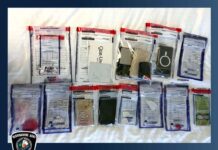
Three Charged After Thunder Bay Police Seize Suspected Drugs and Firearms on Finlayson Street
THUNDER BAY — A Thunder Bay Police Service drug trafficking investigation has resulted in the seizure of suspected fentanyl, crack cocaine, cocaine and two firearms from two homes on Finlayson Street. Police say the estimated street value of the drugs seized is approximately $19,755.
Police search two Finlayson Street homes
Thunder Bay Police Service says officers with the Emergency Task Unit and Intelligence Unit searched two residences as part of the investigation.
Police have connected the matter to occurrence numbers TB26020832 and TB26020814.
The seizure of suspected opioids, cocaine and firearms is significant for Thunder Bay and Northwestern Ontario, where police and health agencies continue to deal with the combined public safety risks of toxic drugs, organized trafficking activity and weapons.
Charges against David Cake
As a result of the investigation, David Cake, 47, of Thunder Bay, has been charged with:
- Possession of a firearm or ammunition contrary to a prohibition order, six counts;
- Possession of a Schedule I substance for the purpose of trafficking — cocaine;
- Possession of a Schedule I substance for the purpose of trafficking — opioid;
- Possession of proceeds of property obtained by crime over $5,000;
- Knowledge of unauthorized possession of a firearm, two counts;
- Careless storage of a firearm, weapon, prohibited device or ammunition, two counts;
- Unauthorized possession of a firearm, two counts;
- Possession of a prohibited or restricted firearm with ammunition.
Cake was remanded into custody following his first court appearance.
Charges against Douglas Shafranski and Saceriya Mohamed
Douglas Shafranski, 47, of Thunder Bay, and Saceriya Mohamed, 31, of Toronto, have each been charged with:
- Possession of proceeds of property obtained by crime under $5,000;
- Possession of a Schedule I substance for the purpose of trafficking — cocaine;
- Possession of a Schedule I substance for the purpose of trafficking — opioid.
Police say Shafranski and Mohamed were both released from custody with future court dates.
Criminal Code and CDSA context
Possession for the purpose of trafficking is covered under section 5(2) of the Controlled Drugs and Substances Act, which prohibits possessing a substance included in Schedule I, II, III, IV or V for the purpose of trafficking. For Schedule I or II substances, the offence is indictable and carries a maximum sentence of life imprisonment. Cocaine and fentanyl are listed under Schedule I of the Act.
Possession of a firearm or ammunition contrary to a prohibition order is addressed under section 117.01 of the Criminal Code. The section applies where a person is alleged to possess a firearm, firearm part, prohibited device, ammunition or related item while prohibited by court order or federal law from doing so. If prosecuted by indictment, the maximum penalty is 10 years in prison.
Unauthorized possession of a firearm is covered under section 91 of the Criminal Code. The offence applies where a person is alleged to possess a firearm without the required licence and, where applicable, registration certificate. If prosecuted by indictment, the maximum sentence is five years in prison.
Possession of a firearm knowing its possession is unauthorized is covered under section 92 of the Criminal Code. Unlike section 91, this offence requires proof of knowledge that the possession was unauthorized. It is an indictable offence with a maximum penalty of 10 years in prison.
Careless storage of a firearm, weapon, prohibited device or ammunition falls under section 86 of the Criminal Code. The section addresses careless use, handling, transport or storage, or storage contrary to regulations. If prosecuted by indictment, the maximum sentence is two years for a first offence and five years for a second or subsequent offence.
Possession of a prohibited or restricted firearm with ammunition is covered under section 95 of the Criminal Code. The offence applies to possession of a loaded prohibited or restricted firearm, or an unloaded prohibited or restricted firearm with readily accessible ammunition, without lawful authorization and registration. If prosecuted by indictment, the maximum sentence is 14 years in prison.
Possession of property obtained by crime is addressed under section 354 of the Criminal Code, with penalties set out in section 355. Where the value is more than $5,000, the maximum indictable sentence is 10 years in prison. Where the value is $5,000 or less, the maximum indictable sentence is two years in prison.
For offences punishable on summary conviction where no other penalty is provided, section 787 of the Criminal Codeallows for a fine of up to $5,000, imprisonment for up to two years less a day, or both.
Sentencing considerations
If there is a conviction, sentencing is determined by the court. Available penalties can range from non-custodial sentences in some cases to significant jail or penitentiary terms, depending on the charge, the Crown’s election, the facts proven in court, the accused’s prior record, the presence of firearms, the quantity and type of drugs, and any aggravating or mitigating factors.
Maximum penalties are not automatic sentences.
Presumption of innocence
None of the allegations has been tested in court. All accused persons are presumed innocent unless proven guilty.