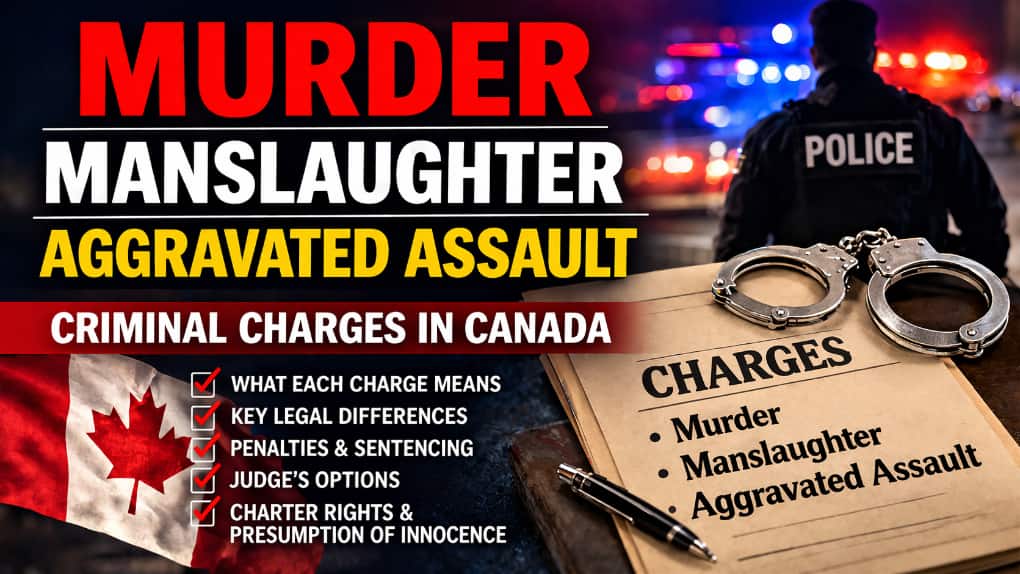
Explainer on murder, manslaughter and aggravated assault charges in Canada and their penalties
THUNDER BAY – LEGAL – When serious violent charges appear in headlines, the legal labels matter. Under Canada’s Criminal Code, murder and manslaughter are forms of culpable homicide, meaning cases where a person causes the death of another human being in circumstances the law treats as criminal.
Aggravated assault is different: it is a non-fatal violence offence that applies where a person wounds, maims, disfigures or endangers the life of the complainant.
How the Criminal Code separates these offences
Murder
Section 229 says culpable homicide is murder where the accused meant to cause death, or meant to cause bodily harm they knew was likely to cause death and was reckless about whether death followed. The section also captures certain cases where a person, pursuing an unlawful object, does something they know is likely to cause death and death results.
Section 231 then divides murder into first degree and second degree.
First-degree murder includes planned and deliberate killings, as well as some murders committed during listed offences such as sexual assault, kidnapping and hostage taking.
All murder that is not first degree is second degree.
Penalty for murder
On conviction for either first-degree or second-degree murder, a judge must impose life imprisonment. For first-degree murder, parole eligibility cannot begin until 25 years have been served. For second-degree murder, the sentence is still life imprisonment, but parole eligibility is set at no less than 10 years and no more than 25 years, depending on what the court orders under the Code.
Manslaughter
Section 234 defines manslaughter as culpable homicide that is not murder or infanticide. In practical terms, that means a death caused in criminal circumstances, but where the Crown cannot prove the legal elements required for murder.
The Code also says a homicide that would otherwise be murder may be reduced to manslaughter if it was committed in the heat of passion caused by sudden provocation, subject to the limits set out in section 232.
Penalty for manslaughter
Manslaughter is an indictable offence with a maximum penalty of life imprisonment. Where a firearm is used in the commission of the offence, section 236 sets a minimum sentence of four years and a maximum of life.
In other manslaughter cases, the Code still allows a sentence up to life imprisonment, but it does not set a general mandatory minimum in that section. If a life sentence is imposed for an offence other than murder, the Code provides for normal parole eligibility rather than the special murder rules.
Aggravated assault
Aggravated assault is one of the most serious assault charges short of homicide. Section 268 says it applies where the accused wounds, maims, disfigures or endangers the life of the complainant.
That makes it a more serious category than assault causing bodily harm or assault with a weapon under section 267, which covers bodily harm, use or threatened use of a weapon, or choking, suffocating or strangling.
Penalty for aggravated assault
A conviction for aggravated assault carries a maximum sentence of 14 years in prison. The offence is indictable only. Section 268 does not prescribe a general mandatory minimum sentence, which means the judge has discretion to impose a fit sentence up to that 14-year ceiling, subject to the Code’s sentencing rules and any required ancillary orders in the individual case.
What judges consider at sentencing
The Criminal Code says the purpose of sentencing is to protect society and maintain a just, peaceful and safe society. Judges must impose a sentence that is proportionate to the gravity of the offence and the degree of responsibility of the offender. They must also weigh aggravating and mitigating factors.
The Code specifically lists aggravating circumstances that can increase sentence severity, including hate motivation, abuse of an intimate partner or family member, abuse of a child, abuse of a position of trust, offences linked to criminal organizations and terrorism, among others. It also directs courts to consider all available sanctions other than imprisonment where reasonable, with particular attention to the circumstances of Indigenous offenders.
Why these distinctions matter in news coverage
For readers in Thunder Bay and Northwestern Ontario, the differences are not just technical. The gap between these offences is large: murder brings a mandatory life sentence, manslaughter can range widely up to life, and aggravated assault carries a maximum of 14 years. That is why two violent cases that may sound similar in early headlines can lead to very different charges, trials and sentences once intent, causation and the seriousness of the injuries are tested in court.
A final legal point
A charge is not a conviction. Under section 11(d) of the Canadian Charter of Rights and Freedoms, any person charged with an offence has the right to be presumed innocent until proven guilty according to law in a fair and public hearing by an independent and impartial tribunal.