Trade Advocacy or Election Interference? Canada–U.S. Dispute Raises Stakes for Ontario
Analysis: Washington’s accusations against Canadian politicians add uncertainty for border communities, but political pressure over tariffs does not automatically establish unlawful election interference
THUNDER BAY — POLITICS — October 22, 2026 — For Northwestern Ontario businesses, workers and families with connections across the American border, the latest dispute between Ottawa and Washington raises a practical concern: could an argument about election interference make an already difficult trading relationship worse?
The U.S. Embassy’s October 21 accusations bring Ontario Premier Doug Ford and federal Industry Minister Mélanie Joly directly into that dispute. Canadian officials say they are defending jobs and attracting investment. Washington is portraying their efforts to influence American trade policy as evidence of involvement in American politics.
The distinction matters. Governments routinely seek changes in other countries’ policies. Election-related financing and participation are governed by specific rules. Treating every attempt to change trade policy as election interference risks blurring those boundaries.
It also creates a political challenge for Canada: defending its economy while avoiding language or activities that suggest it is campaigning for a particular American electoral outcome.
What Washington alleges—and Ottawa’s response
The embassy issued a document titled Monitoring Canadian Activities in U.S. Politics, citing statements by Canadian officials as evidence of efforts to influence American politics. Canadian Press reporting identifies Joly and Ford among those quoted, including remarks about pressuring American businesses and targeting particular states in response to tariffs.
Ford denied an interest in interfering in American elections. Carney responded by emphasizing that the United States initiated the trade actions and that Canada’s response serves Canadian workers and families.
The material supplied for this article also records Joly saying her American visits were intended to attract investment. Her comments about meeting governors and potential presidential candidates nevertheless illustrate the communications risk: when trade advocacy is discussed in the context of an election outcome, opponents can portray it as partisan intervention.
The accusations arrive shortly before the November 3 U.S. federal election.
Influencing policy and influencing an election are different questions
Diplomacy involves persuasion. Canadian officials meet American officeholders, explain the consequences of tariffs and seek support for policies favourable to Canada.
An American governor can be a useful trade contact because of the businesses and workers in that state. The fact that the governor also has national political ambitions does not, by itself, establish improper conduct.
The United States has substantial restrictions on foreign involvement in elections. Federal Election Commission guidance prohibits foreign-national contributions and specified election-related spending, as well as participation in decisions about election-related activities. Its definition of foreign nationals includes foreign governments.
However, the FEC also distinguishes those restrictions from political activity unrelated to an election and discussion of public-policy issues. Its guidance cites a court decision recognizing a distinction between issue advocacy and spending expressly supporting or opposing a candidate’s election.
That is not blanket permission for every advertisement, meeting or lobbying campaign. The details—including content, financing, coordination and the applicable rules—matter.
An embassy statement is a diplomatic accusation. It should not be reported as a finding by an election regulator or court.
The material reviewed for this analysis does not establish a legal finding against Ford or Joly arising from these allegations.
Canada should apply a consistent standard
Canadian security guidance distinguishes foreign interference from normal diplomacy and acceptable foreign-state lobbying. It emphasizes covert, deceptive or coercive conduct. That Canadian framework does not determine American election law, but it helps explain why the word “interference” requires care.
Open disagreement with a government’s trade policy is different from secretly financing candidates, concealing the source of political messages or directing campaign activities.
At the same time, transparency alone does not make every action lawful. Canadian officials should be prepared to explain who paid for American-facing campaigns, what those campaigns sought to achieve and whether any coordination occurred with electoral organizations.
Canada’s strongest defence is a consistent one: advocate openly for Canadian interests, maintain relationships across party lines and leave American electoral choices to American voters.
Targeted tariffs create political pressure—but what kind?
Retaliatory tariffs are intended to impose costs that encourage the other government to reconsider its policy.
Selecting products associated with politically influential states can increase that pressure. It can also impose costs on Canadian importers and customers, which makes the choice of targets an economic decision as well as a political one.
There are two questions to separate:
- Is Canada trying to persuade Washington to change its trade policy?
- Is Canada undertaking prohibited activity to help elect or defeat particular candidates?
The first does not automatically establish the second.
Still, Canadian politicians weaken their own position when they describe trade measures in terms that appear to favour one party’s electoral fortunes. That language gives Washington an opening to shift attention from the consequences of tariffs to Canada’s intentions.
The practical lesson for Ottawa and Queen’s Park is to explain trade measures through their objectives, costs and expected benefits—and document the evidence behind those decisions.
For Northwestern Ontario, uncertainty is the immediate risk
The embassy’s statement does not itself announce a new tariff or border restriction. Residents should not interpret the accusation as an immediate change to travel or customs requirements.
The concern is what could follow if the dispute hardens negotiating positions.
For an exporter, uncertainty can complicate pricing and long-term contracts. For an importer, it can affect decisions about inventories and suppliers. For a business considering new machinery or hiring, it can make waiting appear safer than investing.
Those are potential consequences, rather than measured local losses attributable to this week’s statement.
Northwestern Ontario also has a different economic profile from Ontario’s automotive manufacturing centres. Local analysis needs to examine forestry, mining services, transportation, tourism and other cross-border business relationships on their own terms.
The experience of an auto-parts manufacturer in southern Ontario cannot simply be applied to every Thunder Bay business.
The $8.7-billion package is a response to economic vulnerability
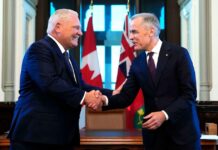
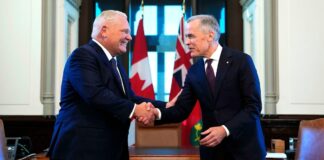
The dispute unfolded as Carney and Ford announced an $8.7-billion industrial support package covering steel, automotive manufacturing and critical-mineral infrastructure.
The commitments include a $5.22-billion steel fund, $2.5 billion in additional automotive capital support and up to $1 billion in federal funding for Ring of Fire roads.
Politically, the agreement shows federal and provincial cooperation despite their different party affiliations.
Economically, it reflects an effort to make Canadian industries less vulnerable to decisions in Washington. The federal backgrounder identifies production changes, overseas markets, domestic purchasing and critical-mineral infrastructure among the priorities.
For Northwestern Ontario, infrastructure investment could create opportunities. It will take project agreements, approvals, construction and commercial activity to turn those commitments into measurable benefits.
Public spending can help businesses adjust. It cannot guarantee access to American customers or eliminate uncertainty about future U.S. policy.
The Hoekstra petition is political evidence, not a national poll
A House of Commons petition, e-7531, calls for U.S. Ambassador Pete Hoekstra to be declared persona non grata. Its allegations include statements petitioners consider damaging to Canada–U.S. relations. Those remain the petitioners’ claims.
The supplied account places support above 280,000 signatures. That current total could not be independently confirmed from the parliamentary page during this review.
Even a large petition measures participation by people motivated to sign. It is not a representative survey of Canadians.
The associated controversy over American contacts with Alberta separatists also demands careful evidence. Allegations about one country’s conduct do not settle allegations about the other’s. The same questions should apply in both directions: what happened, who funded or directed it, and which rules were engaged?
What deserves attention before November 3
The next developments worth watching are concrete:
- Whether Washington produces further evidence or announces formal proceedings.
- Whether Canadian officials provide fuller context for the statements cited.
- Whether either government changes tariffs, negotiating positions or trade rules.
- Whether Canadian outreach continues across Republican and Democratic political networks.
- Whether industrial support reaches businesses through clear agreements and timelines.
The strongest Canadian approach combines firm advocacy with disciplined conduct. Ottawa and Queen’s Park can explain how tariffs affect workers, seek investment and build relationships without making Canada’s economic strategy dependent on one American party winning.
For Ontario’s border communities, the test is whether diplomacy protects reliable trade and investment. Escalating accusations make that work harder. Clear evidence, predictable rules and continued communication offer a more useful path forward.