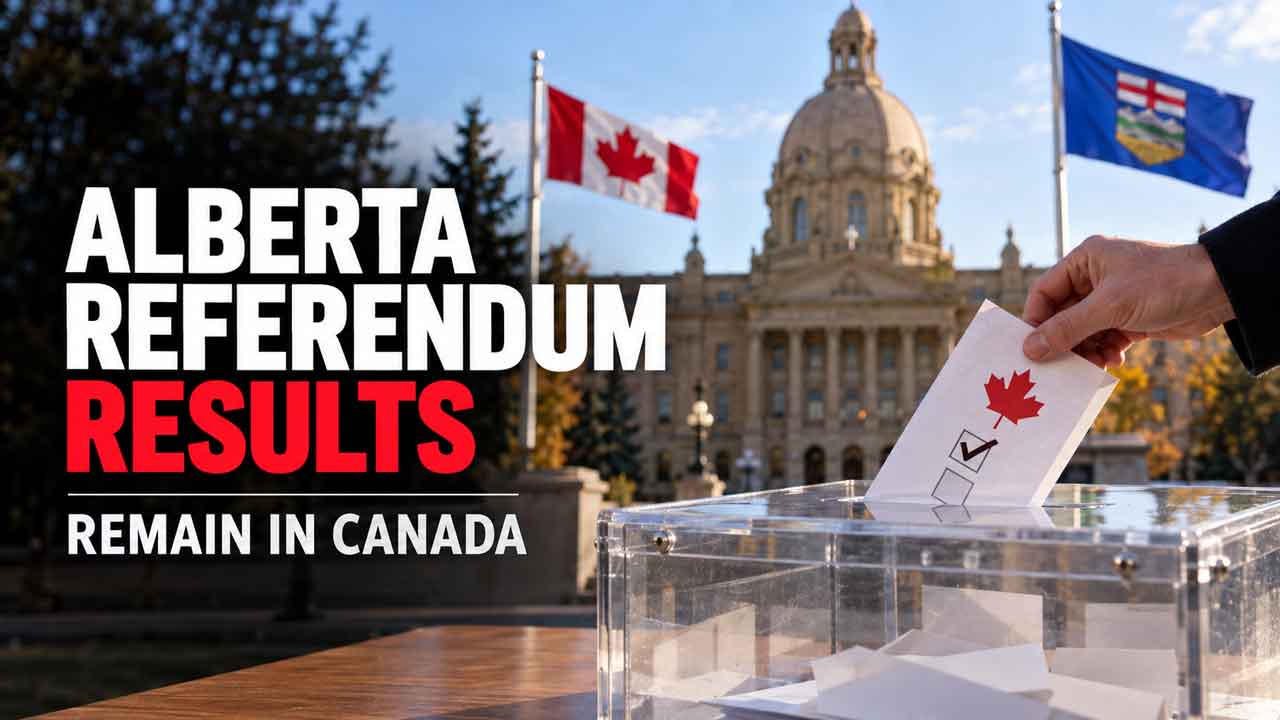
Alberta Referendum Results: Voters Reject Separation Path, but Back Greater Provincial Control
EDMONTON — October 20, 2026 — Alberta voters have rejected a proposal to begin the constitutional process that could lead to a future referendum on separation from Canada.
Early unofficial results from the October 19 referendum show approximately 76 per cent support for remaining a province of Canada and about 24 per cent support for beginning the legal process toward a future separation vote.
The question was not a direct vote on independence. It asked whether the Alberta government should start the process required to hold a later, binding referendum on separation.
The result is a significant political setback for Alberta separatists and a victory for Prime Minister Mark Carney’s campaign for national unity.
However, the other nine questions on the ballot show that many voters also support a stronger Alberta role in immigration, public services and constitutional negotiations with Ottawa.
It is also perhaps a real indication of how much over the past twenty years how Alberta has changed. The robust economy has attracted Canadians from across the country. The political environment has changed. Throughout the past century, Alberta was governed by a long-time Social Credit government, then almost half a century of Progressive Conservative government. Since then there has been a New Democrat government, the Progressive Conservative Party is virtually gone. However as the vote to leave shows the far right in Alberta doesn’t have the political muscle it once did, or thought it did.
Results remain unofficial
Elections Alberta says the official results will be released on October 29, 2026, at 10 a.m. Until then, the vote totals may change as election officials complete counts and verify ballots.
Election officials also warned that counting was delayed at some voting locations. In one southern Alberta polling area serving Siksika Nation, high turnout and a shortage of ballots contributed to extended voting hours.
The figures below are an unofficial snapshot reported as counting continued. The number of ballots counted varied from question to question.
| Question | Unofficial result reported | Approximate share of counted votes |
|---|---|---|
| Question 10: Remain in Canada or begin the separation process | Remain: 1,213,088; separation process: 386,557 | Remain 75.8%; process 24.2% |
| Question 1: Greater provincial control over immigration | Yes: 509,328; No: 358,580 | Yes 58.7% |
| Question 2: Limit provincial program eligibility | Yes: 433,869; No: 325,594 | Yes 57.1% |
| Question 3: Twelve-month residency requirement for some supports | Yes: 393,318; No: 284,643 | Yes 58.0% |
| Question 4: Fees or premiums for some non-permanent residents | Yes: 329,469; No: 250,035 | Yes 56.9% |
| Question 5: Proof of citizenship to vote | Yes: 319,476; No: 189,510 | Yes 62.8% |
| Question 6: Provincial selection of some judges | Yes: 229,244; No: 222,667 | Yes 50.7% |
| Question 7: Abolish the Senate | Yes: 198,367; No: 172,383 | Yes 53.5% |
| Question 8: Opt out of federal programs while keeping funding | Yes: 175,113; No: 173,213 | Yes 50.3% |
| Question 9: Give provincial laws priority in some conflicts | Yes: 190,755; No: 173,113 | Yes 52.4% |
What the separation question meant
Question 10 asked voters to choose between two options:
- Alberta should remain a province of Canada; or
- The Alberta government should begin the constitutional process required to hold a binding provincial referendum on whether Alberta should separate from Canada.
Elections Alberta states that this question was not binding. A vote for the second option would not have made Alberta independent and would not, by itself, have created a binding separation referendum. It would have directed the provincial government to begin a legal and political process.
The decisive lead for remaining in Canada means there is no immediate provincial mandate to begin that process. Alberta remains part of Canada, and no change to the province’s constitutional status follows from the unofficial vote.
Immigration questions receive majority support
Questions 1 through 4 dealt with immigration and access to provincial programs.
Question 1 asked whether Alberta should seek greater control over immigration, reduce immigration to what the question called more sustainable levels, prioritize economic migration and give Albertans first priority for new employment opportunities.
The early count showed roughly 59 per cent support. That result gives Premier Danielle Smith’s government a political argument for pressing Ottawa for a larger role, although the question itself does not amend Canadian immigration law.
Questions 2, 3 and 4 addressed eligibility and waiting periods for some provincial programs. They proposed restricting access to provincially funded services for people without permanent status, requiring some non-permanent residents to live in Alberta for 12 months before qualifying for social supports, and allowing fees or premiums for certain health-care and education services.
All three questions led on the Yes side in the early count. Their wording, however, does not itself create new legislation. Any changes would still have to be drafted, debated and tested against provincial, federal and constitutional law.
Citizenship identification question leads
Question 5 asked whether people should be required to provide proof of Canadian citizenship, such as a passport, birth certificate or citizenship card, to vote in an Alberta provincial election.
The Yes side held the strongest lead among the first five policy questions, with nearly 63 per cent of reported votes. If the government proceeds, it would need to establish the rules, acceptable documents and procedures for voters who do not have immediate access to citizenship records.
The question concerns Alberta provincial elections. It does not directly change federal voting rules or the rules used in municipal elections outside Alberta.
Constitutional questions were much closer
Questions 6 through 9 asked whether Alberta should work with other provinces to seek constitutional amendments. The subjects included provincial involvement in selecting judges, abolishing the Senate, opting out of federal programs while retaining associated funding, and giving provincial laws priority in some areas of shared jurisdiction.
Unlike Question 10, these were not questions about immediate separation. They were proposals to pursue constitutional negotiations with other provinces and the federal government.
The early results were considerably closer than the immigration questions. Questions 6 and 7 showed narrow Yes leads. Question 8 was nearly tied, while Question 9 also remained close. The margins could change as more ballots are counted.
The narrow results suggest that voters were more divided over constitutional reform than over the question of whether Alberta should remain in Canada.
What the result means for Danielle Smith
Premier Danielle Smith called the referendum while facing pressure from separatist groups within and outside the United Conservative Party. Smith has said she supports Alberta remaining in Canada, but argued that the province needed a public mandate on immigration, provincial powers and its relationship with Ottawa.
The result allows Smith to say that Albertans support a stronger provincial voice without giving separatists the outcome they wanted. At the same time, the strong Yes votes on several immigration questions may increase pressure on her government to pursue policy changes.
Separatist leaders have indicated that the movement will continue despite the defeat. Reuters reported that the campaign’s supporters view the vote as part of a longer political effort rather than a final test of the movement.
Carney claims national unity victory
Prime Minister Mark Carney welcomed the early result, saying Albertans had chosen to remain within Canada. His campaign linked the vote to the country’s wider economic and political challenges, including the trade dispute with the United States and pressure to develop new energy and transportation links.
Carney has argued that Alberta’s energy resources, skilled workers and economic strength are central to a stronger Canada. He is expected to use the result to press for cooperation on trade diversification, infrastructure and energy development.
The vote does not erase Alberta’s longstanding complaints about federal energy policy, equalization, immigration and the distribution of political power. It does, however, show that those grievances did not produce majority support for beginning a separation process.
Indigenous rights remain a central issue
The referendum also raised questions about Treaty rights, Indigenous sovereignty and the constitutional role of First Nations.
The Supreme Court of Canada and the federal Clarity Act establish that a province cannot unilaterally leave Canada. Any lawful secession would require constitutional negotiations involving the federal government and the provinces, while also considering Indigenous rights and minority protections.
First Nations leaders have argued that their treaties are agreements with the Crown and Canada, not simply with the Province of Alberta. That means any future discussion of separation would have to address treaty obligations, land rights, borders, governance, assets, debt and the status of Indigenous peoples.
The Clarity Act specifically requires the House of Commons to consider the views of Indigenous representatives when assessing whether a referendum has produced a clear expression of support for secession.
What happens next
The immediate next step is the completion of the count and the official announcement scheduled for October 29.
After that, Premier Smith will face pressure from several directions:
- Separatists may demand that the movement continue despite the result.
- Federalists will call for an end to separation campaigning and a focus on economic cooperation.
- Immigration advocates and affected communities will watch to see whether the government introduces legislation based on Questions 1 through 4.
- Constitutional experts will examine whether any proposed changes can be implemented without federal negotiations.
- First Nations will continue to insist that treaty rights and Indigenous consent cannot be treated as secondary issues.
Why the vote matters beyond Alberta
For the rest of Canada, the referendum provides a short-term measure of national unity. The result is a clear rejection of beginning a separation process, but it is not a declaration that all Albertans are satisfied with the federal government.
For Northwestern Ontario, Alberta’s vote matters because the region is connected to national trade, transportation, energy and resource-development decisions. A prolonged constitutional dispute could have affected investment confidence, interprovincial trade and federal attention to major infrastructure projects.
Mining, forestry, transportation and construction companies in Northwestern Ontario also operate in a national market. Continued federal-provincial cooperation is important for ports, railways, highways, critical minerals and energy corridors linking Western Canada with Ontario and international markets.
The early referendum result reduces the immediate risk of a new constitutional crisis. It does not end the political debate over federalism, resource development or the balance of power between Ottawa and the provinces.
Bottom line
Alberta voters have chosen to remain in Canada and have rejected, by a wide margin in the early count, the proposal to begin a separation process. At the same time, voters have signalled support for tighter immigration controls, citizenship identification rules and a stronger provincial role in negotiations with Ottawa.
The final results are still pending. The political debate that produced the referendum is likely to continue, but the vote has not set Alberta on a legal path to independence.