Carney and Ford Announce $8.7-Billion Industry Plan, Including Ring of Fire Road Funding
Steel and automotive investments aim to counter U.S. tariff pressure, while Northern Ontario receives a federal infrastructure commitment of up to $1 billion
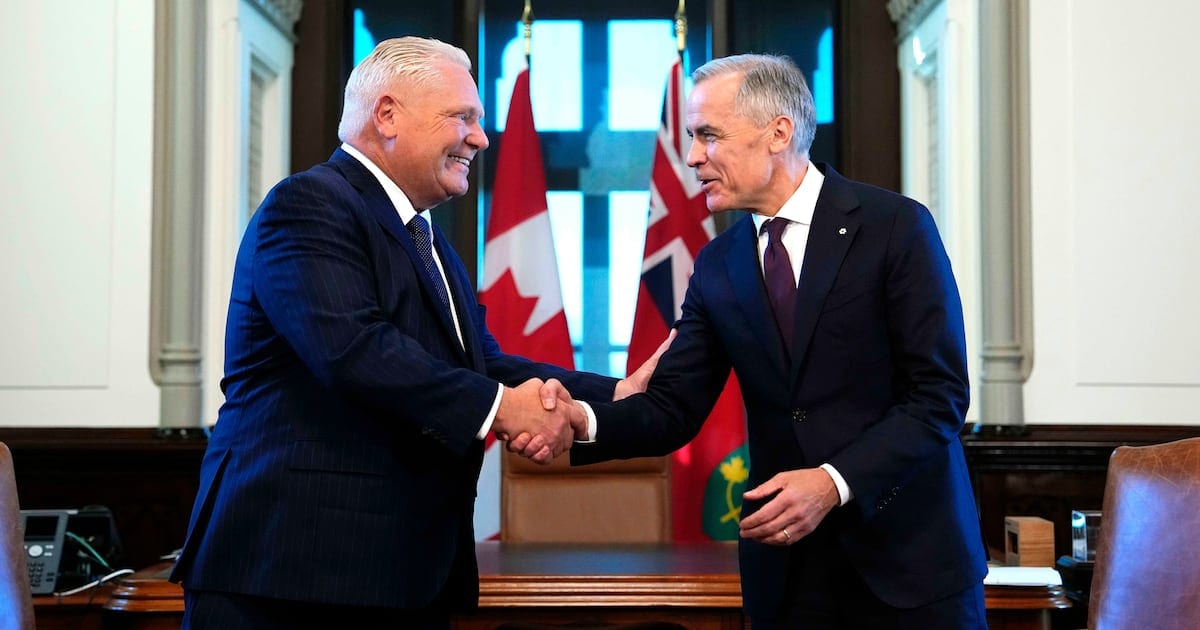
OTTAWA — POLITICS — Prime Minister Mark Carney and Ontario Premier Doug Ford have announced an $8.7-billion package intended to strengthen steelmaking, automotive manufacturing and critical mineral development as Canadian industries contend with U.S. tariffs.
Unveiled October 21, the agreement includes a five-year steel fund, additional automotive investment and federal support for roads into Northern Ontario’s Ring of Fire. The governments describe the package as an effort to protect workers while expanding domestic production and overseas markets.
For Thunder Bay and Northwestern Ontario, the road funding is the announcement’s most direct regional component. Its economic significance will depend on which projects proceed, how First Nations participate and whether construction generates lasting regional business opportunities.
How the funding breaks down
The announced commitments total approximately $8.72 billion, rounded to $8.7 billion by the governments.
| Investment | Federal commitment | Ontario commitment | Timeframe |
|---|---|---|---|
| Joint Steel Action Fund | $3.55 billion | $1.67 billion | Five years |
| Additional automotive capital support | Up to $1.5 billion | Up to $1 billion | Two years |
| Ring of Fire roads | Up to $1 billion | Matches an earlier provincial commitment of up to $1 billion | Federal funding over three years |
Ontario’s steel and automotive contributions total $2.67 billion. Its previously announced Ring of Fire commitment is separate from that amount and should not be counted again as new funding within the $8.7-billion announcement.
Steel fund targets production, markets and purchasing
The $5.22-billion Joint Steel Action Fund is intended to help mills diversify their products and supply industries such as defence, advanced manufacturing, energy and infrastructure.
Ottawa and Ontario also plan to use their domestic purchasing policies to strengthen demand for Canadian steel. A joint task force will examine competitiveness, including transportation costs, while federal border enforcement will target unfairly traded imports.
For workers and suppliers, the practical questions concern which facilities receive support, what production changes are funded and whether those investments preserve employment.
A funding commitment establishes the resources available. Contracts, completed upgrades and sustained orders will determine its results.
Automotive support includes regulatory flexibility
The additional $2.5 billion for automotive capital projects is intended to support modern machinery and production lines for connected and electrified vehicles.
The federal government also announced that the fleet-average greenhouse gas performance standard for new light-duty vehicles will remain at its 2026 level of 172 grams per mile through the 2029 model year. The planned annual tightening resumes with the 2030 model year.
Ottawa says the pause gives manufacturers flexibility during trade-related disruption. A joint automotive task force will coordinate implementation of the sector’s measures.
These are investments and policy changes aimed at supporting employment. They should not be interpreted as guarantees that particular plants or every existing position will be protected.
Ring of Fire commitment puts Northern Ontario in the national strategy
Ottawa’s commitment of up to $1 billion over three years is directed toward essential road infrastructure supporting Ring of Fire development.
The agreement also proposes coordinated federal and provincial permitting and a process to identify priority projects eligible for other funding tools. A federal-provincial working group will support First Nations consultation and engagement, including consideration of conservation and Indigenous protected areas.
For Thunder Bay businesses, potential opportunities include engineering, transportation, construction, equipment maintenance and other services connected to northern development. Those opportunities remain dependent on project approvals, procurement decisions and actual construction.
The announcement does not establish that every proposed road or mine is approved. Nor does the creation of a government working group establish agreement among affected First Nations.
Regional readers should watch for project-specific funding agreements, Indigenous partnership arrangements and clear construction milestones.
Political cooperation now faces a delivery test
The agreement places Carney and Ford behind a common industrial strategy: increase Canadian production, reduce exposure to trade disruption and connect northern resources with manufacturing.
Its success will be measured beyond the headline investment.
Workers need to see employment retained and new production secured. Businesses need accessible funding programmes and predictable decisions. Northern communities need infrastructure that delivers durable benefits, with meaningful participation in the decisions shaping their future.
The announcement sets multi-year funding windows, but the documents reviewed do not provide a complete list of recipients, individual allocations or a single application process covering the entire package.
For Northwestern Ontario, the next significant news will be which road projects receive funding, when that funding becomes available and how communities and regional companies participate.
Mark Carney, Doug Ford, Ontario politics, Canadian politics, Ring of Fire, Thunder Bay, Northern Ontario, steel industry, automotive industry, U.S. tariffs, critical minerals, infrastructure