Northwestern Ontario Wildfire Update: Seven New Fires Confirmed, 62 Active Across Region
THUNDER BAY — WILDFIRE UPDATE — Seven new wildland fires were confirmed across Northwestern Ontario since the previous update, bringing the regional total to 62 active fires as of 6 p.m. CDT on Sept. 3.
Six of the seven new fires remain not under control. One, Dryden 68 near Daniels Lake, has been extinguished.
The large Rinker Complex, made up of Thunder Bay 36, Dryden 34 and Dryden 35, also remains classified as not under control, although fire activity has stayed relatively low in recent days.
Seven New Fires Confirmed Across Northwestern Ontario
The new fires are:
- Dryden 68 — near Daniels Lake, about seven kilometres north of Highway 17. The 0.1-hectare fire is now out.
- Nipigon 108 — near Eskwanonwatin Lake, about 21 kilometres west of Highway 585. The 0.5-hectare fire is not under control.
- Fort Frances 69 — near Highway 502, about two kilometres northwest of Bearpaw Lake. The 0.1-hectare fire is not under control.
- Fort Frances 70 — about one kilometre west of Laver Lake near Highway 502. The 0.1-hectare fire is not under control.
- Fort Frances 71 — near the east end of Bearpaw Lake, about four kilometres east of Highway 502. The 0.1-hectare fire is not under control.
- Fort Frances 72 — south of Bearpaw Lake, about 4.5 kilometres east of Highway 502. The 0.1-hectare fire is not under control.
- Thunder Bay 86 — on an island in Max Lake, about one kilometre west of Highway 527. The 0.1-hectare fire is not under control.
At the time of the update, the 62 active wildland fires in the Northwest Region included:
- nine not under control;
- three being held;
- 12 under control; and
- 38 being observed.
Rinker Complex Remains Not Under Control
All three fires in the Rinker Complex remain classified as not under control.
Ontario’s Aviation, Forest Fire and Emergency Services notes that the classification can cover a wide range of fire behaviour.
Recent activity across the complex has remained on the lower end of that range, although smoke is still visible in some areas.
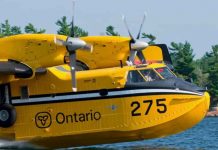
Fire crews continue to suppress hotspots with support from helicopter bucketing operations while equipment is being removed where it is no longer required.
The three fires are:
- Thunder Bay 36 — 301,240 hectares
- Dryden 34 — 45,800 hectares
- Dryden 35 — 30,158 hectares
Together, the fires have burned more than 377,000 hectares.
NOTAM Remains in Effect Near Thunder Bay 36
A Notice to Airmen remains in effect around Thunder Bay 36.
Pilots are reminded that this restriction is in addition to the standard airspace protections around active forest fires.
Under Canadian Aviation Regulations, airspace within five nautical miles of an active forest fire and up to 3,000 feet above ground level is restricted to authorized forest-fire suppression aircraft.
Pilots should check current NOTAM information through NAV CANADA’s flight-planning services before operating in affected areas.
Unauthorized aircraft, including drones, can pose serious risks to fire crews and may force firefighting aircraft to suspend operations.
Fire Hazard Conditions Can Change Quickly
Forest-fire danger ratings vary across Northwestern Ontario and can change during the day as temperature, humidity, wind and precipitation conditions shift.
Residents, campers, hunters and people working in remote areas should check current conditions before burning or travelling into fire-affected areas.
Late summer and early fall can still produce rapidly changing fire conditions, particularly during dry and windy periods.
Outdoor Burning Rules Remain in Effect
Ontario’s legislated fire season continues until Oct. 31.
Aviation, Forest Fire and Emergency Services is reminding residents to consider alternatives such as composting or using local landfill services rather than burning yard waste or woody debris.
Where outdoor burning is permitted, fires may be lit no earlier than two hours before sunset and must be extinguished no later than two hours after sunrise.
Anyone burning outdoors should have adequate water and tools available to control the fire.
Residents within municipal boundaries should also check with their local fire department for additional burning restrictions or permit requirements.
How to Report a Wildland Fire
To report a wildland fire north of the French and Mattawa rivers, call:
310-FIRE (3473)
For fires south of those rivers, call 911.
Residents should not approach an active wildfire or attempt to fight a fire that is beyond their ability to control safely.
What Northwestern Ontario Residents Should Watch
The new cluster of small fires near Highway 502 and Bearpaw Lake deserves monitoring because four Fort Frances District fires were confirmed in a relatively concentrated area.
Thunder Bay 86, near Highway 527, is also a local watch point for residents and travellers north of Thunder Bay.
The Rinker Complex remains the region’s largest active wildfire concern, even though current fire behaviour has been relatively subdued.
September conditions can still change quickly, and the region remains in active fire season for nearly two more months.