Mining news Aug. 27: copper, Ring of Fire, Red Lake gold, lithium and major drilling updates
THUNDER BAY — MINING NEWS — Copper prices approaching record territory, a renewed international race to secure critical-mineral supply, new Ontario support for domestic cobalt refining and accelerating infrastructure work toward the Ring of Fire are among the mining stories to watch Thursday, Aug. 27, 2026.
For Northwestern Ontario, the most consequential developments are increasingly tangible. Ring of Fire road projects are moving into construction, West Red Lake Gold Mines is reporting improving production and costs at the Madsen Mine, Frontier Lithium continues to advance a lithium mine-and-processing strategy with a proposed downstream facility in Thunder Bay, and Storm Exploration has fresh financing ahead of drilling north of Fort Frances.
Across the exploration sector, drills are also turning for copper, tungsten, uranium, gold, nickel and potash. Investors and industry watchers should distinguish between laboratory assays and preliminary visual, geological or radiometric observations as companies report results.
Copper Near Record Highs as Trade Policy Reshapes the Global Mining Market
Copper remains one of the most important international mining stories entering Thursday.
Three-month copper on the London Metal Exchange reached as high as US$14,343 per tonne this week, putting it close to the record of US$14,527.50, according to Reuters. The unusual feature of the current rally is that analysts do not necessarily see an outright global shortage.
Instead, threatened U.S. tariffs on refined copper are changing where available metal is being stored.
Traders have been moving large quantities of copper into the United States to take advantage of higher prices and position inventories ahead of possible tariffs. Reuters reports U.S. COMEX inventories have climbed to record levels while available inventories elsewhere have tightened.
That matters for Northwestern Ontario.
Copper is central to electrical transmission, electric vehicles, renewable generation, data centres and defence manufacturing. Persistently high prices can improve the economics of Canadian copper exploration projects, including projects in Ontario, while also increasing the cost of electrical infrastructure required to develop remote mines.
The situation is a reminder that mineral prices are increasingly being influenced by trade and national-security policy as well as traditional supply and demand.
International — Argentina and Chile Revive Cross-Border Mining Push
South America could become even more important to the future copper market.
Argentina and Chile are reviving a 1997 mining integration treaty intended to make it easier to develop projects that cross or sit close to their shared border.
Officials say the framework could help unlock more than US$20.7 billion in mining investment and ultimately add about 540,000 tonnes of annual copper production, according to Reuters.
Projects that could benefit include McEwen Copper’s Los Azules, Glencore’s El Pachón and Vicuña, the copper project associated with Lundin Mining and BHP.
The potential advantage is infrastructure.
Large Argentine copper projects close to the Andes could gain access to Chilean ports, roads, power systems or water infrastructure rather than building every component independently.
Argentina has not produced copper since the Alumbrera mine closed in 2018, but its development pipeline could put the country among the world’s major copper producers during the next decade.
For Ontario, the message is competitive.
Mining jurisdictions are increasingly competing not simply on geology, but on roads, electricity, permitting timelines, Indigenous partnerships, processing capacity and access to export infrastructure.
That puts the construction of northern Ontario transportation and energy corridors into a much larger global context.
International — Gold Holds Near US$4,600 as Mining Margins Strengthen
Gold remains another powerful force behind Canadian mining activity.
Spot gold was trading around US$4,600 per ounce Thursday morning, with investors awaiting comments from U.S. Federal Reserve Chair Kevin Warsh. Reuters reports bullion continues to receive support from concerns over government debt, currencies and geopolitical uncertainty.
Those prices are having a direct impact on mining company financial results.
South Africa’s Harmony Gold reported an 87 per cent increase in annual profit Thursday, helped by a 35 per cent increase in its average realized gold price even as production declined.
Northwestern Ontario is particularly sensitive to the gold cycle.
Red Lake remains one of Canada’s best-known gold camps, while significant exploration continues around Dryden, Pickle Lake, Sioux Lookout, Fort Frances and other parts of the Northwest.
High gold prices can generate stronger cash flow at operating mines and make marginal deposits more attractive. They can also make financing easier for exploration companies.
However, high commodity prices do not eliminate geological, construction, permitting, labour or cost risks.
International — Critical Minerals Competition Keeps Accelerating
The geopolitical competition surrounding critical minerals is broadening beyond simply opening new mines.
Brazilian mining giant Vale is studying whether rare earth elements, gold and other valuable minerals can be recovered from existing mining waste, Reuters reported Thursday.
The development highlights a growing industry focus on extracting additional value from tailings and historical waste while potentially reducing the environmental footprint required to produce some minerals.
At the same time, Washington announced US$500 million in support last week for U.S. lithium, cobalt and battery-material projects as the United States attempts to reduce its reliance on Chinese-controlled mineral supply chains.
For Canada, the strategic question is becoming increasingly clear: Can Canadian mines be connected to Canadian processing quickly enough to remain a central part of the emerging North American supply chain?
National — Ontario Finalizes $17.5 Million for Electra Cobalt Refinery
Electra Battery Materials has finalized agreements with Invest Ontario for $17.5 million toward construction of its cobalt sulphate refinery in Temiskaming Shores.
Construction is underway, including structural steel, concrete, equipment installation and piping.
Electra says selected commissioning activities are targeted to begin during the fourth quarter of 2026, followed by mechanical completion in the second quarter of 2027 and commercial production in the fourth quarter of 2027.
The facility is designed to initially produce 5,120 tonnes of contained cobalt annually, with crystallizer capacity of as much as 6,500 tonnes.
Electra has also secured the cobalt feedstock it says is required for commissioning and ramp-up through 2027 under an agreement with Glencore.
If completed as planned, the facility is expected to become North America’s only refinery producing battery-grade cobalt sulphate.
That makes this more than a single-company development.
Ontario is attempting to establish a mine-to-processing-to-manufacturing critical-minerals chain rather than simply exporting raw mineral concentrate.
For Northwestern Ontario, that strategy parallels proposals involving lithium, nickel, copper and chromite.
The biggest economic opportunity for Northern Ontario could ultimately come from combining mineral production with processing, transportation, engineering, fabrication and other value-added activities.
Regional — Ring of Fire Roads Move Into the Construction Era
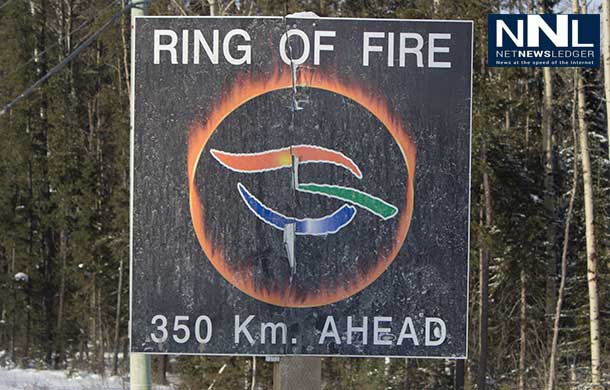
The Ring of Fire remains the largest long-term mining infrastructure story in Northern Ontario.
Ontario and Aroland First Nation announced this week that work is underway on major upgrades to the Anaconda and Painter Lake roads.
Work began June 30 and is expected to include upgrades along about 97 kilometres of roadway, including replacement of 62 culverts, bridge and drainage improvements, widening and realignment.
The roads would eventually help connect Highway 643 toward a proposed all-season road network serving the Ring of Fire.
Construction of the Webequie Supply Road began in June. Ontario says construction of the Marten Falls Community Access Road is scheduled to begin in August, while the Northern Road Link is targeted to begin in spring 2028, subject to required approvals and consultation.
The distinction between work underway and work scheduled to begin remains important.
The Ring of Fire has been promoted by successive governments for more than a decade because of its mineral potential, particularly chromite, nickel, copper and other critical minerals.
Infrastructure, environmental assessment, financing and Indigenous rights have remained central to whether mines can actually be developed.
First Nations also do not hold one uniform position on Ring of Fire development. Aroland, Webequie and Marten Falls First Nations are advancing specific infrastructure initiatives, while other Indigenous communities have raised concerns involving Treaty rights, cumulative environmental effects, consultation, jurisdiction and the pace of development.
For Thunder Bay, a functioning all-season transportation network could generate opportunities in construction, mine supply, aviation, environmental services, engineering, transportation, training and mineral processing.
Regional — Madsen Mine Posts Higher Gold Production and Lower Costs
West Red Lake Gold Mines is reporting improving results from the Madsen Mine in the Red Lake mining district.
Gold production increased 51 per cent quarter over quarter to 8,576 ounces during the second quarter, compared with 5,667 ounces during the first three months of 2026.
Gold sales increased 34 per cent to 8,260 ounces, while revenue reached approximately $49 million.
The company reported all-in sustaining costs of US$3,284 per ounce, down 30 per cent from US$4,678 during the previous quarter.
West Red Lake Gold also reported $9.7 million in positive free cash flow during the quarter.
The company mined 75,524 tonnes during Q2, a 46 per cent increase from the previous quarter, with the average mined grade increasing to 4.3 grams per tonne gold.
Madsen’s ramp-up deserves close attention because restarting a previously operating underground mine is not simply a matter of turning equipment back on. Mine sequencing, underground development, grade reconciliation, labour productivity and mill throughput all have to stabilize.
West Red Lake Gold says it expects processing rates to increase toward approximately 1,000 tonnes per day during the second half of the year.
For Red Lake and Northwestern Ontario’s mining-service sector, consistent production growth would be economically significant.
Regional — Frontier Lithium Keeps Thunder Bay in the Critical Minerals Picture
Frontier Lithium’s latest quarterly filing is another important regional development because the company’s PAK Lithium Project includes plans for downstream processing in Thunder Bay.
Frontier reported approximately $20.9 million in cash and cash equivalents as of June 30, following a $15-million bought-deal financing completed in April.
The company says work continues on permitting, infrastructure, environmental baseline studies and technical development of the PAK project.
PAK is being advanced through a joint venture owned 92.5 per cent by Frontier Lithium and 7.5 per cent by Mitsubishi Corp.
The integrated proposal includes a mine and mill in Northwestern Ontario along with a downstream lithium conversion facility in Thunder Bay.
Frontier’s 2025 feasibility study outlined a projected 31-year mine life and an after-tax net present value of approximately $932 million using an eight per cent discount rate. Those figures are company estimates based on feasibility-study assumptions and should not be interpreted as guaranteed economic outcomes.
For Thunder Bay, the downstream plant remains the most important element.
Northern Ontario has historically exported significant quantities of raw resources. A lithium conversion facility would represent an effort to keep a larger share of the processing value chain within the region.
Regional Drilling Watch — Storm Exploration Raises $2 Million Ahead of Fort Frances Program
Storm Exploration is moving toward a new drilling program at its Gold Standard Project, approximately 60 kilometres north of Fort Frances.
The company announced Wednesday that a corporation beneficially owned by Eric Sprott will subscribe for a $2-million private placement.
Storm says the financing strengthens its treasury as it prepares for up to 3,000 metres of drilling at Gold Standard.
The company received a drilling permit earlier this month covering a five-kilometre-long target interpreted as prospective for volcanogenic massive sulphide mineralization.
Storm plans to test the target for precious and base metals.
The project is within the traditional territories of Naicatchewenin and Nigigoonsiminikaaning First Nations. Storm says it has memorandums of understanding with both communities.
This is one of the more locally relevant exploration programs to monitor through the fall because it combines gold exploration with potential copper-zinc VMS mineralization within driving distance of Fort Frances.
Drilling Update — Tungsten, Uranium, Copper, Gold and Potash Programs to Watch
The junior exploration sector generated a heavy flow of drilling updates Wednesday. Several deserve watching, although many results remain preliminary.
- Rackla Metals — Northwest Territories: Rackla has added a second rig at its Lentung tungsten project. The combined reverse-circulation and diamond program is expected to total approximately 10,000 metres during the 2026 season. Five diamond holes had been completed as of Aug. 25. Rackla says visual examination under ultraviolet light indicates scheelite mineralization, but laboratory assays are still required to establish tungsten grades. A modern mineral resource estimate is targeted for the first quarter of 2027.
- Xcite Uranium — Saskatchewan: The first three holes at the Don Lake uranium project near Uranium City returned anomalous radioactivity, including a reported peak hand-scintillometer reading of 51,978 counts per second. Radioactivity readings can help identify uranium-bearing zones but are not equivalent to laboratory uranium assays. Chemical analysis will be needed to determine grades and widths of economic significance.
- Globex Mining Enterprises — Quebec: Globex has started a 4,800-metre, 11-hole drilling program using two rigs at its Wood/Central Cadillac Gold Mines property east of Rouyn-Noranda. The company is testing mineralization beneath historical workings along the Larder Lake-Cadillac structural corridor. A further 1,335 metres of drilling is planned at Rouyn-Merger after the program is completed.
- Oreterra Metals — British Columbia: Oreterra says drillhole TS26-06 at Trek South in the Golden Triangle has encountered porphyry-style alteration with visually identified bornite, chalcopyrite and magnetite. Drilling is continuing. The geological observations may be encouraging, but visual copper mineralization does not establish grade and assays will be required before the economic significance can be evaluated.
- Copper One Resources — British Columbia: Copper One’s 2,400-metre diamond program continues at the Redonda copper-molybdenum project. The company reports visual mineralization in RED-26-02 from portions of the hole drilled to date. Copper One itself cautions that grade and continuity can only be established through laboratory analysis.
- Visionary Metals — Wyoming: Visionary is mobilizing for up to 4,500 metres of drilling across eight nickel-copper sulphide targets at its King Solomon and Tin Cup projects. The program is being conducted under an exploration alliance with Teck American.
- New Pacific Metals — Bolivia: The Canadian-listed company has secured administrative mining contracts covering its Carangas silver-gold project and expects a roughly 30,000-metre drilling campaign to begin during the week of Sept. 8. About 25,000 metres are planned for resource-upgrade drilling, with the balance intended for step-outs and new targets. Legislative ratification of the mining contracts remains a required step.
- Millennial Potash — Gabon: Drillhole BA-006 at the Banio project reached 674 metres and encountered about 80 cumulative metres of potash mineralization in multiple seams, according to the company. The hole extends drilling southwest of the area covered by the existing mineral resource estimate.
- Buffalo Potash — Saskatchewan: Buffalo reports it has completed the first of three planned horizontal wells at the Disley Initial Production Module and has started the second. The company is targeting first production during the first quarter of 2027. The proposed initial module is designed for 125,000 tonnes per year of soluble-grade potash.
What NetNewsLedger Mining NewsHawks Should Watch Next
Copper should remain the leading commodity watch. The current price strength is being magnified by trade policy and inventory movements rather than a straightforward global production shortage. Any clarification from Washington on refined-copper tariffs could move prices quickly.
Ring of Fire construction deserves boots-on-the-ground reporting. The next important questions are which contracts have been awarded, which First Nations and northern companies are participating, how many workers are being hired and whether the Marten Falls Community Access Road has physically entered construction.
Thunder Bay’s critical-mineral processing ambitions need continued scrutiny. Frontier Lithium’s conversion proposal, regional transmission capacity, port and rail access, industrial land and skilled labour are increasingly connected to whether Northwestern Ontario captures value beyond extraction.
Red Lake is again becoming an operating-mine story as well as an exploration story. Madsen’s production and cost trends over the next several quarters will provide a clearer picture of whether the restart can achieve sustainable commercial performance.
Finally, drill-core headlines require caution. Visual sulphides, scintillometer readings and geological alteration can guide exploration decisions, but they are not substitutes for certified laboratory assays. For investors, communities and governments, the most meaningful milestones remain demonstrated grades, continuity, mineral resources, economic studies, permitting, financing and ultimately responsible mine construction.
For Northwestern Ontario, the larger trend is unmistakable: global governments are treating copper, lithium, nickel, cobalt, tungsten, uranium and other minerals as strategic assets. Whether the region benefits will depend not only on what is found in the ground, but on roads, power, Indigenous partnerships, permitting, financing and the ability to build processing capacity close to where those minerals are produced.