Canada-U.S. tariffs risk higher prices, weaker growth and job losses on both sides of the border
THUNDER BAY — The escalating tariff confrontation between Canada and the United States is often described as one country taxing another.
For consumers, workers and businesses, the reality is considerably more complicated.
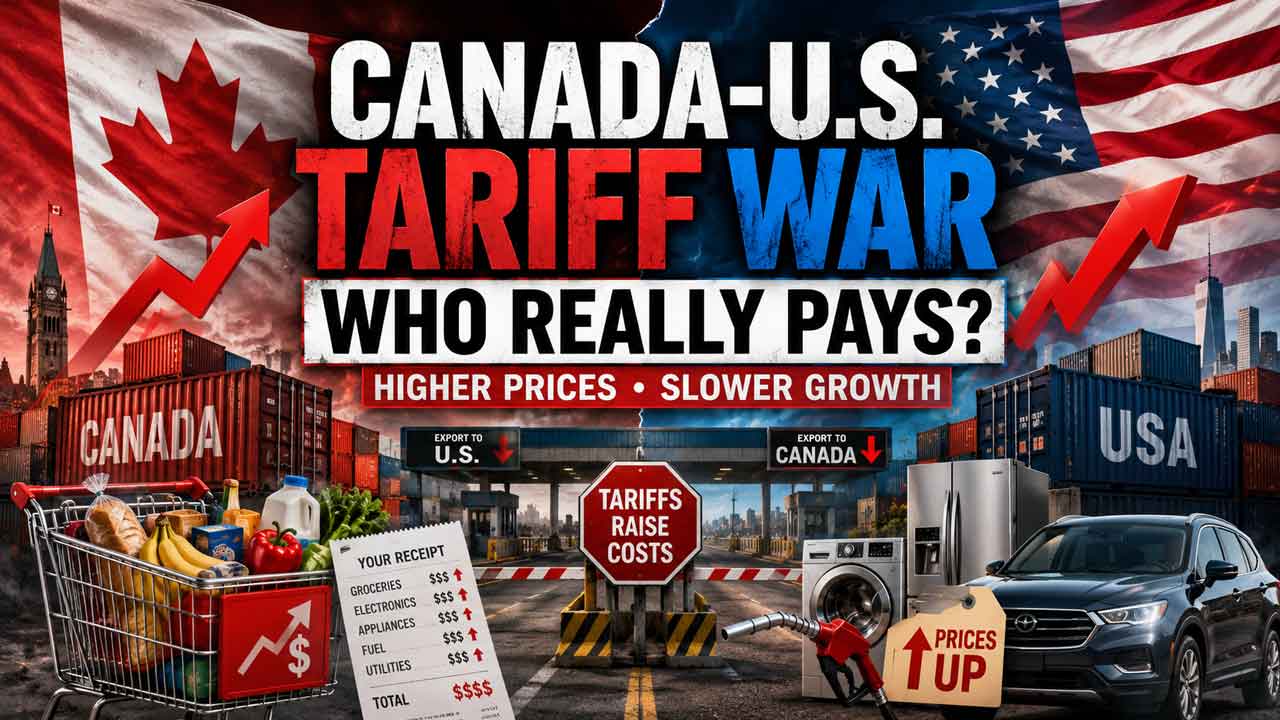
United States President Donald Trump has imposed tariffs on billions of dollars worth of Canadian products entering the U.S. Canada is responding with tariffs on American products imported north of the border.
The immediate question for families is whether those tariffs mean higher prices.
The larger question is what happens if retaliatory tariffs continue escalating into a prolonged trade war.
History offers a warning.
Tariffs can protect individual industries and generate government revenue, but when major trading partners repeatedly retaliate against each other, the effects can spread through the economy: consumer prices rise, exports decline, supply chains are disrupted, companies delay investment and hiring, and economic growth can weaken.
For Canada and the United States — two economies that have spent decades building highly integrated supply chains — those risks are especially significant.
Who Actually Pays the Tariffs?
A tariff is collected from the company importing a product, not directly from the foreign government.
Suppose a Canadian company imports a $1,000 piece of American equipment subject to a 25 per cent Canadian tariff.
The Canadian importer could face an additional $250 charge at the border.
The company then has several choices.
It can absorb some of the cost, demand a lower price from its American supplier, increase its Canadian selling price, find another supplier or use some combination of those options.
The same process operates in the United States.
When Washington imposes a tariff on a Canadian product, the U.S. importer pays the tariff.
That does not mean Canadian companies escape the consequences. Canadian exporters may have to reduce their prices to remain competitive, lose American customers or cut production.
Ultimately, the cost can be divided among producers, importers, retailers, workers and consumers.
Canada’s Next Round of Tariffs Starts Sept. 8
The United States imposed 50 per cent tariffs on $27.6 billion worth of Canadian goods effective Aug. 22.
Ottawa announced Tuesday that Canada will match those measures dollar for dollar and rate for rate.
Beginning Sept. 8, Canada will impose tariffs of 15, 25 and 50 per cent on $27.6 billion worth of U.S. imports.
The federal government says the counter-tariffs will focus on sectors including steel, dairy products, appliances, agricultural equipment, pulp and paper and electronics.
That means the dispute can increasingly reach consumers through both finished products and the materials businesses use to make other products.
A 50% Tariff Does Not Automatically Mean a 50% Price Increase
A headline announcing a 50 per cent tariff does not mean a $100 retail product automatically becomes $150.
The tariff is generally calculated on the customs value of the imported product, rather than its final retail price.
Companies can also absorb part of the cost or change suppliers.
Recent Bank of Canada research examining Canadian tariffs imposed in 2025 found products subject to 25 per cent tariffs became about six per cent more expensive relative to comparable untariffed products after approximately three months.
That is a meaningful increase, but considerably less than 25 per cent.
The study also found businesses were more likely to pass costs on when they expected tariffs to remain in place longer.
That is why the duration of the current confrontation matters.
History’s Warning: The Smoot-Hawley Tariff War
The most famous historical example of a tariff confrontation came almost a century ago — and Canada was directly involved.
In June 1930, U.S. President Herbert Hoover signed the Tariff Act of 1930, better known as the Smoot-Hawley Tariff Act.
The legislation sharply increased American protection against a wide range of imported goods.
Canada was among the countries hit.
Historical Federal Reserve research notes that Smoot-Hawley increased duties on Canadian products including dairy products, potatoes, cattle, grains, apples, lumber and halibut.
Canada retaliated by increasing tariffs on 125 American products and expanded preferential trade relationships with Britain.
More recent economic research examining the Smoot-Hawley trade war found Canada raised duties against U.S. goods twice during 1930. At that time, approximately 43 per cent of Canadian exports went to the United States, making Canada particularly vulnerable to American protectionism.
There is an obvious historical parallel with 2026: a highly integrated Canadian economy suddenly confronting substantial new barriers in its largest export market and responding with tariffs of its own.
There are also important differences. Today’s Canadian economy, financial system, trade agreements and social supports bear little resemblance to those of 1930.
Still, the basic economic danger of retaliation remains relevant.
Did Tariffs Cause the Great Depression?
No.
That distinction is important.
The Great Depression had already begun before Smoot-Hawley became law. The stock-market crash, banking failures, a collapse in the money supply, falling demand and severe financial instability were central causes of the Depression.
Federal Reserve historians note U.S. economic output ultimately declined by roughly 30 per cent and unemployment climbed to about 25 per cent by 1933.
It would therefore be inaccurate to claim Smoot-Hawley caused the Great Depression.
What the tariff did was add another barrier to international commerce at precisely the wrong time.
The U.S. State Department’s historical account says protectionist policies adopted by countries during that period contributed to a severe contraction in international trade. World trade fell by about 66 per cent between 1929 and 1934, although the Depression itself accounted for a substantial portion of that collapse.
Smoot-Hawley became a lasting example of the danger of countries trying to protect themselves by restricting one another’s trade during an economic downturn.
What Happened Between Canada and the United States?
The damage was not one-sided.
When the United States made Canadian products more expensive, Canadian exporters lost access to American customers.
When Canada retaliated, American exporters faced the same problem in Canada.
Historical records presented to the U.S. Congress show American exports to Canada fell sharply during the early 1930s while U.S. purchases from Canada also declined.
Some of that decline was unquestionably caused by the Depression itself.
But tariffs made an already difficult situation worse by putting additional barriers between buyers and sellers.
Canada also responded by redirecting more of its trade toward Britain and the British Empire.
That demonstrates another long-term consequence of tariff wars: customers can find new suppliers, and those relationships may not automatically return when the dispute ends.
That lesson could matter considerably in 2026.
If Canadian companies spend several years developing customers in Europe or Asia because the U.S. market has become unreliable, some of those trade patterns could become permanent.
The reverse is also true. American customers forced to replace Canadian suppliers may build new relationships elsewhere.
The 2018–19 U.S.-China Trade War Offers a More Recent Example
There is also much more recent evidence.
During Trump’s first presidency, the United States imposed major tariffs on imports from China beginning in 2018. China retaliated against American goods.
Federal Reserve researchers studying those tariffs found the additional import costs were passed through rapidly into American consumer goods prices.
Their analysis found the 2018–19 tariffs were reflected fully and quickly in affected consumer prices, with much of the pass-through occurring within approximately two months.
Federal Reserve regional reports from the period also recorded manufacturers reporting higher material costs and supply disruptions associated with tariffs.
By late 2018, tariff-related cost increases were being reported not only by manufacturers but by contractors, retailers and restaurants.
That illustrates how a tariff moves beyond the industry originally targeted.
A tax on imported steel, for example, does not only affect steel companies.
It can affect manufacturers buying steel, contractors using steel products, businesses purchasing equipment made from steel and eventually consumers purchasing finished goods.
Retaliation Is Where a Tariff Dispute Becomes More Dangerous
A government may impose a tariff believing it will protect domestic industries.
The calculation changes when the other country retaliates.
Now exporters are being hit at the same time importers are paying higher costs.
Economic research published by the International Monetary Fund in 2025 concluded retaliation can significantly amplify the effects of unilateral tariff increases.
Its analysis found broad trade wars can reduce the volume of international trade while lowering welfare, employment and national income.
That is the central danger facing Canada and the United States.
Washington imposes tariffs on Canadian products.
Ottawa retaliates against American products.
Washington answers Canada’s retaliation.
Canada responds again.
Each government attempts to increase pressure on the other, but each additional measure can also increase costs inside its own economy.
That is how a tariff dispute can become a tariff war.
Businesses May Stop Investing Before They Start Laying Off Workers
One of the most damaging effects of prolonged trade uncertainty may not immediately appear on a store receipt.
Companies hate uncertainty.
Consider a Northwestern Ontario forestry company deciding whether to spend $50 million expanding a mill.
Its executives need to estimate future demand, prices and access to the American market.
If they do not know whether U.S. tariffs next year will be zero, 25 per cent or 50 per cent, delaying the investment may appear safer.
The same applies to a U.S. manufacturer considering a new plant that depends on Canadian aluminum, lumber or automotive components.
Federal Reserve research into previous tariff confrontations identifies uncertainty as one route through which trade disputes can reduce investment and hiring. Higher tariffs can also disrupt supply chains and lower productive capacity over the longer term.
That means a trade war can weaken economic growth before widespread layoffs appear.
Projects get postponed.
Equipment purchases are cancelled.
Hiring plans are reduced.
Businesses hold onto cash.
Those individual decisions accumulate across the economy.
Tariffs Can Create an Inflation and Growth Problem at the Same Time
Tariffs present central banks with a difficult problem.
Normally, when an economy slows sharply, a central bank can consider lowering interest rates to encourage borrowing, investment and consumer spending.
But tariffs can simultaneously push prices upward.
That creates conflicting pressures.
The Bank of Canada could face weaker Canadian economic growth at the same time households are paying more for tariff-affected goods.
The U.S. Federal Reserve can face the same dilemma.
IMF research notes that tariff-induced price pressures can make central banks reluctant to lower interest rates even while trade restrictions are weakening economic activity.
For consumers, that combination can be especially painful.
Families may face higher prices without receiving the relief that lower borrowing costs would normally provide during an economic slowdown.
Jobs Can Be Lost on Both Sides of the Border
Tariff supporters frequently emphasize jobs that might be protected when imported goods become more expensive.
There can indeed be winners.
A Canadian manufacturer competing against a tariffed American import may gain customers.
An American manufacturer competing against Canadian imports may experience the same benefit.
But other businesses can lose.
A Canadian sawmill may lose U.S. customers.
An American construction company may pay more for Canadian lumber.
A Canadian mining operation may face higher equipment costs.
A U.S. factory may pay more for Canadian components.
A transportation company can lose freight volumes when fewer goods cross the border.
The economic result depends on whether the jobs and investment created in protected industries outweigh losses elsewhere.
When countries retaliate against each other, those potential losses become broader.
Supply Chains Make Canada and the U.S. Especially Vulnerable
Canada and the United States are not simply two countries shipping finished products back and forth.
Many industries operate as one continental production system.
The auto sector is perhaps the clearest example.
Parts manufactured in Ontario can travel to an American plant, become part of another assembly and later return to Canada in a finished vehicle.
The same principle applies to food processing, forestry products, machinery, steel, aluminum and other industries.
That means a tariff imposed at one stage of production can increase the cost of the finished product several steps later.
The deeper the supply-chain integration, the harder it is to impose tariffs on the other country’s businesses without affecting domestic businesses as well.
What Could Canadian Consumers Pay More For?
Canada’s Sept. 8 counter-tariffs cover selected American products in sectors including appliances, electronics, steel, dairy, agricultural equipment and pulp and paper.
Consumers could therefore eventually see higher prices on some products in those categories.
The effect will vary greatly.
Retailers may have inventories purchased before tariffs took effect.
Some may switch suppliers.
Others may absorb costs.
Canadian manufacturers could replace certain American imports.
Products from Europe, Asia or elsewhere could become more competitive.
Consumers should therefore not expect every American product to suddenly increase by the headline tariff percentage on Sept. 8.
Price changes are more likely to emerge gradually as inventories turn over and businesses make longer-term pricing decisions.
Construction and Housing Can Feel Tariffs Indirectly
Many tariff costs will never appear on a shelf with a sign saying “tariff increase.”
Consider housing.
A homebuilder purchases steel products, electrical equipment, appliances, machinery and other materials.
If several of those costs increase, the cost of building a home increases.
That can eventually appear as a higher selling price or rent.
The same applies to road construction, mines, commercial buildings and public infrastructure.
Governments themselves can end up paying more to build projects.
That means taxpayers can ultimately share in tariff costs as well.
What It Could Mean for Thunder Bay and Northwestern Ontario
Northwestern Ontario could feel the trade confrontation from several directions.
Forestry remains closely connected to American markets.
Mining companies purchase specialized machinery and industrial equipment.
Agriculture depends on machinery, parts and other inputs.
Trucking companies rely on freight moving efficiently between Canada and the United States.
Construction companies use materials produced throughout North America.
Thunder Bay businesses purchase American goods and equipment.
At the same time, Northwestern Ontario contains critical minerals that Canada and the United States increasingly consider strategically important.
That gives the region potential economic leverage, but it does not eliminate the danger of a prolonged trade war.
If businesses become unsure about future access to the American market, some investment could be delayed.
Conversely, Canada’s effort to diversify away from the United States could create opportunities for Thunder Bay’s port, rail system, mining-service sector and Great Lakes transportation connections.
The outcome will depend heavily on how long the confrontation lasts.
Remote First Nations Can Face Added Cost Pressures
Tariff-driven inflation can have different consequences in remote Northern communities than it does in large urban centres.
Many remote First Nations already face significantly higher transportation costs.
Equipment, construction materials, food and other goods may travel long distances before reaching the community.
If tariffs raise the wholesale price before those transportation costs are added, the final increase can be particularly difficult for households, businesses and community governments.
That makes monitoring Northern and remote prices important as Canada’s retaliation takes effect.
Could Buying Canadian Reduce the Impact?
In some cases.
If a tariff makes an American product more expensive and there is a comparable Canadian product available, consumers and businesses can switch.
That is partly how tariffs are intended to encourage domestic production.
Businesses may also source products from countries other than the United States.
But Canada does not manufacture everything it consumes.
Replacing sophisticated machinery, electronics, automotive components or specialized industrial equipment can take time.
There is also a historical lesson here.
Once businesses change suppliers, the new relationship can last.
A prolonged trade war may therefore permanently alter some Canada-U.S. trade patterns even if tariffs are eventually removed.
Tariff Revenue Is Not Free Money
Governments collect significant revenue from tariffs.
Ottawa can use that money to support affected workers and companies.
Canada announced $7.5 billion in new and expanded assistance as it unveiled the latest counter-tariffs.
But tariff revenue is not money extracted painlessly from another country.
It initially comes from domestic importers paying the tax.
If businesses pass those expenses forward, some ultimately comes from consumers.
The economic question is therefore not simply how much tariff revenue a government collects.
It is how much economic activity, consumer purchasing power and business investment is lost or redirected in the process.
The Historical Lesson Is About Escalation
History does not tell Canadians and Americans that every tariff inevitably produces a depression.
It does tell us something more useful.
Tariffs rarely remain isolated when trading partners retaliate.
Smoot-Hawley demonstrated how protectionism could spread from one country to another while international trade was already under severe pressure.
The 2018–19 U.S.-China dispute demonstrated that modern tariffs can move rapidly into consumer prices and business supply chains.
Modern economic research also suggests retaliation makes the overall economic consequences worse.
That is the risk facing Canada and the United States in 2026.
A 15, 25 or 50 per cent tariff on one product is one issue.
A cycle in which each government continually answers the other’s tariffs with additional tariffs is something much larger.
The Bottom Line for Consumers and the Economy
Trump’s tariffs are intended to put economic pressure on Canada.
Canada’s counter-tariffs are intended to put economic and political pressure on the United States.
Neither country, however, can completely direct that pain across the border.
American importers pay American tariffs.
Canadian importers pay Canadian tariffs.
Exporters can lose markets.
Consumers can face higher prices.
Manufacturers can pay more for components.
Workers can face reduced hours or job losses.
Businesses can postpone investments because they do not know what trading conditions will look like next year.
And central banks can face the difficult combination of weaker economic growth and tariff-driven price increases.
The experience of the 1930s should not be used to claim another Great Depression is inevitable. The economic conditions today are fundamentally different.
The more relevant lesson is that retaliatory protectionism can become self-reinforcing.
Canada and the United States spent decades lowering the economic barriers between them.
Their industries, workers and consumers adapted to an economy in which goods could move across the world’s longest international border with relatively little friction.
Rebuilding those barriers comes with a cost.
For Thunder Bay and Northwestern Ontario, the consequences could reach far beyond the checkout counter — into forestry, mining, transportation, construction, investment and employment.
The longer the tariff war lasts, the greater the chance those effects become structural rather than temporary.