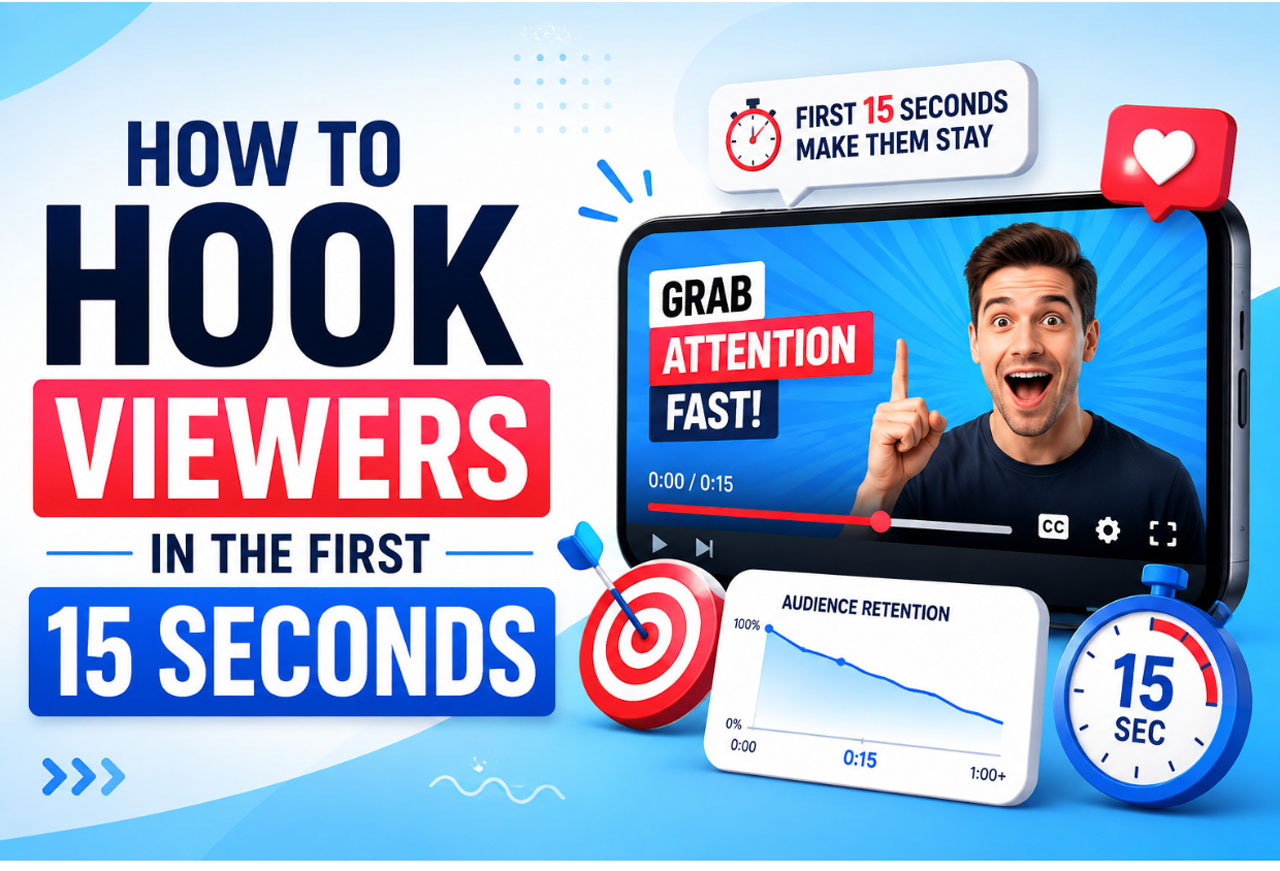
Lose the first 15 seconds and you may lose the viewer for good.
If you create videos for YouTube, TikTok, or Instagram, you are competing with an endless stream of content. Your viewer can swipe away, click another video, or scroll past you in less than a second.
That makes your opening one of the most important parts of the video.
In my experience with SEO and social media content, the strongest video hooks have one thing in common: they give viewers a reason to care before asking them to invest more time.
If you’re looking to give your videos an early boost with YouViews, remember that promotion cannot replace strong creative. Your hook still needs to earn the viewer’s attention.
Why the First 15 Seconds Matter
The first few seconds establish whether your video deserves the viewer’s attention. A weak opening creates friction. A strong one creates curiosity, relevance, or an immediate reason to keep watching.
YouTube’s own analytics make this particularly clear. Its audience retention report shows where viewers stay, rewatch, skip, or abandon a video. YouTube also specifically recommends experimenting with the opening when viewers drop off early.
This is why I don’t treat the intro as a warm-up. I treat it as part of the content itself.
If your video promises a transformation, show the transformation. If it promises an answer, create a reason to want that answer. If it solves a problem, make the viewer recognize that problem immediately.
If your goal is to improve your video’s watch time, start by improving the part of the video that determines whether people stay long enough to consume the rest.
What Makes a Good Video Hook?
A good hook does not have to be loud, dramatic, or clickbait-heavy. It simply needs to answer the viewer’s silent question:
“Why should I keep watching this?”
I usually look for three ingredients.
1. Relevance
The viewer should immediately recognize that the video is meant for them.
Instead of:
“Hey guys, welcome back to my channel. Today we’re going to talk about…”
Try:
“If your videos get views but lose people after 10 seconds, here’s what you’re probably doing wrong.”
The second version identifies the audience and problem immediately.
2. Curiosity
Give viewers a reason to want the next piece of information.
For example:
“There’s one mistake almost every beginner makes when editing their videos.”
You haven’t revealed the answer yet, but you’ve created a reason to stay.
3. A Clear Payoff
The viewer should understand what they will get from watching.
“I’ll show you three hook formulas you can use in your next video.”
Now the viewer knows what is coming and why it may be useful.
10 Ways to Hook Viewers in the First 15 Seconds
1. Start With a Provocative Question
Questions naturally invite an answer.
Ask something directly connected to the viewer’s problem, curiosity, or desired outcome.
Examples:
- “Why do some videos go viral while better videos get ignored?”
- “What would happen if you stopped starting your videos with an introduction?”
- “Are your first 10 seconds actually killing your retention?”
The best questions are specific enough to feel relevant and open enough to create curiosity.
2. Lead With a Surprising Statistic
A strong statistic can instantly establish stakes.
For example:
“Most people decide whether to keep watching within seconds.”
If you use statistics, make sure they are accurate, relevant, and sourced. Don’t invent numbers simply because they sound impressive.
3. Show the Result First
This is one of my favorite approaches for tutorials and transformation-based content.
Instead of spending 15 seconds explaining what you’re about to do, show the finished result immediately.
For example, a video about editing could open with:
“Here’s the final video. Now I’ll show you exactly how I created it.”
This works because the viewer can see the payoff before committing to the process.
4. Create a Curiosity Gap
Give viewers part of the story, but leave an obvious question unanswered.
For example:
“I changed one thing in my video openings, and the difference was much bigger than I expected.”
The viewer now wants to know what changed and what happened.
The important part is delivering the promised answer later. Curiosity without payoff quickly becomes clickbait.
5. Start With the Problem
Speak directly to a frustration your target audience already has.
“If people click your videos but leave almost immediately, your hook may be the problem.”
This is especially effective for educational, business, marketing, finance, and how-to content.
6. Use a Cold Open
A cold open skips the traditional introduction and starts inside the action.
Instead of:
“Hi everyone, today we’re going to…”
Start with:
“I had 30 minutes to fix this campaign, and this is what happened.”
The viewer enters the story immediately.
YouTube has highlighted the cold open as one way creators can make their introductions more compelling.
7. Use a Pattern Interrupt
A pattern interrupt breaks the predictable rhythm of scrolling.
It could be:
- An unexpected visual
- A sudden change in camera angle
- On-screen text
- Movement
- A surprising statement
- A quick demonstration
- An unusual opening shot
Don’t use random effects just to create noise. The visual should reinforce the hook.
8. Tease the Payoff
Tell viewers what they will see if they continue.
“In the next few minutes, I’ll show you exactly how I turned this weak introduction into one that keeps people watching.”
The promise should be realistic. Overpromising may win a click, but it can damage retention when the content fails to deliver.
9. Speak to a Specific Audience
“Everyone” is rarely a useful target.
Compare:
“Today we’re talking about video marketing.”
with:
“If you’re a small creator struggling to keep viewers past the first 15 seconds, this is for you.”
The second version immediately tells the right person to pay attention.
10. Make the First Visual Count
Your hook isn’t only what you say.
The opening frame can feature:
- A surprising result
- A before-and-after
- A product demonstration
- A strong facial reaction
- A relevant visual
- Large, readable text
- A compelling scene
This matters particularly on short-form platforms, where viewers are constantly deciding whether to swipe.
A Simple 15-Second Hook Formula
When I write or review video concepts, I like to break the opening into four stages.
Seconds 0–3: Stop the Scroll
Lead with the most interesting element.
Question + result + surprising statement + strong visual
Seconds 3–7: Establish Relevance
Make the viewer understand why this matters to them.
Seconds 7–12: Create the Payoff
Tell them what they are going to discover, learn, or see.
Seconds 12–15: Start Delivering
Don’t add another introduction. Get into the actual content.
A simple formula is:
Hook → Problem or Promise → Curiosity → Value
This works across long-form YouTube videos, Shorts, TikTok videos, and Instagram Reels.
What Should You Avoid in the First 15 Seconds?
Some of the biggest retention problems come from delaying the actual content.
Avoid:
- Long logo animations
- Lengthy channel introductions
- “Welcome back to my channel” openings
- Explaining your credentials
- Asking people to subscribe immediately
- Repeating the title word for word
- Unrelated stock footage
- Long disclaimers
- Empty small talk
- Clickbait that the video cannot support
Your audience did not click because they wanted to see your logo animation. They clicked because something in your title, thumbnail, recommendation, or social feed made them curious.
Give them that thing quickly.
Match Your Hook to Your Title and Thumbnail
This is one of the most important principles in video retention.
Think of the viewer journey as:
Thumbnail → Title → Hook → Content → Payoff
If the thumbnail promises one thing and the first 15 seconds deliver something completely different, viewers have a reason to leave.
For example:
Title:
How I Grew a YouTube Channel From 0 to 10,000 Subscribers
Weak opening:
“Hey everyone, welcome back. In today’s video, I’m going to talk about growing a YouTube channel.”
Stronger opening:
“Six months ago, this channel had zero subscribers. Today, it’s at 10,000. Here’s what changed.”
The second opening confirms the promise immediately.
YouTube specifically notes that strong intro performance can indicate that the first 30 seconds matched the expectations created by the video’s title and thumbnail.
How to Hook Viewers on YouTube, TikTok, and Instagram
The basic psychology is similar, but the execution changes.
YouTube
You have more room for storytelling, explanation, and setup, but the opening still needs to establish the video’s value quickly.
Use:
- Questions
- Results
- Story openings
- Problems
- Curiosity gaps
- Strong visual demonstrations
TikTok
Speed matters even more.
Use a strong first frame, concise language, movement, captions, and an immediate payoff. Don’t make viewers wait for context they don’t need.
Instagram Reels
Start with the most visually interesting part of the story. Text overlays can reinforce the hook, particularly when the video needs to work without sound.
Across all three platforms, the principle remains the same:
Don’t make the viewer wait for the interesting part.
How to Know if Your Hook Is Working
Don’t rely entirely on your instincts.
Use your analytics.
In YouTube Studio, the audience retention report can show gradual declines, dips, spikes, and top moments. Dips can indicate where viewers abandon or skip content, while spikes can show sections that people rewatch or share.
I recommend comparing several videos rather than judging one video in isolation.
Look for patterns:
- Are viewers consistently leaving during the introduction?
- Does retention improve when you start with the result?
- Do question-based openings perform better?
- Are viewers staying longer when you remove the intro?
- Which moments are generating replays?
YouTube also allows creators to compare retention against their typical performance for videos of similar length.
That gives you something much more useful than guessing.
Final Takeaway
The best first 15 seconds don’t feel like an introduction. They feel like the beginning of the value.
Give viewers a reason to care, create curiosity, make the payoff clear, and start delivering before their attention disappears.
Then use your retention data to find out which hooks actually work for your audience.
That people-first approach also aligns with Google’s guidance: useful content should demonstrate real expertise, provide original value, satisfy the reader’s goal, and offer more than a rewritten version of what already exists in search results.
Frequently Asked Questions
1. How do you hook viewers in the first 15 seconds?
Start with a question, surprising fact, compelling visual, problem, result, or curiosity gap. Then quickly establish why the viewer should care and what they will get by continuing to watch.
2. What should I say in the first 15 seconds of a video?
State something that immediately creates interest. You can ask a relevant question, introduce a problem, reveal a result, make a surprising claim, or promise a specific benefit.
3. How do you hook viewers in the first 3 seconds?
Use your strongest visual or statement immediately. Avoid greetings and unnecessary context. A specific question, surprising result, bold claim, or visually compelling moment can work well.
4. How do you grab someone’s attention in a video?
Create immediate relevance or curiosity. Show the result, identify a problem, ask an intriguing question, or introduce an unexpected visual. The opening should give the viewer a reason not to scroll.
5. What is a video hook?
A video hook is the opening element designed to capture attention and encourage someone to continue watching. It can be verbal, visual, or both.
6. What makes a good YouTube hook?
A good YouTube hook is relevant to the viewer, creates curiosity, and matches the promise made by the title and thumbnail. It should also move into the actual content quickly.
7. Should you introduce yourself at the beginning of a video?
Usually, you don’t need a lengthy introduction. If your name or branding matters, incorporate it naturally without delaying the content the viewer came to see.
8. How long should a video hook be?
There is no universal ideal length. For a video framed around the first 15 seconds, use those seconds strategically rather than filling them with an introduction. Start delivering the video’s value as early as possible.
9. How can I improve audience retention?
Review your audience retention data to identify dips, spikes, and moments where viewers leave. Then test different openings, pacing, visuals, and ways of delivering the payoff.
10. What is a curiosity gap in video marketing?
A curiosity gap gives viewers enough information to make them interested while withholding the answer they want. The technique works best when the video actually delivers the promised answer.
11. Should a video start with a question?
Questions can be highly effective because they immediately involve the viewer. The strongest questions are specific, relevant, and connected to something the audience genuinely wants to know.
12. How do you write a strong video hook?
Start with the viewer’s problem or desire. Then choose a hook format such as a question, surprising result, mistake, challenge, statistic, or curiosity gap. Keep the language specific and move into the promised value quickly.