In most Canadian cities, hockey season winds down once the NHL playoffs end. In Thunder Bay and Northwestern Ontario, it never really does. The rinks stay busy, minor hockey registration stays high, and the conversation about the game just keeps going, straight through summer and into fall camp. This article looks at what actually keeps hockey so central to community life here, year-round.
The Rinks That Never Really Close
Fort William Gardens is the anchor of it all. Opened in 1951 and still owned by the City of Thunder Bay, it seats close to 4,700 and has hosted local hockey continuously for more than 70 years. Today it is home ice for both the Thunder Bay North Stars junior team and the Lakehead Thunderwolves university program, a rare arrangement that puts junior and university hockey under one roof. Beyond the Gardens, the region runs an unusually dense network of community arenas for its population:
- Multiple rinks operating across Thunder Bay proper
- Additional community arenas spread through smaller Northwestern Ontario towns
- On-reserve arenas serving First Nations communities across the region
That density is what makes summer hockey schools and skill camps possible in the first place. The ice is readily available, and hockey is deeply rooted in the culture, making youth gravitate towards hockey. As a result, there is noticeable growth in hockey player registration across the local scene.
That same enthusiasm extends beyond participation, with local fans following junior, university, and professional hockey closely and increasingly turning to online resources for game analysis, including hockey betting predictions and the latest news. This creates a broader hockey community that extends well beyond the rink itself.
Junior Hockey and the SIJHL – The Heartbeat of Regional Competition
The Superior International Junior Hockey League, founded in 2001, is the region’s Junior A league, and it’s where community identity gets most directly invested. Thunder Bay’s own flagship team, the Thunder Bay North Stars, plays out of Fort William Gardens and has won seven league playoff championships, most recently in 2026. With notable takeaways being:
- Games at the Gardens regularly draw in raw local crowds rather than just scatterings of parents.
- Smaller Northwestern Ontario communities field their own SIJHL teams under the biggest sporting institutions in town.
- The league has historically fed players into university hockey, the OHL, and other leagues.
For a lot of smaller communities in the region, the local junior teams are essential parts of the culture. They are the thing everyone shows up for, and each team has its dedicated supporters and aspiring players.

The Thunderwolves and University Hockey
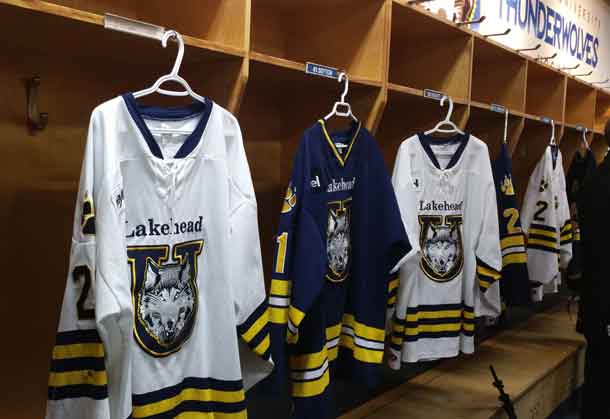
Lakehead University’s men’s hockey team, the Thunderwolves, gives Thunder Bay a second layer of serious hockey on top of the community game. The program plays in the OUA under U Sports, calls Fort William Gardens home, and has been known to lead the conference in attendance with crowds that look more like minor pro hockey than a typical university game. The results speak for themselves as well:
- The Thunderwolves won the OUA’s Queen’s Cup in 2005-2006 and finished as the national runner-ups that same year.
- The program hosted the national university championship in 2009 and 2010.
- Locally developed juniors have regularly seen places in the Thunderwolves lineup, representing their hometown.
This is not just a university sport with interest from Thunder Bay residents. It is a team that is loved and followed the way a hometown club is.
Northwestern Ontario’s NHL Legacy
This is the part locals are genuinely proud of, and the numbers back it up. On a per-capita basis, Thunder Bay is consistently ranked among the very best producers of NHL talent in Canada, outperforming cities many times its size.
Strong examples are the Staal brothers, who all came up through Thunder Bay minor hockey and made their way to the NHL. Not to miss Patrick Sharp and Alex Auld, two players who grew up playing hockey in the city. Finally, of course, Alex Delvecchio, a Hall of Fame member whose roots trace back to the region as well.
The cold winters help for sure, but it’s really the combination of the dense hockey infrastructure and that treats the game as an integral part of its culture. It is a city that will keep producing NHL players and prospects because of its deep-rooted love for the sport.
Indigenous Hockey Traditions in Northwestern Ontario
No honest look at hockey in this region is complete without the Indigenous communities that helped build it. Fort William First Nation, right next to Thunder Bay, has hosted the Anemki Unity Winter Classic, a tournament bringing together Indigenous and non-Indigenous players from tyke to midget divisions from across Northwestern Ontario, including communities like Lake Helen and Cat Lake. This pipeline of Indigenous players into regional and provincial hockey is a very important part of the culture, and one that should be highlighted.
What Year-Round Hockey Culture Actually Looks Like
Communities across Northwestern Ontario maintain outdoor rinks well into summer for ball hockey and open skating, a small thing, but it’s basically volunteer community service dressed up as a hobby. Draft season and preseason talk pick up locally the moment the Stanley Cup is handed out, not months later.
What makes Thunder Bay’s hockey culture distinctive isn’t the cold winters or even the rinks themselves. It’s that hockey is genuinely stitched into daily life here, in a way that never really needed a season to sustain it in the first place.