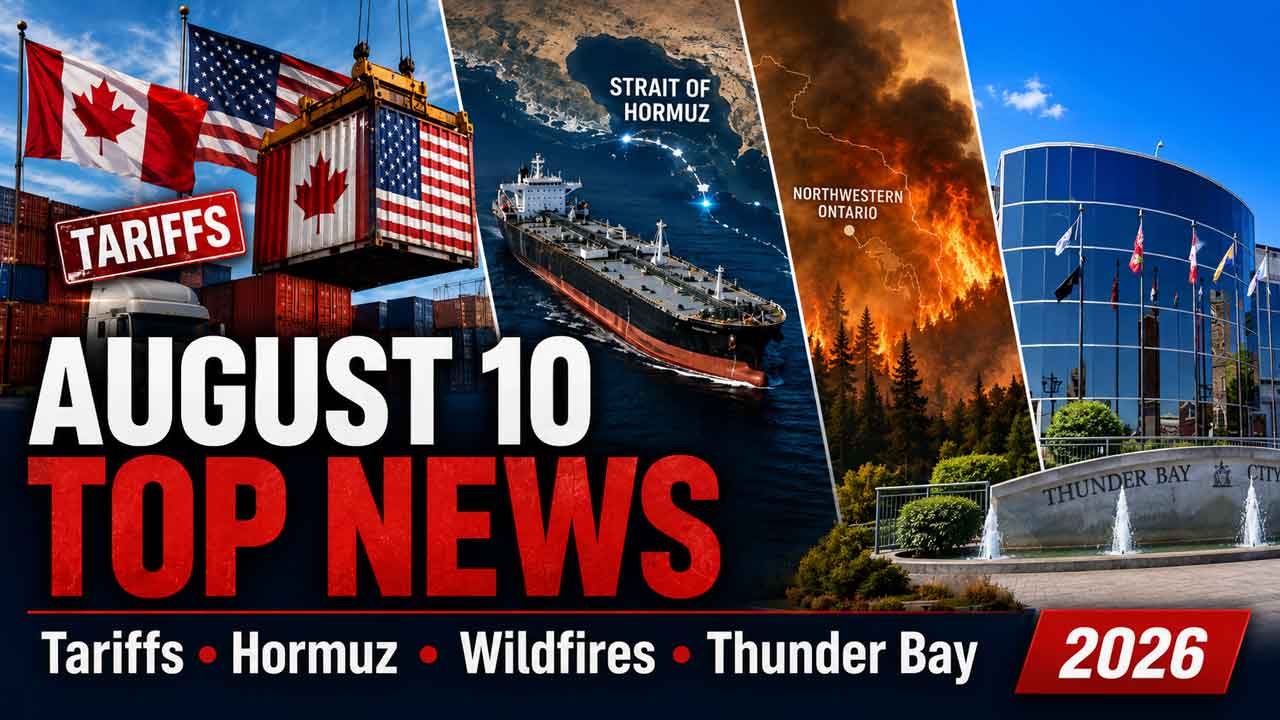
Aug. 10 news: U.S. tariffs, Hormuz, 112 NWO wildfires and key Thunder Bay city hall issues
THUNDER BAY — Canada-U.S. trade negotiations, uncertainty over reopening the Strait of Hormuz and an intense wildfire season at home and across Canada are driving the news agenda on Monday, Aug. 10.
For Northwestern Ontario, these are not distant stories. The tariff dispute could affect forestry, mining, manufacturing and cross-border transportation; developments in the Middle East can move fuel and transportation costs; and Northwestern Ontario entered Monday with 112 active wildland fires. In Thunder Bay, attention is also turning to a major Arundel Street development hearing Tuesday and an increasingly crowded municipal election.
The Five Stories to Put at the Top of the Morning File
- Canada-U.S. tariff talks: New 50 per cent U.S. tariffs on certain Canadian products are scheduled to take effect Aug. 19. Canada and the United States are negotiating possible concessions, but Reuters reported Friday there is no guarantee of an agreement. This is the most important national economic story for Northwestern Ontario.
- Strait of Hormuz negotiations: Iran and Oman say a shipping arrangement is nearing completion, but Iran has tied reopening the strait to concessions from Washington. The distinction is important: an agreement to establish shipping lanes does not yet mean the waterway has fully reopened.
- Northwestern Ontario wildfires: The Northwest Region entered Monday with 112 active fires, including 12 classified as not under control. Thunder Bay 36 remains approximately 301,240 hectares.
- British Columbia wildfire emergency: Federal assistance is being mobilized after the Bald Range wildfire forced roughly 18,000 people from their homes and prompted a provincial state of emergency.
- Thunder Bay city hall: Tuesday’s public meeting on the proposed redevelopment of 791 Arundel St. will put housing development, greenspace and neighbourhood concerns directly before council, just as the 2026 municipal election campaign begins to accelerate.
International: Hormuz Talks Could Move Fuel Prices Quickly
The Strait of Hormuz remains the international story with the clearest immediate connection to household and business costs in Northwestern Ontario.
Iranian Foreign Minister Abbas Araqchi says an agreement with Oman governing new shipping lanes is in its final stages. Iran, however, says reopening the waterway depends on the United States meeting several demands, including sanctions relief and compensation related to earlier U.S.-Israeli military action.
Before the current disruption, roughly one-fifth of global oil and liquefied natural gas flows passed through the Strait of Hormuz. Oil markets reacted strongly last week to expectations that traffic might resume, with crude prices falling more than seven per cent before rebounding Monday as Iran dampened expectations of a rapid reopening. Brent crude was trading around US$84 a barrel early Monday.
That matters locally. Northwestern Ontario has long transportation distances and heavy dependence on diesel for trucking, mining, forestry, construction and remote-community supply chains. Aviation is also essential to many northern First Nations. A sustained reduction in global oil prices could eventually ease some transportation and fuel costs; renewed disruption could push in the opposite direction.
The key reporting caution is that Hormuz has not simply “reopened.” Negotiations are progressing, but important political conditions remain unresolved.
Typhoon Dolphin Hits China and Disrupts Shanghai
Typhoon Dolphin is another international economic story worth watching.
The storm brought torrential rain and flooding to eastern China after making landfall in Zhejiang province. Reuters reports 943 flights were cancelled at Shanghai’s two airports, representing nearly 40 per cent of scheduled air traffic, while streets flooded and transportation and businesses were disrupted in affected districts.
Dolphin made landfall with sustained winds around 151 km/h and is the strongest typhoon to strike China so far this year. Its remnants are expected to continue carrying heavy rain inland.
The Northwestern Ontario connection is primarily through supply chains. China remains a major source of manufactured goods, industrial components, electronics and equipment used throughout Canada. Significant port, airport or factory disruption can eventually affect delivery times and costs for construction, mining and retailers here.
Ukraine War Escalates With Deadly Drone Attack Inside Russia
The Russia-Ukraine war produced another significant development early Monday.
Russian authorities say Ukrainian drones struck Nizhnekamsk in Tatarstan, about 800 kilometres east of Moscow, killing at least 13 people, including a child, and injuring 39. Ukraine’s military said it targeted Tatneft’s TANECO oil refinery in the city. Russia described the attack as terrorism, while Ukraine has said its campaign against Russian petroleum infrastructure is aimed at weakening Moscow’s ability to sustain the war. Both countries deny deliberately targeting civilians.
For Canada, continued attacks on energy infrastructure can have consequences for global petroleum markets while the broader war continues to shape Canadian defence spending, NATO commitments, grain markets and support for Ukraine.
National: Nine Days Until New U.S. Tariffs Are Scheduled to Hit
The Canada-U.S. trade dispute should be the principal Canadian economic story for NetNewsLedger on Monday.
Global Affairs Canada says U.S. Section 338 tariffs scheduled to take effect Aug. 19 could impose a 50 per cent duty on certain Canadian products. That measure is separate from another U.S. tariff action announced in July that maintains an exemption for CUSMA-compliant Canadian goods.
It was reported on Friday that Ottawa and Washington are discussing a potential deal. Canada could make concessions involving U.S. automobiles, dairy quota administration and the return of American alcohol to provincial store shelves, while Washington could reduce some existing steel and aluminum tariffs. The discussions remain sensitive and an agreement is not assured.
For Northwestern Ontario, the newsroom angle should be jobs, investment and orders, rather than Ottawa political theatre.
Forestry companies operate in an integrated North American market. Mining developments purchase equipment and seek capital internationally. Trucks move goods through the Fort Frances-International Falls and Pigeon River border crossings, and Thunder Bay businesses rely on U.S. customers and suppliers.
Even companies whose products are not directly captured by a new tariff can face secondary effects through higher input costs, weaker customer demand or investment delays.
B.C. Wildfires Become a National Emergency Story
British Columbia’s worsening wildfire emergency is now one of Canada’s biggest national stories.
The province declared a state of emergency over the weekend as the Bald Range wildfire expanded around Summerland and Peachland in the Okanagan. Federal officials said Sunday approximately 18,000 people had been evacuated as the fire grew beyond 10,000 hectares. Ottawa is assisting with shelter and accommodation, with the federal Government Operations Centre coordinating support.
The situation has changed rapidly. Initial reporting Saturday put the number of people forced from their homes above 20,000 before later estimates placed the number at approximately 18,000. That illustrates why evacuation totals should be attributed and updated as authorities refine them.
The national implications extend into Northwestern Ontario. Severe fire seasons in several provinces at once can increase competition for aircraft, crews and specialized personnel, although mutual-aid and international deployments also move resources to where they are most needed. British Columbia currently has firefighters from several countries assisting its response.
For northern First Nations, the B.C. emergency also reinforces issues already exposed in Ontario this summer: evacuation capacity, reliable warnings, emergency accommodations and the ability to move residents safely from isolated communities.
It is unknown at this time if Prime Minister Mark Carney will travel to British Columbia to see the damage. The Prime Minister did not visit Northern Ontario at the peak of the wildfires, despite repeated requests.
Canadian Jobs Report Delivers a Stronger-Than-Expected July
Canada’s latest employment report provides a somewhat more encouraging economic signal.
Statistics Canada says employment increased by 75,000 jobs in July, or 0.4 per cent, while the unemployment rate declined to 6.4 per cent, its lowest level since July 2024.
That is useful national context, but it should not be interpreted as evidence that every region experienced the same improvement. Northwestern Ontario’s labour market is shaped by its own conditions in health care, construction, retail, forestry, mining, transportation, tourism and the public sector.
A worthwhile NetNewsLedger follow-up would be to examine whether employers in Thunder Bay, Dryden, Kenora, Fort Frances and regional First Nations are seeing the same improvement.
Regional: Northwestern Ontario Back to 112 Active Wildfires
Wildfires remain the dominant regional public-safety story.
Ontario’s current wildfire information shows 112 active fires in the Northwest Region, with 12 not under control, seven being held, six under control and 87 being observed.
Thunder Bay 36 remains one of the largest active fires in Canada at approximately 301,240 hectares and is still classified as not under control. The Rinker Lake Complex also includes Dryden 34 at roughly 45,800 hectares and Dryden 35 at more than 31,000 hectares.
The continuing fire load matters well beyond the flames themselves. Evacuations, aviation restrictions, highway and rail access, tourism, forestry operations and remote-community supply routes can all be affected.
This summer has already demonstrated the particular vulnerability of remote First Nations. Namaygoosisagagun First Nation was among the communities devastated by wildfire, and many evacuees have relied on Thunder Bay for accommodation and support.
The wildfire story therefore remains both a regional emergency and a long-term public-policy issue involving preparedness, Indigenous emergency management, infrastructure and climate resilience.
Ring of Fire: August Construction Target Now Comes Into Focus
Another major Northwestern Ontario story to watch this week is whether Ontario’s accelerated Ring of Fire road schedule moves into its next stage.
Ontario’s published plan schedules construction of the Marten Falls Community Access Road to begin in August 2026, with completion targeted for November 2031. The proposed all-season corridor is approximately 184 kilometres long.
The Webequie Supply Road reached its construction stage in June.
The project carries major potential implications for First Nations access, employment and contracting, critical-mineral development and Northern Ontario transportation. It also remains connected to environmental assessment, consultation and Indigenous rights issues. Different First Nations have different positions and interests concerning Ring of Fire development, and those perspectives should not be treated as interchangeable.
Local: Arundel Street Development Heads to Thunder Bay Council
A major Thunder Bay land-use debate arrives at city hall Tuesday.
Council will hold a public meeting at 6:30 p.m. Aug. 11 regarding an Official Plan and zoning amendment for 791 Arundel St. The vacant, partly treed property is currently designated Community and zoned Community.
The current application would redesignate the property Residential and rezone it Urban Mid-rise. According to the city’s latest notice, the proposal would allow two 180-unit apartment buildings, for a total of 360 units, along with shared access, parking and related facilities.
The project puts two significant city priorities into direct conversation: Thunder Bay needs additional housing, while neighbourhood residents are raising concerns around development and greenspace.
Monday is also the deadline for people wishing to register to participate in Tuesday’s meeting online, and additional written comments can be submitted through the end of the day.
This is likely to become an important municipal-election issue because it touches housing supply, growth, neighbourhood planning and what residents expect from city-owned or undeveloped urban lands.
Thunder Bay Election Field Is Taking Shape
Thunder Bay’s 2026 municipal election campaign is moving into a decisive two-week period.
As of Monday morning, seven people have filed nomination papers for mayor and seven have filed for at-large council seats. Several ward races are also taking shape. The city stresses that people who have filed are nominees and do not become officially certified candidates until the city clerk completes certification.
Nominations close Friday, Aug. 21 at 2 p.m., certification is scheduled for Aug. 24 and municipal election day is Oct. 26.
That means the political landscape can still change substantially over the next 11 days.
For NetNewsLedger, this is the time to begin pressing candidates for specific answers on taxation, housing, homelessness, policing, infrastructure, economic development, the waterfront, relations with First Nations and Thunder Bay’s role as the service centre for Northwestern Ontario.
Local Public Safety: Search for Clifton Loon Remains Important
Thunder Bay Police have asked for the public’s assistance locating 25-year-old Clifton Loon, who was reported last seen Aug. 3 in the Oliver Road area.
Police describe Loon as an Indigenous man, six feet tall and approximately 180 pounds, with black brush-cut hair, brown eyes and a tattoo on his right arm. He was last seen wearing a grey T-shirt and black pants. Anyone with information is asked to contact Thunder Bay Police at 807-684-1200 or Crime Stoppers.
As of the police service’s current public media-release listing Monday morning, the missing-person notice remains posted and no subsequent public notice announcing that he has been located appears on that page.