Ontario alcohol laws and practical steps to make Thunder Bay sidewalks, trails and parks safer
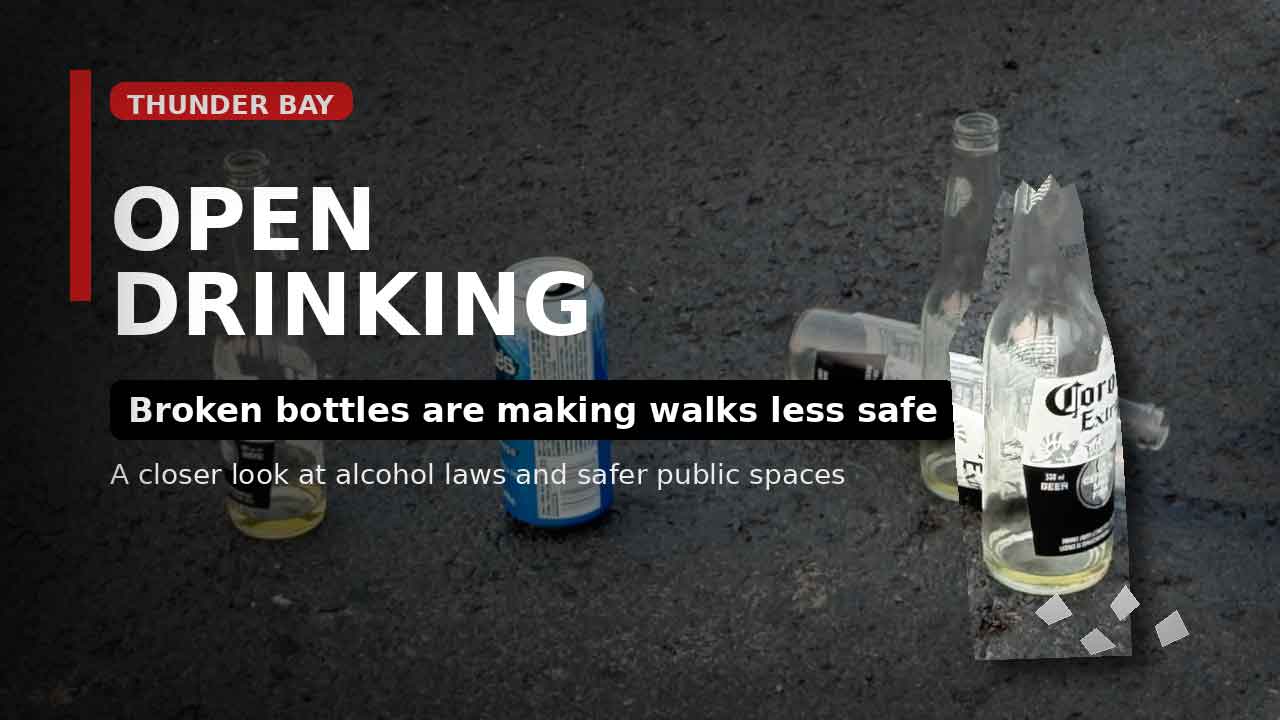
THUNDER BAY — Taking children to a playground, walking a dog or following one of Thunder Bay’s creek-side pathways should not require a constant scan for broken bottles and discarded syringes.
It also should not mean being on guard, especially with younger children to avoid intoxicated people.
Yet many residents describe doing exactly that.
Smashed alcohol bottles, open drinking and visible drug use can make sidewalks, trails, parks and waterways feel less welcoming. The risks are particularly serious for children, pets, maintenance workers and anyone who cannot easily avoid sharp debris.
This has become a growing problem in our city, and it often appears nothing is being actively done to solve the problem.
It would be easy to point fingers of blame at groups. That of course won’t solve the problem.
There is no readily available public dataset showing whether discarded glass and needles have increased citywide, where complaints are concentrated or how quickly hazards are removed.
That information gap matters.
Thunder Bay needs to respond to what residents are seeing while also collecting enough reliable data to determine the scale of the problem and measure whether interventions work.
What Ontario law says about open alcohol
Ontario law does not generally permit people to walk along a sidewalk, trail or waterfront with an open alcoholic drink.
Section 41 of Ontario’s Liquor Licence and Control Act, 2019, prohibits possessing liquor in an open container or consuming it anywhere other than an authorized location. Permitted locations can include a residence, licensed premises, a private place, an event operating under a permit or a public place specifically designated by municipal bylaw.
Thunder Bay’s Municipal Alcohol Policy similarly states that alcohol is not permitted in municipally owned parks, open spaces, streets and other facilities unless the location or event has been specifically approved.
It seems that this policy is simply not being enforced.
That apparent lack of enforcement only makes the problem worse. It is condoning the activity and making what was once illegal and enforced become everyday normal.
The Ontario Court of Justice lists a $100 set fine for having liquor in an open container in an unauthorized place and a $100 set fine for consuming liquor in an unauthorized place.
Public intoxication has a listed set fine of $50. Victim fine surcharges and court costs can increase the final amount payable.
There are limited exceptions. Ontario expanded the places where adults aged 19 and older may consume alcohol in many provincial parks in 2026, including certain picnic and beach areas.
That change applies to provincial parks under the provincial framework; it does not make open alcohol legal on ordinary Thunder Bay streets, municipal trails or creek pathways.
The law therefore gives authorities tools to address open drinking. The more difficult questions are whether violations are being reported, whether officers are available to respond and whether enforcement prevents the same behaviour from returning to the same location.
Open drug use falls under a different legal framework
Ontario does not have a direct provincial counterpart to the open-liquor rule covering every instance of visible drug consumption.
Unauthorized possession of substances listed in the federal Controlled Drugs and Substances Act remains illegal. Under section 4, the potential maximum penalty for possession depends on the substance and how the charge proceeds. Possession of a Schedule I substance can carry a maximum sentence of seven years when prosecuted by indictment. For a first summary-conviction offence, the maximum is a $1,000 fine, six months in jail or both.
Federal prosecution policy, however, directs prosecutors to consider warnings, referrals and alternatives to prosecution in many simple-possession cases, reserving prosecution primarily for circumstances involving significant public-safety concerns. That reflects an effort to treat substance dependence partly as a health issue rather than relying exclusively on criminal charges.
The legal response to visible drug use can also depend on the surrounding conduct. Police may have grounds to intervene when there are threats, assaults, trafficking, property damage, obstruction, trespassing or an immediate danger to the public. A person experiencing an overdose or medical crisis requires an emergency health response, not simply a ticket.
British Columbia’s temporary decriminalization pilot ended on Jan. 31, 2026. Possession of illicit drugs is again prohibited there, apart from limited exempt locations such as authorized supervised consumption and drug-checking sites.
Any person charged with an offence is presumed innocent unless proven guilty in a court of law.
What other Canadian cities are doing
Canadian municipalities are using different combinations of enforcement, cleanup, outreach and designated spaces. No single program has eliminated public substance use, but several approaches offer lessons for Thunder Bay.
In Calgary, the Alpha House HELP Team responds to non-emergency concerns involving homelessness, public intoxication and substance use. The mobile team can transport people to shelters, detoxification programs and other services while working with police and emergency medical services when necessary.
Alpha House also operates a dedicated Needle Response Team that patrols known locations and responds to reports from the public. The organization reports that its HELP Team handled 29,706 calls and recorded more than 76,000 interactions during its 2025-26 reporting period. Its needle team collected more than 51,000 pieces of needle debris, including material recovered after 892 public calls.
The Calgary model gives residents a clear point of contact while diverting appropriate calls away from police. It also treats needle collection as a specialized, measurable public service rather than leaving cleanup to individual residents or general maintenance crews.
Toronto has taken a different approach to alcohol.
Toronto permits alcohol consumption in specifically designated parks while continuing to prohibit it elsewhere. City monitoring found that more than 80 per cent of surveyed park users reported feeling satisfied and safe, without significant increases in disruptive behaviour, overflowing waste containers or police calls in participating parks.
Edmonton allows alcohol only at designated picnic sites, not throughout parks, on trails, in open fields or in parking lots.
Montreal generally prohibits alcohol in parks unless it is consumed with a meal in an authorized picnic area or under a permit.
These policies make a useful distinction. Responsible consumption in a clearly defined location is not treated the same way as drinking that produces broken glass, intimidation, disorder or hazards on a public pathway.
Drug policy remains more contested. Health Canada says supervised consumption sites provide clean equipment, trained overdose response and connections to health and social services. Ontario has moved in the opposite direction by ending provincial funding for consumption services and replacing several sites, including the former Thunder Bay model, with Homelessness and Addiction Recovery Treatment hubs.
Whatever position governments take on supervised consumption, closing or relocating a service does not eliminate addiction. Municipalities still require a plan for preventing public use, responding to overdoses and removing discarded equipment.
Thunder Bay already has pieces of a response
Thunder Bay is not starting from zero.
The city has established several community-safety teams. Its Specialized Support and Response team focuses on municipal property, transit terminals, bus stops and transit routes.
The Situation Table and Community Safety and Well-Being system connects agencies, while the city’s STAR team can provide intervention and support during some mental-health and addictions-related situations. Neighbourhood navigators and an encampment response team are also part of the structure.
Thunder Bay’s enhanced encampment strategy includes additional sanitation and cleanup, designated allowable areas, a public-space bylaw review, a temporary shelter village and efforts to connect people with long-term housing.
The planned shelter village includes 80 units with access to support services.
The Thunder Bay District Health Unit’s Street Outreach program provides confidential, non-emergency assistance to people who are homeless, under-housed or using substances. The Rapid Access Addiction Medicine clinic offers counselling, medications, withdrawal support and connections to treatment.
Superior Points collects discarded needles and other drug-use equipment. Residents who find a needle and do not feel comfortable handling it can request pickup by calling 807-621-7861.
The issue is not an absence of programs. It is whether residents understand which service to contact, whether coverage is available when problems occur and whether the various teams operate as a visible, co-ordinated system.
What Thunder Bay can do better
Thunder Bay should adopt a public-space safety strategy that combines consistent enforcement with rapid cleanup, outreach, treatment and housing.
Create one public reporting gateway. Residents should not have to determine whether a discarded syringe belongs with public health, municipal enforcement, parks staff or police. One telephone number and one online reporting category should accept reports of needles, broken glass, open drinking, illegal dumping and non-emergency welfare concerns, then dispatch the correct team.
Set public cleanup standards. Needles and broken glass near playgrounds, schools, trails, bus stops and waterfront areas should receive priority service. The city should establish response targets, including an urgent category for hazards involving children or heavily used pathways.
Publish the results. A public dashboard should show the number of reports, general hotspot areas, average response times, material collected and locations generating repeated complaints. Personal information should not be published. The objective is accountability and better deployment, not the stigmatization of neighbourhoods or individuals.
Expand specialized mobile response. Calgary’s model demonstrates the value of a team capable of addressing both intoxication and discarded equipment. Thunder Bay could strengthen Superior Points and its existing outreach teams with dedicated evening and weekend patrols along creek corridors, downtown routes, transit locations and other identified hotspots.
Enforce conduct consistently. Open-liquor laws should be applied where drinking creates hazards or persistent disorder. Police and municipal enforcement should focus on conduct that makes public places unsafe: smashed bottles, threats, obstruction, property damage, trafficking and repeated refusal to leave restricted property.
Enforcement should not criminalize someone merely for being poor, homeless or visibly unwell. It should protect public access while creating a direct route to shelter, detoxification, treatment and other supports.
Design safer spaces. Better lighting, clear sightlines, regular vegetation maintenance, accessible washrooms, secure garbage containers and properly located sharps bins can reduce hidden activity and make cleanup easier. Active programming and legitimate use of parks can also discourage behaviour that flourishes in isolated or neglected areas.
Build the response with Indigenous partners. Thunder Bay serves a large geographic region, and many people arriving in the city for health care, education or other services are far from their home communities and support networks. Indigenous health and social-service organizations should be directly involved in designing culturally safe outreach, treatment and housing responses.
Start with a focused 90-day pilot
Thunder Bay does not need to wait for another major strategy document.
The city could launch a 90-day pilot covering several creek corridors, downtown pedestrian routes, transit locations and high-use parks. The pilot would combine scheduled glass and needle patrols, targeted open-liquor enforcement, mobile outreach and publicly reported response times.
Before the pilot begins, the city should document existing complaints and cleanup volumes. After 90 days, council and residents should be able to see whether hazards declined, whether response times improved and whether people encountered through outreach entered shelter, treatment or other services.
That would replace anecdotes with evidence while producing visible improvements in the places residents use every day.
What residents should do
Residents should keep children and pets away from discarded syringes and should not pick them up with bare hands. Superior Points can be contacted at 807-621-7861 for collection assistance. Broken glass and other hazards on municipal property can be reported to the city.
Call 911 when a person appears to be overdosing, is unconscious, cannot be awakened, is having difficulty breathing or presents an immediate danger to themselves or others.
Public spaces must remain public. That means protecting residents from sharp debris and threatening conduct while ensuring that people living with addiction, mental illness or homelessness can reach effective help.
Thunder Bay has many of the necessary agencies and programs.
What it needs now is a response residents can understand, access and measure — one that makes it possible to walk a child, grandchild or dog without feeling as though every step requires special radar.
When candidates seeking to be elected to City Council show up at your doorstep looking for your support, ask them what their plans are on the issues that matter.