On March 10, 1995, four Japanese skiers stood on the podium at Big Thunder with gold in the Nordic combined team event at the FIS Nordic World Ski Championships. Two of them, Kenji and Tsugiharu Ogiwara, were twin brothers. Japan had won the previous Olympic and world team titles by such margins that FIS changed the relay from three 10-kilometre legs to four five-kilometre legs, and Thunder Bay was the first championships to use the new format. At the same championships, Norway’s Fred Børre Lundberg won the individual title, defending the world crown he had taken in 1993.
Thunder Bay was the first Canadian city to host the championships, and only the second host anywhere outside Europe. Between 1,500 and 2,000 volunteers worked the event from March 9 to 19, the Chronicle-Journal recalled on its 25th anniversary.
Thirty-one years later, Nordic combined has lost its place at the Olympics. On July 7, 2026, the International Olympic Committee’s executive board approved the program for the 2030 Winter Games in the French Alps without it, ending a run at every Winter Olympics since 1924. The IOC said the sport ranked lowest on most popularity measures over the past four Games, including 11 of 14 at Milan Cortina in February, and that only five national Olympic committees won medals in it during that span. It remains on the program for the 2028 Winter Youth Olympic Games and could return for Utah 2034 through a candidate pathway.
The sport’s governing body took it badly. “I am at a loss for words and struggle to understand the reasoning behind it,” Lasse Ottesen, the Nordic combined race director at the International Ski and Snowboard Federation, said in the federation’s statement.
A hill built for the world
Big Thunder opened in 1963 and hosted 29 FIS World Cup events between 1975 and 1995. Nordic combined World Cup competitions came in 1989 and 1994, before the world championships arrived. To get ready for 1995, the site put floodlights on its big jumps and built a 50-kilometre cross-country trail system, Anishinabek News reported in 2015.
The big hill produced its own legends. Steve Collins of Fort William First Nation set the K120 record of 128 metres in 1980. During the 1995 championships, Austria’s Andreas Goldberger went 136 metres, and Norway’s Tommy Ingebrigtsen, the large hill champion, went one metre further.
NetNewsLedger looked back at that championship and its winners in a December 2023 retrospective.
What’s left at Big Thunder
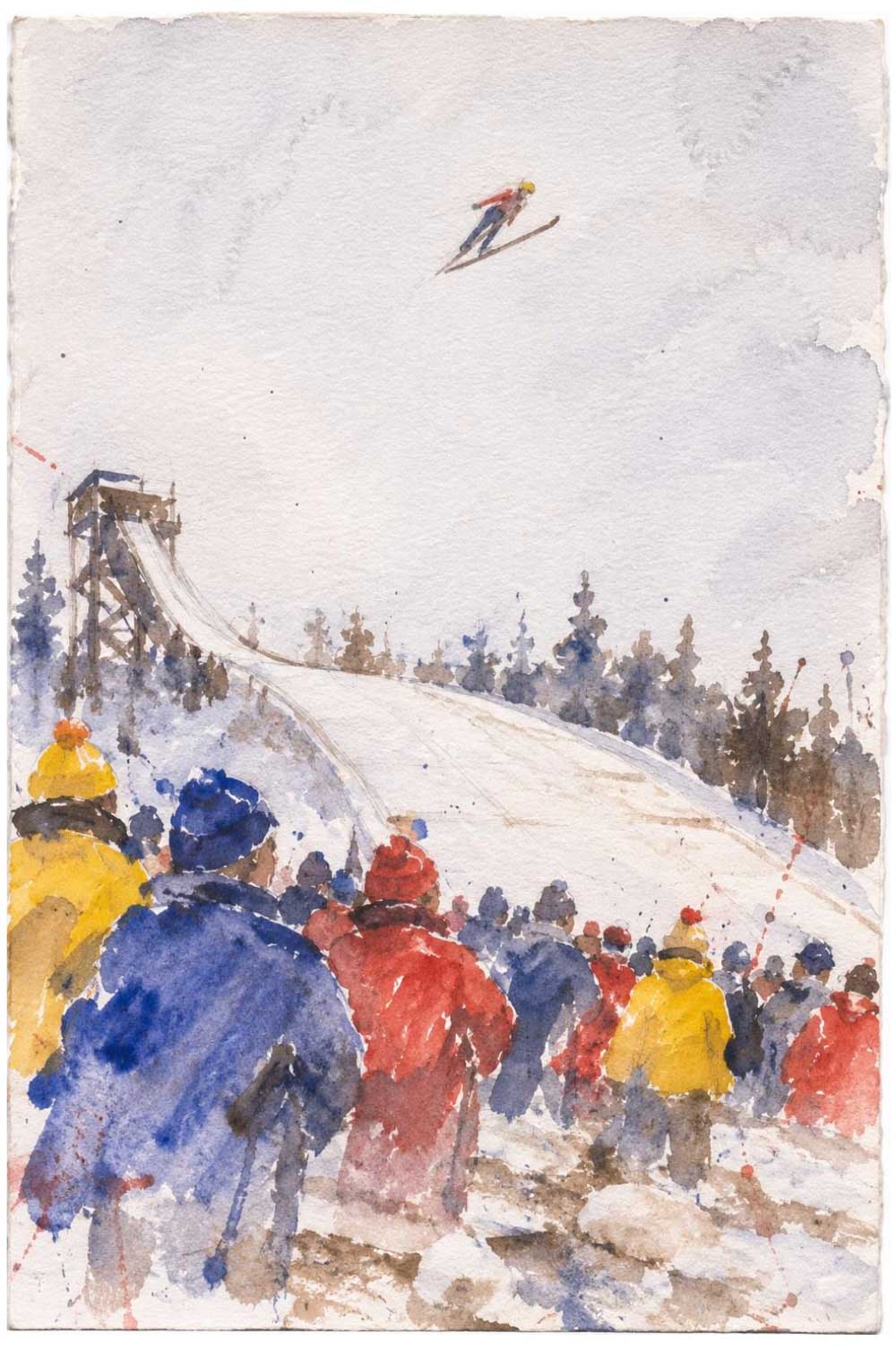
Months after the championships, the province cut the site’s funding. The gates were locked on June 30, 1996, according to Darren McChristie, a former assistant operations manager at Big Thunder, who wrote about the site for The Walleye 22 years later. He described the steel tower under the K120 in-run still rising above the pines along Highway 61, with Infrastructure Ontario managing the property for the province at the time. He also noted that the big jumps no longer meet FIS standards.
The site sits in Neebing, about three kilometres west of Fort William First Nation’s reserve boundary. Collins has worked to bring ski jumping back to his community. In May 2022 he took Canada’s Beijing 2022 bronze medallists Mackenzie Boyd-Clowes and Matthew Soukup to see the old facility, the Canadian Olympic Committee reported. Soukup, TBNewswatch reported at the time, trained in Slovenia because of a lack of facilities in Canada.
A medallist’s verdict
Allar Levandi knows the sport from the podium and the coaching box. He won bronze in individual Nordic combined at the 1988 Olympics in Calgary, skiing for the Soviet Union, and later coached Estonia’s national team.
He discussed the IOC’s decision on the Winz-presented video podcast Külmalt ja keerutamata, a title that translates roughly as “cold and without spin.” The regular show about Estonian winter sport runs on Delfi, one of Estonia’s largest news sites, and is hosted by Kaarel Nurmsalu, a former Nordic combined athlete and ski jumper.
“It was still surprising that a decision like that was made about a sport that has been at the Olympics since the very beginning, a Nordic sport, but once again it has fallen victim to some reforms,” Levandi said on Külmalt ja keerutamata.
Nurmsalu was blunter. “Not that the sport’s future is dark, but I’d rather say that today I no longer see a future for it, if I can put it that way,” he said on the podcast.
Women never got an Olympic start in the sport at all. Nordic combined was the only Winter Olympic sport with no women’s event, and the IOC turned down a bid to add one for Milano Cortina 2026. “It is a shock that will take time to process,” Norway’s Ida Marie Hagen, a two-time overall women’s World Cup champion, told The Associated Press.
Tommy Ingebrigtsen’s 137-metre jump from March 1995 is still listed as the hill record at Big Thunder.