
Thunder Bay’s crime, opioid and homelessness crises demand accountability
Analysis: Rising crime and opioid deaths demand accountability
THUNDER BAY — October 22, 2026 — Thunder Bay has strong reasons to demand better results from governments confronting crime, addiction and homelessness. Public records show years of warnings about opioid deaths, calls for expanded services and repeated changes to the timetable for the city’s Temporary Shelter Village.
Those records support serious questions about the speed and adequacy of the response.
They do not establish a simple chain in which government inaction caused addiction, addiction caused homelessness, and homelessness caused the city’s entire increase in crime.
The most defensible criticism is more specific: governments knew the risks, services were identified as needing expansion, and an important local shelter project arrived substantially later than earlier schedules anticipated.
First, what does the crime increase actually measure?
Now lets be realistic, there are no figures that directly connect the homeless situation to the increased violent crime. Often it is more in the property crime that people are expressing concerns over, as thefts of their property continue.
Statistics Canada’s published metropolitan-area summary report that Thunder Bay’s police-reported crime rate increased 18 per cent in 2025, reaching 8,373 incidents per 100,000 people. Its Crime Severity Index rose three per cent, to 114.1.
The crime rate measures the volume of reported offences relative to population. The Crime Severity Index also considers their seriousness. The metropolitan area is not identical to the City of Thunder Bay or the Thunder Bay Police Service’s jurisdiction.
These are 2025 statistics released in 2026, rather than a measurement of crime during the first ten months of this year.
They also do not identify how much of the increase involved people experiencing homelessness, people with addictions, trafficking networks or other circumstances.
Establishing those connections requires more detailed offence and case information.
The opioid crisis was recognized years ago
The claim that governments simply ignored opioids is too broad. There were public warnings, programmes and interventions. Former Ontario Regional Chief Stan Beardy was talking about this crisis ten years ago, and it is almost like his words were never heard.
In August 2020, the City of Thunder Bay reported that 142 community members had died from opioid poisoning over the preceding five years. Its announcement identified existing supervised consumption, outreach, rapid-access addiction medicine and withdrawal-management services—and explicitly said those services needed expansion.
The city’s drug strategy coordinator also called for greater resources.
That record matters. It establishes that officials understood the danger and publicly acknowledged service gaps years before today’s debate.
Residents in Thunder Bay visiting businesses in both the Waterfront District and the Fort William BIA see the impact daily. The problem for small businesses continues to drive uncertainty as well.
Federal action also predates the current crisis
Health Canada expanded access to naloxone in 2016, including emergency access to nasal spray. Those measures contradict a blanket assertion that no government responded. They do not establish that the response was timely or sufficient.
The question requiring scrutiny is whether governments expanded prevention, treatment, housing and overdose protection fast enough to meet the documented need.
The human toll remains severe

The Thunder Bay District Health Unit reported 61 opioid-toxicity deaths in the district in 2025. It identified the toxic, unregulated drug supply as an ongoing threat and reported a mortality rate of 52.72 deaths per 100,000 people—nearly six times the provincial average.
Think of that for a moment: Six times the provincial average. Yet that has not resulted in serious action from the federal government.
Each death represents a person and a network of family members, friends and others affected by the loss.
The figures demonstrate the seriousness of the emergency.
They do not tell us whether the people who died were homeless or establish that a particular municipal decision caused their deaths.
Addiction and homelessness overlap, but one does not explain every case
Federal research supports a connection between substance use and housing loss. In an analysis of earlier national homelessness surveys, approximately one-quarter of respondents identified addiction or substance use as a reason for their most recent loss of housing.
Respondents could identify multiple reasons.
That finding is significant, but it also means substance use was not reported as a reason by most respondents in that analysis.
Housing affordability, income, personal safety and access to suitable accommodation must also be examined. Federal survey reporting identifies inability to pay rent or a mortgage among the reasons people lose housing.
While it would be easy to suggest people just “find homes” or “find jobs” the real issues are solving the individual issues
An effective response therefore needs to address both housing and health. A treatment referral cannot resolve an unaffordable rent bill. A shelter space alone cannot provide all the care someone with a serious substance-use disorder may need.
Neither homelessness nor addiction establishes that a person has committed a crime.

The shelter village provides a documented example of delay
The strongest local evidence concerns the time taken to deliver the Temporary Shelter Village.
On July 9, 2025, the city recommended a Miles Street location after what it described as nearly two years of research and review. The announcement followed council’s reversal of its earlier decision to use Kam River Heritage Park.
That July release identified funding deadlines requiring at least 40 units ready for occupancy by December 15, 2025, with remaining units operational by February 27, 2026.
By October 24, 2025, the project was proceeding at 879 Alloy Place, and the city anticipated an opening in spring 2026.
The village ultimately opened in October 2026, with resident intake expected to begin October 2. At opening, 40 of its 80 units were connected to electricity.
The city’s published information indicates the remaining 40 units were expected to receive power by the end of October. That is a target, rather than confirmation that all units are occupied.
Getting answers from Thunder Bay’s City Manager John Collin continues to be difficult. Questions from media and public seem to be ignored or passed off. That accountability issue will likely be something the incoming Mayor will have to deal with after the municipal election.
What is hard to figure out is how over the summer, it appears little work was going on toward finding people to live in the new village. On opening day, two of the tiny homes were occupied.
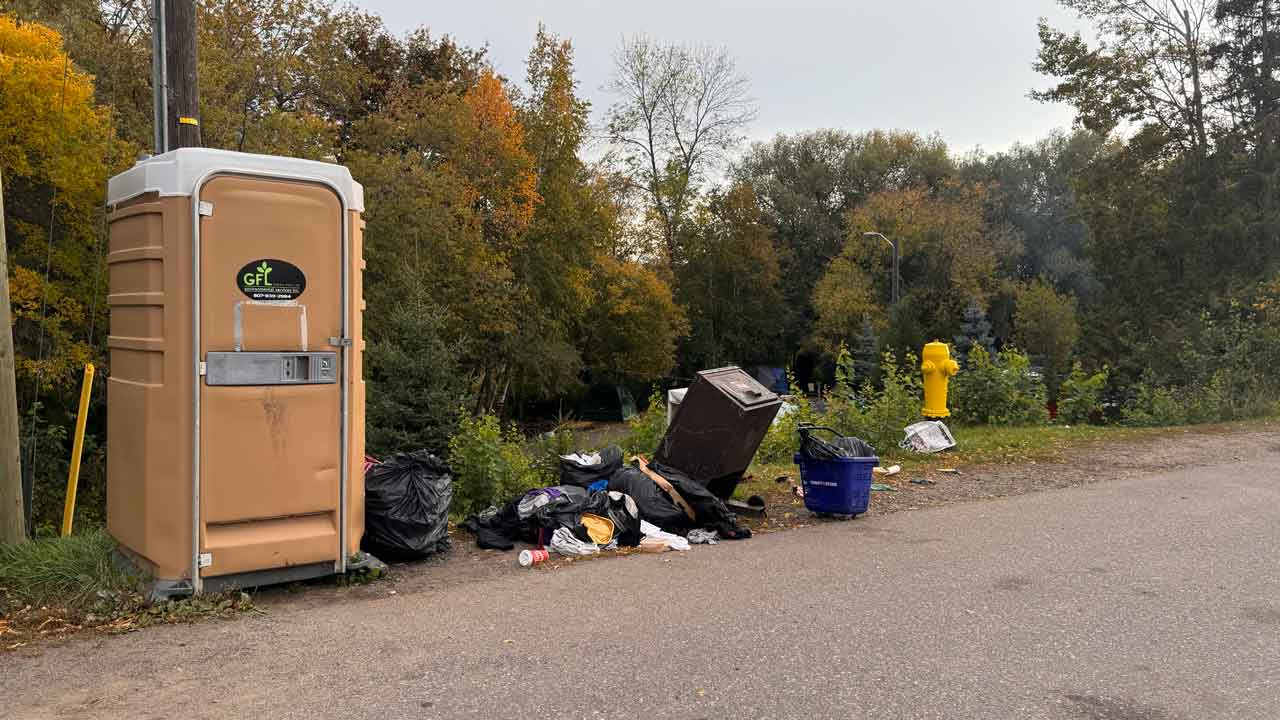
Meanwhile the tent encampments at Freedom Park, Donald Street and along McVicars Creek have grown. Along McVicars Creek there are people building their own structures even though the COTB has said that the encampments there need to move.
This chronology supports criticism of delayed delivery.
It does not establish how many crimes or overdoses could have been prevented by an earlier opening.
That question would require evidence beyond the project schedule.
Government action should be acknowledged—and tested
The village is now a tangible response. The city describes it as temporary supported accommodation, with access to basic needs, health services and pathways to housing.
Its stated performance measures include occupancy, connections to services and the number of residents moving into stable housing. Those are appropriate measures which NetNewsLedger will be following up on.
Ontario also included Thunder Bay in its announcement of the first nine Homelessness and Addiction Recovery Treatment Hubs in 2025. The existence of a programme, however, does not by itself demonstrate that everyone needing help can receive it promptly.
There is reason to scrutinize future capacity.
Ontario’s Financial Accountability Office projects that the number of households supported by provincial homelessness programmes will fall from 204,876 in 2025–26 to 187,205 in 2028–29 under the spending outlook it examined. That is a provincial projection, not a confirmed reduction in Thunder Bay services.
What meaningful accountability would look like
Thunder Bay needs a public accounting of results across the organizations responsible for policing, housing, health care and social supports.
A useful quarterly report would show:
- Crime trends by offence, with explanations of changes in reporting or enforcement.
- Treatment waiting times and the number of people receiving care.
- Shelter availability, occupancy and barriers preventing people from accessing it.
- Moves into permanent housing and whether those placements last.
- Opioid deaths and emergency responses, clearly distinguishing city and district figures.
- Project deadlines, actual delivery dates and explanations for missed milestones.
Residents who experience theft, threats or violence deserve protection and an effective police response. People living outdoors and families affected by addiction deserve accessible care and stable housing.
The documented history gives governments difficult questions to answer: why acknowledged service gaps persisted, why shelter delivery took so long, and what measurable improvements their spending is now producing. Accountability will be strongest when it follows those records closely and demands results that the public can verify.
Summary: Thunder Bay’s crime, opioid and homelessness crises demand accountability. Records show longstanding warnings and shelter delays, but causes remain complex.