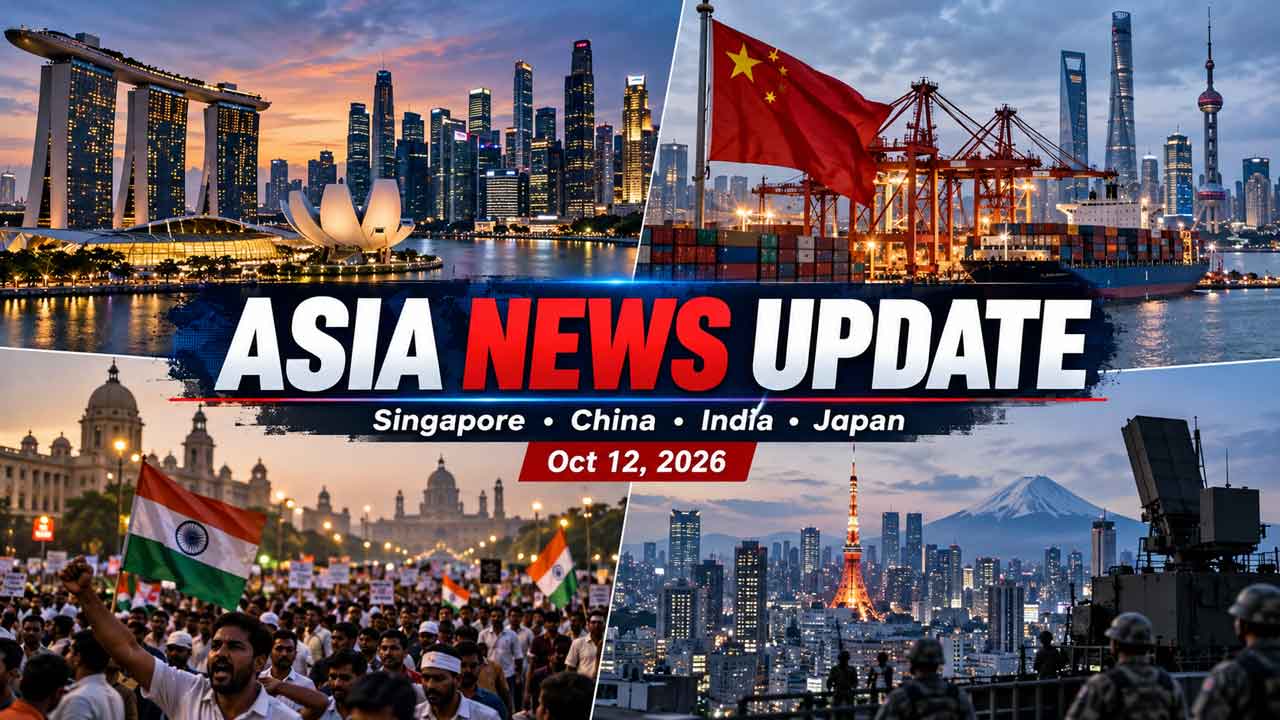
Asia news for October 12, 2026: China-EU trade negotiations, India’s inflation and protests, North Korean missiles, and Singapore’s AI warnings
NetNewsLedger International News | Monday, October 12, 2026
THUNDER BAY, ON — Asia’s largest economies are facing a week of growing political, economic and security challenges as trade disputes, inflation, artificial intelligence and military tensions reshape the region.
For Monday, October 12, 2026, the leading developments across Singapore, China, India and Japan include a new China-European Union trade arrangement, widespread political protests in India, North Korean ballistic missile launches near Japan, and warnings from Singapore’s leaders about the impact of artificial intelligence on employment.
The news matters far beyond Asia. Decisions being made in Beijing, New Delhi, Singapore and Tokyo could influence Canadian manufacturers, Ontario’s critical minerals industry, global investment and the cost of imported goods.
For Northwestern Ontario, where mining, forestry, transportation and international trade remain essential parts of the economy, developments in Asian markets deserve close attention.
Singapore: Artificial Intelligence, Economic Growth and Public Health


1. President Tharman warns artificial intelligence is threatening entry-level jobs
Singapore President Tharman Shanmugaratnam delivered a warning at the International Monetary Fund and World Bank annual meetings in Bangkok on Monday.
Speaking about the growing use of artificial intelligence, Tharman said governments need to address a decline in demand for workers entering the labour market.
New university graduates may be among the first to experience the change, as businesses turn to automated systems for tasks previously handled by junior employees.
The Singapore president also warned that AI could widen economic divisions between richer countries and developing nations.
The concern is not simply that existing jobs will disappear. It is that young workers could lose the entry-level opportunities that traditionally allow them to gain experience and advance into better-paying careers.
The issue has become an international economic challenge as companies invest heavily in AI systems that can handle research, financial analysis, customer service and administrative work.
2. Prime Minister Lawrence Wong calls for AI to strengthen society
Singapore Prime Minister Lawrence Wong is also urging businesses and educators to use artificial intelligence without sacrificing the development of human skills.
Wong said Singapore must protect basic learning in schools and ensure employers continue training and mentoring junior employees.
His government’s approach places emphasis on retraining, fair treatment of displaced workers and regional digital cooperation through the Association of Southeast Asian Nations (ASEAN).
The message is that Singapore wants to benefit from AI-driven growth without allowing technology to weaken education or eliminate pathways into employment.
3. Singapore faces an important monetary policy decision on October 14
The Monetary Authority of Singapore is expected to tighten monetary policy when it releases its next decision on Wednesday, October 14.
All 10 economists surveyed by Reuters before the meeting expected further tightening.
Singapore’s economy has benefited from strong investment in technology and AI infrastructure, but rising energy prices and food supply risks have created fresh inflation concerns.
Unlike the Bank of Canada, Singapore’s central bank primarily manages monetary conditions through the exchange rate rather than a conventional policy interest rate.
Economists are watching whether the authority will allow the Singapore dollar to appreciate more quickly to help control the cost of imported goods.
4. Smoke and haze raise health concerns
Singapore is also dealing with unhealthy air quality linked to regional haze.
The government has activated medical subsidy measures beginning October 12 to help eligible residents seek treatment for haze-related health problems.
The environmental problem has affected transportation, with Malaysian carrier Firefly cancelling flights between Seletar and Subang airports as a safety precaution.
The situation illustrates how air pollution crossing international borders can affect public health, business operations and transportation across Southeast Asia.
Why Singapore matters to Canada: Singapore is a major financial, shipping and technology centre. Its experience with AI, inflation and regional trade offers an early view of challenges that Canadian businesses and governments are also confronting.
China: European Trade Negotiations, Taiwan and Growing Economic Pressures


1. China and European Union reach arrangement on hybrid vehicle exports
One of Monday’s biggest international business developments comes from trade negotiations between Beijing and Brussels.
China’s Ministry of Commerce announced the outcome of extensive consultations with the European Union over trade in hybrid and electric vehicles.
The arrangement addresses European concerns about the growing volume of Chinese-made vehicles entering its markets while attempting to provide Chinese exporters with greater certainty.
European officials have indicated the measures could sharply reduce Chinese hybrid vehicle shipments to the EU. China says the arrangement must avoid discrimination and provide a predictable framework for exporters.
The outcome follows three months of negotiations involving senior trade officials.
However, the agreement does not resolve every trade dispute between China and Europe.
The broader issue remains competition between China’s rapidly expanding automotive industry and European manufacturers facing significant pressure from lower-cost imports.
Why this matters to Ontario
Ontario’s automobile manufacturing industry is closely linked to the North American market, but competition from China has become a major international issue.
Chinese electric vehicle manufacturers have developed substantial capacity in battery technology, vehicle assembly and supply chains.
The European arrangement could influence how other governments consider tariffs, import restrictions and industrial policy.
For Northern Ontario, the longer-term implications include investment in nickel, lithium, graphite and other minerals used in batteries and advanced manufacturing.
A significant shift in where electric vehicles are manufactured can influence which mining and processing projects attract investment.
2. Beijing imposes sanctions on officials from two countries that recognize Taiwan
China announced sanctions Monday against officials from Paraguay and Belize over their countries’ diplomatic relationships with Taiwan.
The sanctions target Paraguay’s Communications Minister Gustavo Villate and Belize’s Foreign Minister Francis Fonseca.
Measures include travel restrictions covering Hong Kong and Macau and prohibitions on cooperation with Chinese organizations.
Taiwan condemned the move as interference in the sovereign foreign-policy decisions of other countries.
Beijing considers Taiwan part of China and has worked for years to reduce the number of countries maintaining official diplomatic relations with Taipei.
The sanctions are largely symbolic, but they underscore continuing diplomatic tensions surrounding Taiwan’s international recognition.
3. China’s growing debt raises questions about its economic model
A separate economic analysis published Monday by The Wall Street Journal examines the mounting debt associated with China’s investments in manufacturing, technology, infrastructure and local government projects.
China has continued to prioritize industrial expansion and technological leadership, even as weak domestic demand and difficulties in the property market put pressure on economic growth.
High borrowing levels have raised concerns about whether some investments will generate enough revenue to repay their costs.
The challenge for Beijing is balancing support for strategically important industries with the need to strengthen household consumption and financial stability.
China’s ability to manage its debt will affect global demand for minerals, construction materials and industrial equipment.
4. China continues investing in artificial intelligence infrastructure
Chinese companies and governments are accelerating investment in computing facilities designed to support large-scale AI applications.
State news agency Xinhua reported Monday on the development of so-called token factories, facilities that provide the computing capacity required to run AI services at scale.
The expansion reflects China’s ambition to compete with the United States in artificial intelligence and the infrastructure behind it.
Such growth requires advanced chips, electricity, cooling systems, data centres and substantial capital investment.
For Northwestern Ontario, the important question is whether this global technology expansion creates sustainable demand for copper, nickel and other mineral inputs, and how much of that opportunity Canadian producers can capture.
India: Mass Protests, Rising Inflation and Renewed Canada-India Diplomacy


1. Political protests challenge India’s election authorities
One of India’s biggest stories Monday is a growing protest movement challenging the country’s election authorities.
Thousands of demonstrators marched in New Delhi demanding the resignation of Chief Election Commissioner Gyanesh Kumar.
The protests centre on allegations that changes to electoral rolls removed large numbers of voters and unfairly benefited Prime Minister Narendra Modi’s ruling Bharatiya Janata Party.
Opposition groups and youth activists have accused election officials of undermining democratic accountability.
The allegations are serious, but they should not be treated as proven findings of electoral misconduct.
Security has increased across New Delhi, with barricades, detention vehicles and restrictions affecting traditional protest areas.
2. Journalists allege mistreatment during demonstrations
The political crisis has also become a press freedom issue.
Reuters reported Monday that nearly three dozen journalists had been detained during coverage of the youth-led demonstrations.
Journalists and press freedom organizations alleged that police seized mobile phones and interfered with reporters carrying out their work.
The Press Club of India and other media organizations have called for accountability and an investigation.
Indian authorities have not provided a full public explanation of all the reported incidents.
The dispute raises important questions about how governments balance public security, the right to protest and journalists’ freedom to report on political controversies.
3. India’s inflation rises to 5.54 per cent
India’s economic outlook became more complicated Monday after new figures showed annual consumer price inflation rose to 5.54 per cent in September 2026.
The result was higher than economists had anticipated and brought inflation closer to the Reserve Bank of India’s six per cent upper tolerance limit.
Food inflation reached 7.74 per cent, with price increases affecting essential products.
India has experienced four consecutive months of inflation above the central bank’s four per cent target.
The Reserve Bank of India increased its benchmark interest rate to 5.5 per cent earlier in October, and economists now expect additional rate increases may be needed.
India is particularly vulnerable to energy price increases because it imports much of the oil needed to power its economy.
Weaker monsoon conditions have also contributed to concerns about domestic food production and costs.
4. Indian rupee rebounds after central bank intervention
Despite pressure from inflation and energy costs, India’s currency recorded its strongest one-day gain in approximately six months on Monday.
The rupee strengthened by about one per cent against the American dollar, reaching approximately 95.77 rupees per US dollar.
The improvement followed measures by the Reserve Bank of India intended to reduce demand for US dollars and stabilize currency markets.
Those measures included changes to the way oil companies obtain foreign currency and tighter rules affecting some currency hedging activities.
However, economists caution that India’s currency remains exposed to high energy prices, capital outflows and international financial uncertainty.
5. Canadian Foreign Minister expected to travel to India

An important diplomatic development for Canada is the expected visit of Foreign Affairs Minister Anita Anand to India.
Indian reporting on October 12 says Anand is expected to meet External Affairs Minister Subrahmanyam Jaishankar as the two governments work to strengthen relations.
The visit could offer an opportunity to advance discussions on trade, investment and other areas of cooperation while addressing continuing diplomatic concerns.
Canada and India have important economic connections involving education, technology, agricultural products, professional services and investment.
For Northwestern Ontario, improved bilateral relations could eventually create additional opportunities in critical minerals, mining technology and advanced manufacturing.
Those possibilities remain economic opportunities, not confirmed agreements resulting from the planned visit.
6. India’s finance minister strengthens economic outreach in Singapore
Indian Finance Minister Nirmala Sitharaman has completed a visit to Singapore focused on attracting investment and strengthening cooperation in infrastructure, artificial intelligence and semiconductors.
The initiative reflects India’s efforts to attract international capital and develop more advanced domestic manufacturing capabilities.
Singapore’s financial institutions and technology investment networks make it an important partner for India as it expands its industrial base.
India’s ambition to become a larger manufacturing and technology power could increase competition for investment, skilled workers and raw materials across the global economy.
Japan: North Korean Missile Launches Raise Security Concerns as Tokyo Confronts Economic Challenges


1. North Korea fires multiple ballistic missiles toward the Sea of Japan
Japan’s most significant security development Monday came from North Korea.
North Korea launched multiple ballistic missiles toward the waters off its eastern coast, drawing condemnation from Japan and South Korea.
Reports that the missiles were fired from an area near Pyongyang are circulating. At least one travelled more than 900 kilometres.
Japanese authorities reported detecting two launches, including a projectile exhibiting characteristics associated with hypersonic weapons.
Japan lodged a diplomatic protest through Beijing.
The latest launches follow a South Korean hypersonic missile test on October 9, adding to an escalating cycle of military demonstrations on the Korean Peninsula.
North Korea also conducted a missile test on October 3.
The launches raise concerns about the development of missiles designed to travel at high speeds and complicate existing missile defence systems.
Japan is one of the United States’ most important security partners in the Pacific.
Any deterioration in regional stability could affect shipping, aviation, trade and international investment.
South Korea and Japan are also central to the production of semiconductors, automobiles, electronics and industrial equipment.
A prolonged regional crisis could therefore disrupt supply chains far beyond East Asia.
For Canada, stability in the Pacific is especially important because of growing commercial and security ties with Japan, South Korea and other regional partners.
2. Prime Minister Sanae Takaichi faces a difficult economic balancing act
Japanese Prime Minister Sanae Takaichi is confronting questions about inflation, government spending and the value of the yen.
Her administration has attempted to move away from its reputation for favouring expansive government spending and relatively loose monetary policies.
However, economists and investors remain concerned about Japan’s large public debt and the difficulty of controlling government spending.
Takaichi has pledged to limit new debt issuance to approximately 40 trillion yen, while government budget requests remain historically high.
The administration must balance spending priorities with the need to protect household purchasing power and maintain confidence in government finances.
On October 9, Takaichi said the government would continue to monitor currency and inflation developments carefully and respond when appropriate.
3. Japan’s economic challenges reflect wider global concerns
Japan’s circumstances are part of a larger international debate over rising government debt.
High borrowing costs and persistent inflation are affecting governments across developed economies.
Japan faces an especially difficult challenge because of its ageing population, large public debt and pressure to support economic growth.
A weakening yen can benefit some exporters by making Japanese products less expensive overseas. However, it also increases the domestic cost of imported energy, food and raw materials.
The government’s ability to manage these competing pressures will influence business confidence and investment decisions.
4. Global energy conflict adds pressure to Japan’s economy
Japan is among the countries warning citizens against travel to Saudi Arabia following missile and drone attacks affecting the kingdom.
The escalation in the Middle East has increased concerns about energy supplies, international transportation and economic stability.
Japan, which depends heavily on imported energy, is vulnerable to sustained increases in global oil and gas prices.
For Canadian energy and resource companies, prolonged uncertainty in international energy markets can influence demand, prices and investment. However, those effects depend on how long the conflict continues and whether supply disruptions worsen.
Economic Watch: Asia’s AI Boom Could Support Growth but Disrupt Employment
One of the central stories connecting Singapore, China, India and Japan is the accelerating investment in artificial intelligence.
Speaking at the IMF and World Bank meetings in Bangkok, IMF Managing Director Kristalina Georgieva highlighted the role AI-related investment is playing in supporting economic growth.
The IMF estimates that global growth is running around three per cent, with AI investment offering meaningful support to economic activity.
The technology could raise productivity across advanced and developing economies, but it also creates major workforce challenges.
The IMF has warned that as many as 60 per cent of jobs in advanced economies could be affected by AI, although being affected does not necessarily mean a job will disappear.
The challenge for governments is to ensure the benefits of automation are shared while supporting workers whose jobs are changing.
India’s inflation challenge
Consumer inflation
5.54%
September 2026
Food inflation
7.74%
Annual increase
RBI policy rate
5.50%
October 2026
What These Developments Mean for Thunder Bay and Northwestern Ontario
Although these stories are unfolding thousands of kilometres from Northwestern Ontario, there are several direct economic connections worth watching.
Critical minerals and mining: China remains a major participant in global mineral processing and industrial supply chains. Japan and India are also important markets for industrial materials. Competition over batteries, AI infrastructure and manufacturing could influence investment opportunities for Canadian mining companies.
Forestry and transportation: Asian economic growth influences international demand for building materials, pulp, paper and other products. Trade disputes and changes in shipping costs can affect Canadian exporters even when shipments are destined for North American markets.
Cost of living: Rising global energy prices and disruptions to international supply chains can increase costs for Canadian businesses and households. The effects are not necessarily immediate, but prolonged instability can raise transportation and production expenses.
Technology and employment: Singapore’s warnings about entry-level jobs are relevant to Canadian businesses, schools and governments. Employers adopting AI will need to consider how to preserve training and career development opportunities.
Canada-India relations: Renewed diplomatic engagement could create opportunities for Canadian exporters and investors, especially in technology, education and natural resources.
These are potential channels of impact, not forecasts of specific changes in Thunder Bay jobs, commodity prices or business activity.
What NetNewsLedger’s International News Desk Is Watching Next
The coming days will provide several important tests for Asia’s economic and political stability.
-
October 14 — Singapore: The Monetary Authority of Singapore’s scheduled monetary policy decision could reveal whether inflation is becoming a more serious threat.
-
India’s political unrest: Watch for further demonstrations, responses from election authorities and developments concerning detained journalists.
-
China-EU trade: The practical implementation of the new vehicle trade arrangement will be important for automakers and governments considering their own trade measures.
-
Japan and North Korea: Further missile testing or military responses could raise security concerns across Northeast Asia.
-
Canada-India diplomacy: Minister Anand’s expected meetings could provide an indication of whether the two countries are making progress on trade and diplomatic relations.
The Bottom Line
Monday’s headlines highlight a region caught between substantial economic opportunity and serious political and security challenges.
China is working to protect its industrial exports while confronting domestic financial pressures. India faces inflation and political unrest as it seeks more international investment. Japan must balance national security concerns with economic stability. Singapore is offering a warning about the social and economic consequences of rapidly advancing artificial intelligence.
For Canada and Northwestern Ontario, the opportunity lies in supplying resources, expertise and technology to growing Asian markets. The challenge will be maintaining competitive industries while navigating trade disputes, international instability and changes in global demand.
NetNewsLedger will continue to follow these developments as part of its international business, technology and economic coverage.