Ontario’s Wildfire Preparedness Under Scrutiny: What Supports the NDP’s Criticism?
THUNDER BAY — Ontario New Democrats are demanding accountability for the province’s preparations for the devastating 2026 wildfire season. Available evidence supports serious questions about staffing and readiness, but it does not establish that government decisions caused the destruction or that every loss could have been prevented.
Thunder Bay—Superior North MPP Lise Vaugeois renewed those concerns in an Oct. 2 statement, calling for at least 200 firefighting crews, more year-round staff, better equipment, firebreaks and stronger partnerships with First Nations.
The concern has substance, but the strongest allegations remain unproven
The clearest evidence supporting scrutiny is the gap between the number of operational firefighting crews reported this summer and the staffing levels identified by their union.
Ontario disputes the union’s benchmark and points to permanent hires, increased compensation, aircraft investments and access to additional resources through contracts and mutual aid. Those preparations mean it would be inaccurate to suggest the province took no action before the season. Whether those actions were sufficient is the central unresolved question.
“The question isn’t just how much money this government is spending, but whether it’s spending in the right places and investing in the preparation, equipment and full-time firefighters needed to protect northern communities,” Vaugeois said.
Her further assertion that the devastation “was not inevitable” is a political conclusion. The public sources reviewed for this article do not establish which losses a different staffing or deployment plan would have prevented.
What the staffing figures show
In July, OPSEU/SEFPO reported that Ontario had approximately 156 operational crews, compared with what the union described as an approved complement of 190.
The union subsequently said it had obtained a Ministry of Natural Resources briefing showing 143 crews in July 2024, against an identified optimal complement of 189. That older document supports questions about a recurring staffing gap, although it does not independently establish the appropriate complement for 2026.
The government rejected the characterization of 190 crews as a current target. In a statement published by The Trillium, a ministry spokesperson said Ontario could supplement its capacity through mutual aid and contracts.
The union’s preferred level is higher still: 250 initial-attack crews. Its representative described that figure as an operational judgment by experienced workers, rather than the result of a statistical study. Vaugeois’s call for at least 200 crews should likewise be understood as a proposed staffing standard, rather than a proven threshold that would guarantee community protection.
What Ontario says it did before the season
Ontario’s March 31 preparedness announcement said the province had added 68 permanent staff and increased compensation for wildland firefighters, pilots and aircraft maintenance engineers.
It also identified 100 permanent positions filled during 2024 and 2025, and a previously announced $64-million provincial-federal investment in equipment, suppression tools and training.
Those additions need to be interpreted carefully. Permanent positions include the people who organize and support firefighting, as well as those deployed on crews.
In an August commentary, OPSEU/SEFPO representative Jeremy Rouse said 20 of the 68 new positions were frontline crew-leader roles, with the remainder spread across essential functions including aviation, dispatch, logistics, training and administration. Sixty-eight positions therefore do not mean 68 additional crews.
Natural Resources Minister Mike Harris has defended concentrating permanent employment on experienced leadership roles. He also noted that some seasonal firefighters are students who return to school during the winter.
The budget debate requires an accurate comparison
Ontario’s 2026 budget lists the following figures for its Emergency Forest Firefighting spending line:
| Fiscal year | Amount | Status in the 2026 budget |
|---|---|---|
| 2023–24 | $203 million | Actual spending |
| 2024–25 | $171 million | Actual spending |
| 2025–26 | $271 million | Interim estimate |
| 2026–27 | $150 million | Spending plan |
These figures concern one emergency firefighting allocation, rather than every expenditure supporting wildfire management. The $271-million figure was an interim estimate when the budget was published.
Comparing $150 million with $271 million produces a $121-million difference, but that comparison alone does not establish a $121-million reduction in available firefighting resources. It compares a new spending plan with the previous year’s estimated costs after a difficult season.
Ford has said Ontario would spend beyond the $150-million allocation as required. Reporting in July also identified the previous year’s initial allocation as $135 million — below the 2026 starting amount. The Premier made this statement in a press conference in Thunder Bay this past summer.
The NDP and union raise a different issue: whether predictable funding before the season enables sufficient hiring, training, contracting and advance deployment. Emergency spending after fires escalate does not, by itself, answer that question.
What is the Ontario government’s response?
The government maintains that it will fund the response according to need. The Trillium’s Sept. 30 report described Harris’s explanation of the emergency allocation as “fluid, flexible base funding.”
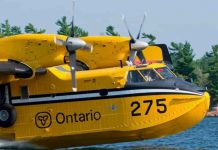
In a Sept. 14 announcement, Ontario pointed to more than 170 permanent fire-management positions added since 2024, higher compensation and a $650-million aircraft investment covering six new waterbombers and five helicopters.
It also announced more than $20 million to modernize the Vedette and Socket Lake forward attack bases in Northwestern Ontario, with completion expected before the 2027 fire season.
The timing matters when assessing preparedness for this summer. Improvements scheduled for 2027 cannot demonstrate that the upgraded facilities were available in 2026. Similarly, reporting based on a ministry announcement placed delivery of the six new waterbombers in the early 2030s. Those aircraft represent future capacity.
Thunder Bay 36 shows the stakes, but does not settle responsibility
The description of Thunder Bay 36 as Ontario’s largest recorded wildfire is supported by July reporting drawing on ministry information. By July 23, the merged fire covered approximately 318,813 hectares.
The disaster forced evacuations around Armstrong and Whitesand First Nation. Residents of Namaygoosisagagun First Nation, also known as Collins, fled by boat when fire swept into their community.
For Thunder Bay and surrounding communities, the consequences extended beyond the fire perimeter to emergency accommodation, displaced families and the uncertainty of returning home.
However, fire size and destruction alone cannot identify which operational decisions were adequate or inadequate. Even Rouse’s criticism acknowledged that additional crews could not guarantee a different outcome on every fire.
The records needed to establish accountability
A convincing assessment of the 2026 response would require more than competing spending announcements. The outstanding questions include:
- How many fully staffed, deployable crews were available each week, and where?
- What aircraft were serviceable, crewed and available when communities faced danger?
- Were requests for crews, aircraft or protective equipment delayed or declined?
- When were threats identified, warnings issued and evacuation assistance requested?
- What prevention work had communities and First Nations requested, and what was funded?
The evidence supports Vaugeois’s demand for scrutiny of preparedness. A definitive finding that particular homes or communities could have been saved requires incident-level records and an independent examination of the decisions made.