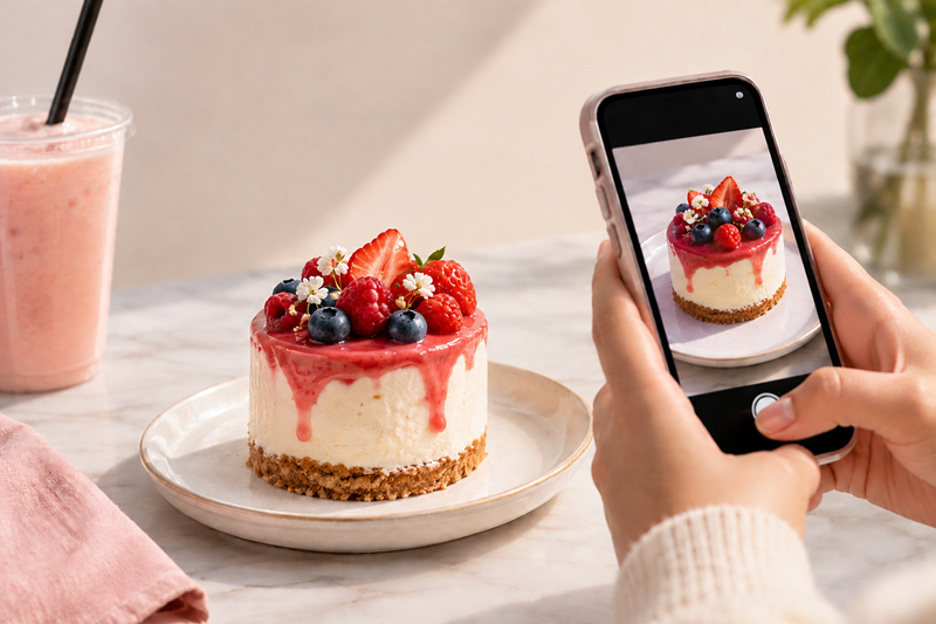
There was a time when a good dessert simply had to taste good. Today, that’s only half the job. If it doesn’t look good enough for a Reel, a Story, or a group chat forward, does it even count? For Gen Z, dessert has quietly become less about the last bite and more about the first click of a camera shutter.
This shift isn’t random. It’s the result of a generation that grew up documenting everything, from breakfast to breakups, and desserts happened to be the most photogenic thing on the table.
Why Food Has Become Part of Gen Z’s Social-Media Identity
Food used to be a private pleasure. Now it’s a public statement. For Gen Z, what you eat, where you eat it, and how you photograph it says something about who you are, what you value, and what’s currently trending in your circle.
Social media has turned every meal into a potential post. A slice of cake isn’t just a slice of cake anymore; it’s content. And content needs to perform. That means colour, texture, and composition matter as much as flavour, sometimes more.
This isn’t shallow vanity, even though it’s often dismissed as such. It’s identity-building. Gen Z uses food choices to signal creativity, curiosity, and taste. Ordering something niche or visually unusual becomes a small act of self-expression, one that gets validated (or not) through likes and comments. Brands that understand this aren’t just selling desserts anymore; they’re selling a moment worth sharing.
What Makes a Dessert “Instagram-Worthy”?
Not every dessert earns a spot on someone’s feed. There’s an unspoken checklist Gen Z applies, often without even realising it.
Visual appeal tops that list. Bold, saturated colours photograph better than muted, “safe” tones. A pastel macaron or a rainbow drip cake simply performs better on camera than a plain vanilla slice, even if the vanilla slice tastes just as good.
Unusual shapes and designs come next. Anything that breaks the expected mould, a geometric cake, a dessert shaped like an everyday object, or a jar dessert layered like a science experiment, tends to stop the scroll.
Personalised messages have also become a quiet trend-driver. A cake with a name, an inside joke, or a birthday roast written across it feels more “postable” than a generic design, because it signals that the dessert was made for someone specific, not pulled off a shelf.
And then there’s portion size. Miniature and individual desserts, think mini bundt cakes, tiny tarts, or single-serve jars, photograph beautifully and fit neatly into a flat-lay. They also solve a very Gen Z problem: wanting variety without commitment to one giant slice.
From Matcha to Dubai Chocolate: The Flavours Gen Z Is Watching
Flavour trends now move at social media speed rather than culinary speed. Matcha went from a niche café order to a mainstream obsession largely because of its striking green colour and “wellness” association, both of which translate beautifully on screen.
Then came Dubai chocolate, the pistachio-kunafa filled bar that took over feeds almost overnight. Its appeal wasn’t just the unusual combination of textures; it was the way it photographed and, more importantly, the way it sounded when someone bit into it on video. Gen Z doesn’t just want to see food anymore; they want to hear it too.
These flavour waves rarely start in bakeries. They start online, get amplified by creators, and only then filter into mainstream demand, often faster than traditional dessert brands can keep up.
Why Cupcakes Fit the Social-Media Dessert Trend
Few desserts fit this new culture as naturally as cupcakes. They’re small, individually portioned, and endlessly customisable, which checks almost every box on the “shareable dessert” list.
A single cupcake can be dressed up with different frostings, toppers, colours, and themes, making it easy to create a dessert that feels personal without needing an entire cake’s worth of effort. For celebrations, a set of mismatched or themed cupcakes photographs far more interestingly than one uniform cake, since each one can tell a slightly different visual story.
Cupcakes also solve a portion-control problem that resonates with Gen Z’s more flexible approach to indulgence. You can have “just one” without committing to a full slice, take a picture, and move on with your day.
The Rise of Personalised and Customised Desserts
Mass-produced desserts are losing their appeal to a generation that values individuality. Customisation has become less of a premium add-on and more of an expectation.
This shows up everywhere, from cakes with edited photo prints to desserts designed around inside jokes, pet names, or niche pop culture references. The goal isn’t just a nice dessert; it’s a dessert that couldn’t have been made for anyone else.
This trend has also blurred the line between baker and designer. Dessert makers are now expected to interpret briefs the way a graphic designer would, translating a vague idea like “something chaotic but cute” into an actual edible design. For brands, this means offering flexible customisation isn’t optional anymore; it’s the baseline.
The Growing Convenience of Online Desserts
None of this trend-chasing would be possible without the sheer convenience of online desserts. Ordering a niche, trending, or highly customised dessert used to mean hunting down a specialty bakery. Now, it means a few taps on an app.
Same-day and midnight delivery options have made it easier for Gen Z to act on impulse, whether that’s recreating a viral dessert they just saw or surprising a friend last minute. Wide catalogues let people compare designs, flavours, and customisation options before deciding, almost the way they’d browse an outfit before buying it.
This convenience has effectively removed the gap between “seeing a trend” and “having it in hand,” which is a big reason dessert trends spread so quickly among this age group.
Are Social-Media Trends Changing the Future of Desserts?
It’s tempting to dismiss this as a passing phase, but the shift looks structural rather than temporary. Dessert brands are increasingly designing with the camera in mind from the start, not as an afterthought.
This doesn’t mean taste is taking a back seat. If anything, brands now have to deliver on both fronts: a dessert has to look good enough to post and taste good enough to justify the hype once the photo is taken.
What’s clear is that the dessert industry’s future will be shaped as much by what performs well online as by what tastes good on the plate. For Gen Z, the two have simply stopped being separate questions.