The ruling restores the outlets’ press passes for 14 days, but it does not end the constitutional fight over whether a president may punish news organizations for coverage he dislikes
WASHINGTON / Thunder Bay – NEWS ANALYSIS – September 24, 2026 – A federal judge has ordered the Trump administration to immediately restore White House press credentials to CNN, MS NOW and Politico, delivering an important but temporary victory for the three news organizations.
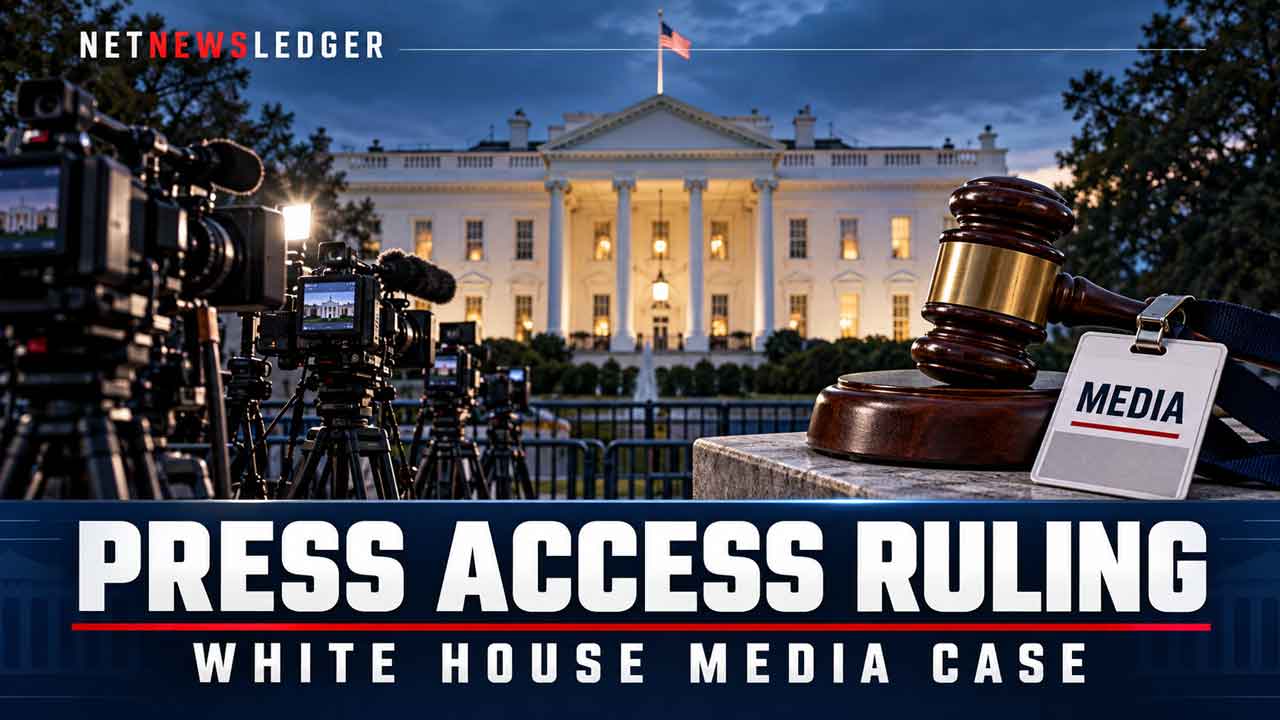
US District Judge Timothy J. Kelly issued a 14-day temporary restraining order shortly after midnight on Thursday. The order returns the dispute to the position it was in before President Donald Trump announced the ban on September 18.
The most important point is also the easiest to miss: Kelly has not issued a final judgment that permanently overturns the ban. He found that the news organizations are likely to succeed, at least on their claim that the White House violated the Fifth Amendment by taking away their passes without fair notice or a meaningful opportunity to respond.
The larger First Amendment question – whether the ban was unconstitutional retaliation for critical reporting – remains before the court.
What the Court Ordered
Kelly ordered administration officials, their agents and anyone acting with them to immediately return, reinstate and restore the White House hard passes held by employees of CNN, MS NOW and Politico.
The order remains in effect for 14 days unless the court changes it. Kelly said he will set an expedited schedule to consider whether a longer preliminary injunction should follow. He also rejected the administration’s request to delay the order while it considers its next legal move.
The court required the three news organizations to post a nominal bond of US$1. That small amount reflects Kelly’s conclusion that the government had not shown it would suffer financial harm from temporarily restoring the passes.
The practical result is immediate access to the White House grounds for credentialed journalists from the three organizations. The ruling does not guarantee them admission to every meeting, interview, Oval Office appearance or other event where space is limited.
How the Ban Began
Trump announced the ban on September 18 through social media. He said CNN, MS NOW and Politico should not be allowed to keep reporting what he described as fiction, lies and fake news while covering the president.
The policy was enforced the next morning. Journalists from the three outlets were turned away from the White House complex. Their electronic credentials had been deactivated, and a Politico reporter’s pass was taken by the Secret Service.
The action was unusually broad. This was not only a decision about who could enter the Oval Office or travel on Air Force One, where security and limited space require a small rotating group. It removed the outlets’ journalists from the White House grounds and their regular work spaces.
The ban also disrupted television coverage far beyond CNN. CNN is one of five major networks that operate the main White House television pool. When CNN was prevented from completing its assigned pool duty during Trump’s trip to the United Nations, ABC, CBS, Fox News and NBC suspended their participation rather than replace it.
A press pool is not an endorsement club. It is a practical system in which a small group gathers video, audio, photographs and written observations on behalf of the wider press corps when every reporter cannot fit into an event. Removing one member can therefore reduce the information available to local stations, newspapers and audiences across the country.
Why the News Organizations Sued
CNN, MS NOW and Politico filed their joint lawsuit on September 21. They argued that the ban violated two separate constitutional protections.
- First Amendment: The government may not retaliate against journalists because it dislikes their reporting or editorial viewpoint.
- Fifth Amendment: When the government has granted a journalist a White House hard pass, it cannot take that protected interest away without fair procedures.
The outlets said there had been no advance warning, clear rule, hearing or chance to respond before their access was cut off. They also argued that Trump’s own statements showed the ban was punishment for negative coverage.
Why Judge Kelly Focused on Due Process
Kelly based the temporary order on the narrower Fifth Amendment issue. Courts often decide emergency applications on the clearest available ground instead of resolving every constitutional question at once.
Two decisions from the US Court of Appeals for the District of Columbia Circuit controlled his analysis.
In Sherrill v. Knight, a 1977 case involving a reporter for The Nation, the appeals court held that a bona fide Washington correspondent has a protected liberty interest in obtaining a White House press pass. The government must use published standards, give reasons for a denial and provide an opportunity to respond.
In Karem v. Trump, decided in 2020, the same appeals court held that a duly issued hard pass cannot be suspended without due process. A journalist must have fair warning about both the conduct that could lead to punishment and the possible sanction.
The administration openly argued that those cases were wrongly decided. Kelly answered that a trial judge remains bound by higher-court precedent, whether the administration agrees with it or not.
He found that the White House had not followed the required process. The outlets received no advance notice and no chance to be heard before their passes disappeared. The administration sent letters explaining its concerns on September 22 – four days after Trump announced the ban, three days after it was enforced and one day after the lawsuit was filed.
In other words, the White House tried to supply a process after imposing the punishment. Kelly found that was not enough on the record before him.
The National Security Argument Did Not Persuade the Judge
Justice Department lawyers argued that White House access is a privilege and that the president could act quickly to protect national security. Letters sent to the outlets accused them of violating standards of professionalism and decorum, publishing falsehoods and reporting sensitive or classified information.
The government pointed to coverage involving the Iran conflict, US weapons supplies, a bunker connected to White House construction and security details associated with a ballroom project.
Kelly accepted that protecting national security is a major executive responsibility. He did not accept that merely using those words proved the ban served that purpose.
The judge found no factual support showing that the cited reporting damaged national security or that returning the passes for 14 days would create a danger. Some of the stories were months or years old. In most cases, the reporters who wrote them did not even hold the White House passes that were revoked.
Kelly also noted that the president’s original announcement focused on allegedly false and negative coverage, not classified information. That timing made the later national security explanation look less like the reason for the ban and more like a legal defence developed after the lawsuit began.
The court also found the supposed rule against conduct falling below expected standards of professionalism and decorum was too vague. Without a clear rule in place beforehand, journalists could not know which reporting would cost them access or whether the penalty would be a warning, a short suspension or a total ban.
What the Ruling Says – and Does Not Say – About the First Amendment
The First Amendment prevents the government from abridging freedom of speech or of the press. It does not give every journalist an unlimited right to enter every government building or attend every presidential event.
The White House may use security checks, capacity limits, neutral credential rules and standards for conduct inside press areas. A president may also choose which outlet receives an interview. Those are not the same as removing already issued credentials from entire news organizations because of their reporting.
Once the government creates a regular press-access system and opens White House facilities to bona fide journalists, it cannot administer that system arbitrarily. Viewpoint discrimination – rewarding favourable coverage and punishing unfavourable coverage – is at the centre of the outlets’ First Amendment claim.
Kelly’s order did not finally decide that claim. It found the outlets had cleared the high threshold for emergency relief because they were likely to succeed on at least one constitutional claim: procedural due process.
This distinction will matter as the case advances. A final First Amendment ruling could establish broader limits on presidential retaliation against whole news organizations. A ruling confined to due process could allow the White House to try again using clearer written rules and a hearing, although a process cannot make viewpoint discrimination constitutional.
Why the Associated Press Case Is Different
The administration is likely to rely on its ongoing dispute with The Associated Press. In 2025, a divided federal appeals panel allowed the White House, while that case continued, to control selection for highly restricted spaces such as the Oval Office and Air Force One.
That decision did not give the president a general power to expel disfavoured outlets from the entire White House complex or cancel their hard passes. The CNN, MS NOW and Politico ban was much broader. That difference weakens any attempt to treat the AP ruling as a complete answer to this case.
Kelly’s decision also rests on due-process precedents dealing specifically with hard passes. Even if the president has wide discretion over a small event, the government still faces rules when it takes away a credential that gives a journalist regular access to established press facilities.
How President Trump Is Likely to React
Confirmed facts: Before Kelly ruled, Trump said he would probably allow the journalists back if the court ordered it. He also said his administration would appeal an adverse decision and criticized Kelly, even while noting that Trump himself appointed the judge in 2017. As this article was prepared Thursday morning, the White House had not issued a detailed public response to the order.
Analysis: Trump’s likely response can be estimated from his statements and his approach in earlier press-access disputes, but it cannot be reported as a settled fact until he or the White House speaks.
- Immediate compliance paired with public criticism: The administration is likely to reactivate the passes because Kelly refused to delay his order. Trump can comply while attacking the ruling, the judge and the outlets in speeches or social-media posts.
- An effort to obtain longer-term appellate review: Trump has already promised an appeal. Kelly noted that temporary restraining orders are generally not immediately appealable, which complicates that route. The more conventional next fight will be over a preliminary injunction, followed by possible review in the D.C. Circuit.
- New credential rules: The White House may publish more detailed standards and provide a written response process. That could address some procedural defects, but it would not cure a policy designed to punish an editorial viewpoint.
- Narrower limits on special access: The administration may concentrate on pool assignments, travel or limited-space events where the president has more discretion. That would set up a closer comparison with the Associated Press litigation.
- More direct-to-audience communication: The White House launched a 24-hour Trump TV stream as the dispute grew. Government-produced video is lawful as government speech, but it is not a substitute for independent reporters who can ask questions, verify claims and report what officials would rather leave out.
The strongest prediction is that Trump will treat the ruling as a temporary legal setback, not as the end of his confrontation with major news organizations. The administration may change tactics while preserving the same political message: that unfavourable reporting is illegitimate.
Why the Ruling Matters Beyond These Three Outlets
The case is not about whether CNN, MS NOW or Politico always report accurately. News organizations can make errors, and governments may challenge them, demand corrections and protect genuine secrets through lawful means.
The constitutional issue is who decides which editorial viewpoint is allowed inside a government press system. If a president can remove an outlet because its coverage is negative, the same power can be used by a future president against conservative, progressive, Indigenous, local or international media.
The immediate effect of the ban showed the wider public cost. Pool video disappeared from events, reporters lost the ability to question officials in person, and the White House increased its reliance on selected outlets and its own video channel.
Independent coverage is often uncomfortable for those in power. That discomfort is not a defect in journalism. It is part of the reason constitutional press protections exist.
What Happens Next
The three outlets can use their restored credentials while the temporary order remains active. The court will receive faster-than-normal written arguments on a preliminary injunction, which could preserve access for much longer while the full lawsuit proceeds.
The next stage should provide a fuller record on the First Amendment claim, the administration’s national security evidence, the standards governing White House credentials and any new process the government creates.
For now, the ruling sends a clear but limited message: a presidential social-media post is not a substitute for constitutional procedure, and a national security label does not end judicial review when the government offers little evidence connecting the alleged danger to the punishment it imposed.
Why Canadians Should Watch This Case
The US ruling does not bind Canadian governments or courts. Canada protects freedom of expression and freedom of the press under section 2(b) of the Charter of Rights and Freedoms, but Canadian access disputes are decided under Canadian law.
The democratic principle is still relevant. Governments may manage security, space and accreditation, but decisions should use transparent, content-neutral rules. Excluding journalists because officials dislike their questions or reporting risks turning public information into political favour.
Editor Warnings – Remove Before Publication
- This is a developing legal story. Check for a White House statement, new court filing, appeal attempt or compliance update immediately before publication.
- Do not say the ban was permanently overturned. The current order is a 14-day temporary restraining order, not a final judgment.
- Keep the constitutional distinction clear. Judge Kelly granted relief on the likelihood of success of the Fifth Amendment due-process claim. The First Amendment retaliation claim remains unresolved.
- Trump’s future reaction is analysis. His statements about probable compliance and an appeal were made before the ruling. Update this section if he responds directly.
- Confirm whether the television pool has resumed normal operations. The order restores hard passes but does not itself settle the networks’ separate suspension of pool coverage.
- Use ASCII punctuation and plain-text temperature style in the WordPress editor. This draft contains no curly quotation marks, curly apostrophes or em dashes.
HUMAN APPROVAL REQUIRED: A NetNewsLedger editor must review and approve this analysis before publication. Refresh the court docket and verify the latest response from President Trump, the White House and the three news organizations.