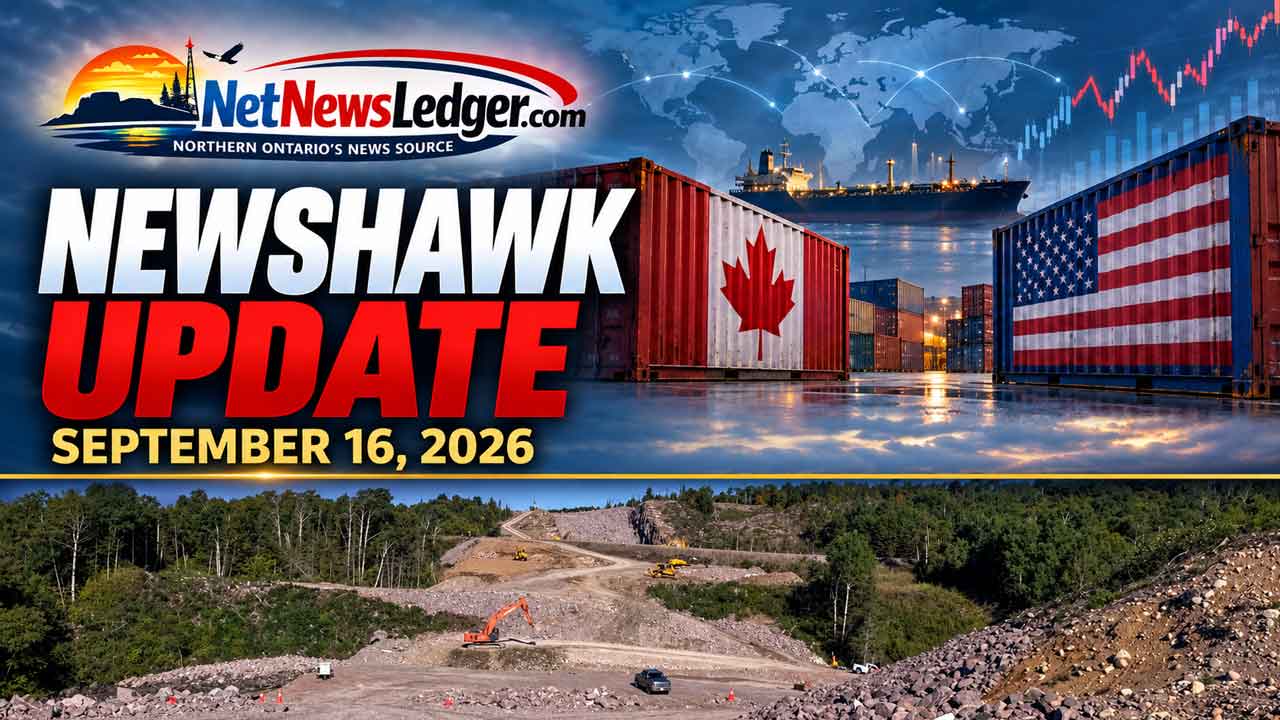
Canada seeks closer European ties during its tariff dispute with the United States as global oil and borrowing costs rise. Here are the international, national, Northern Ontario and Thunder Bay stories to watch September 16, 2026
Canada looks toward Europe as its tariff dispute with the United States deepens, while rising oil prices and borrowing costs create new risks for consumers
THUNDER BAY — NEWS — September 16, 2026 — Canada’s changing relationship with the United States remains the leading story as Canadians begin Wednesday.
Prime Minister Mark Carney is in Europe seeking stronger trade, investment and security partnerships. His government is trying to reduce Canada’s dependence on the United States as President Donald Trump expands his use of tariffs and other trade restrictions.
Overseas, renewed fighting in the Middle East is threatening global energy supplies, while the war in Ukraine continues to move dangerously close to NATO territory.
Closer to home, Northern Ontario municipalities are pressing Ottawa and Queen’s Park to four-lane Highways 11 and 17. Thunder Bay’s shelter-village project and concerns about property crime also remain in focus.
Here are the stories NetNewsLedger NewsHawks need to know:
International: Middle East Fighting Threatens Energy Supplies
Renewed fighting involving Saudi Arabia, Yemen’s Houthi movement and other Iran-backed forces is raising new concerns about global oil supplies.
Missile and drone attacks have targeted Saudi facilities, while diplomatic talks over the Strait of Hormuz remain stalled. The conflict has also spread around the Red Sea, one of the world’s most important shipping routes.
Oil prices moved above US$100 per barrel amid the uncertainty.
For consumers in Thunder Bay and Northwestern Ontario, sustained increases in oil prices could eventually raise the cost of gasoline, diesel, air travel, freight and groceries. Northern communities are especially exposed because nearly every consumer product must travel a long distance by road, rail or air.
Ukraine Reports New Donetsk Offensive as NATO Watches Its Borders
Ukraine says its forces have launched an offensive in the northern Donetsk region near Sloviansk and Kramatorsk.
A senior Ukrainian commander claimed that troops cleared Russian infiltration groups from about 75 square kilometres and recaptured another 10 square kilometres. Reuters could not independently verify those battlefield claims.
Russia continues to seek control of the entire Donetsk region. Peace discussions remain stalled despite renewed American attempts to bring Ukrainian and Russian representatives back to negotiations. Tensions increased after NATO aircraft shot down a drone that entered Lithuanian airspace. The incident followed Russian attacks near the borders of NATO members Poland and Lithuania.
The immediate concern is not simply what happens on the Ukrainian battlefield. Any repeated violation of NATO airspace increases the danger of a direct confrontation between Russia and the alliance.
Global Borrowing Costs Rise as U.S. Bond Yield Tops Five Per Cent
A major selloff in government bonds pushed the benchmark 10-year United States Treasury yield above five per cent on Tuesday—its highest point in almost two decades.
Government bond yields help set borrowing costs throughout the economy. Higher yields can affect mortgage rates, corporate loans, construction financing and the amount governments must spend servicing debt.
The pressure has spread to financial markets in Europe, Japan and Australia. Investors are concerned about inflation, government debt and the possibility of additional interest-rate increases.
This matters in Canada because Canadian rates and financial markets are closely connected to the United States. Even if the Bank of Canada does not immediately raise its policy rate, higher global borrowing costs can make mortgages, business expansion and major infrastructure projects more expensive.
National: Canada Turns Toward Europe During U.S. Trade Dispute
Prime Minister Mark Carney is travelling through Strasbourg, France, and Liverpool, United Kingdom, from September 15 to 17.
Carney is scheduled to address the European Parliament and meet European leaders about trade, investment and security. In Liverpool, he is expected to meet British Prime Minister Andy Burnham to discuss defence, energy, artificial intelligence and critical minerals.
The visit is part of Canada’s attempt to build markets outside the United States.
This does not mean Canada can quickly replace its American market. The United States remains Canada’s largest trading partner and receives most Canadian exports. However, the tariff dispute has made economic diversification a national priority.
Northern Ontario could benefit if new European partnerships generate demand for Canadian nickel, copper, lithium, cobalt, chromite, forestry products and clean-energy technology. Projects will still require financing, infrastructure, environmental approvals and meaningful agreements with affected First Nations. The Prime Minister’s Office outlined the September 15-to-17 European visit.
Inflation Remains at Three Per Cent
Canada’s Consumer Price Index increased three per cent over the 12 months ending in August, matching July’s annual inflation rate.
On a seasonally adjusted monthly basis, consumer prices rose 0.2 per cent in August.
A stable headline rate does not mean household costs are stable. Families may experience very different inflation depending on how much they spend on food, housing, transportation, insurance and energy.
Statistics Canada also reported that Canadian manufacturing sales fell 0.4 per cent in July. The largest declines were recorded in chemical and food-product manufacturing, while petroleum and coal-product sales increased. Statistics Canada published the August inflation and July manufacturing figures.
Investment Summit Promotes Growth but Draws Protests
The first Canada Investment Summit concluded in Toronto after bringing together investors, executives and political leaders.
The federal government promoted more than 160 potential projects involving mining, energy, transportation, technology and infrastructure.
The summit was intended to attract long-term capital and accelerate major Canadian projects. That goal has become more urgent as tariffs disrupt established trading relationships.
Protesters outside the summit raised concerns about fossil-fuel development, military production, artificial intelligence and the possibility of governments using public funds to benefit private investors.
For Northern Ontario, the key question is whether the investment drive will produce projects that deliver local employment, Indigenous ownership, regional procurement and lasting infrastructure—or simply move resources and profits south.
Wet Weather Threatens the Prairie Harvest
Farmers in Saskatchewan, Alberta and Manitoba are struggling with harvest delays caused by repeated rain.
The moisture may reduce the quality and value of wheat, canola, durum and pulse crops. Saskatchewan and Alberta were both behind their five-year harvest averages in early September.
Agricultural problems in Western Canada matter nationally. Lower crop quality can reduce farm income and affect grain exports, food processing and transportation.
Consumers should not assume the harvest problems will immediately produce large grocery-price increases. However, reduced supply, higher fuel prices and rising transportation costs could combine to put additional pressure on food prices.
This can impact the Port of Thunder Bay.
Regional: Ontario Expands Tariff-Support Eligibility
Ontario is expanding eligibility for provincial programs intended to help workers, businesses and communities affected by American trade action.
The move follows new U.S. measures announced September 8, including additional tariffs targeting Canadian exports and import restrictions on some goods.
Northern Ontario’s mining, steel, forestry, manufacturing and transportation sectors are particularly exposed to cross-border disruption.
Government assistance may provide short-term help, but it cannot replace lost customers. Businesses need clear information about which products are covered, how long the tariffs will remain and whether support is available before companies begin reducing production or employment. Ontario’s tariff-support announcement is available through the provincial newsroom.
Northern Municipalities Renew Highway 11 and 17 Campaign
The Federation of Northern Ontario Municipalities and the Northwestern Ontario Municipal Association are calling for a jointly funded federal-provincial plan to four-lane Highways 11 and 17.
The organizations represent 154 Northern Ontario municipalities.
They want a phased plan with priorities, timelines and measurable progress. Northern municipal leaders argue that the highways are not only local transportation routes but essential parts of Canada’s national supply chain.
Highways 11 and 17 carry food, fuel, mining equipment, forestry products, consumer goods and military traffic. Serious collisions or weather-related closures can leave communities and businesses without a practical alternative route.
The proposal would take years and cost billions of dollars. The immediate request is for Ottawa and Queen’s Park to agree that four-laning is the long-term goal and begin identifying the most dangerous and economically important sections. FONOM lists its Northern Ontario transportation advocacy and current releases.
Ontario Commits More Money to Wildland Fire Bases
Ontario is investing more than $20 million to upgrade the Vedette and Socket Lake forward attack bases.
The bases support crews responding to fires in Northern Ontario. The announcement follows an extremely active 2026 fire season that forced evacuations and placed enormous pressure on firefighters, aircraft and host communities.
Ontario had recorded 785 fires by September 13, compared with 541 during the same period in 2025 and a 10-year average of 678.
As of September 14, the Northwest Fire Region had 45 active fires: four being held, 11 under control and 30 under observation.
The falling number of active fires is encouraging, but the legislated fire season continues until October 31. Residents must continue following provincial and municipal burning rules.
Local: Thunder Bay Shelter Village Committee Accepting Applications
The City of Thunder Bay is accepting applications for the Temporary Shelter Village Neighbourhood Liaison Committee.
The proposed village at 879 Alloy Place is expected to provide 80 private, climate-controlled units with beds, locking doors, food, hygiene facilities and 24-hour staffing.
The liaison committee will include people connected to the surrounding area, nearby businesses, service agencies, police, the City and the village operator.
It will be an advisory body. It will not control admissions, direct daily operations or make final decisions about funding and policy.
Applications close September 27. The City says the village will cost approximately $5 million to construct and establish. It has secured $2.8 million in outside capital funding, while the municipal contribution to yearly operating costs is capped at $1.5 million.
Residents will be watching the construction schedule, security arrangements, operating rules and whether the project successfully moves people from homelessness into stable housing. The City has posted project and committee details online.
Online Crime Reports Lead to Thunder Bay Charges
Thunder Bay Police say online reports and security-camera footage helped investigators connect a suspect to several incidents reported between August 1 and September 7.
Police allege the incidents occurred around Arthur Street West, Prince Arthur Boulevard, Fort William Road, Donald Street East, Lillie Street North, Selkirk Street North and Wiley Street.
A 50-year-old Thunder Bay man faces nine counts of mischief under $5,000, nine counts of failing to comply with probation and four counts of theft under $5,000.
The accused was remanded into custody following a first court appearance. The charges are allegations and have not been proven in court.
The investigation demonstrates the value of making online reports and preserving clear security footage, even when the incident does not require an emergency police response.
FireCon Brings Northwestern Firefighters to Thunder Bay
FireCon 2026 continues in Thunder Bay through September 19.
The event provides training for firefighters and emergency responders serving municipalities, unincorporated areas and First Nations across Northwestern Ontario. Activities are taking place at the Valhalla Hotel and Conference Centre and the Thunder Bay Fire Training Centre.
The gathering includes practical instruction and a trade show featuring firefighting equipment and emergency-response technology.
After a wildfire season that tested departments, First Nations, emergency managers and host communities across the North, training and cooperation between agencies have taken on greater importance. The Ontario Association of Fire Chiefs has FireCon information.
The NewsHawk Bottom Line
The major stories are connected.
Wars and instability are raising oil prices. Higher energy prices can feed inflation. Inflation and government debt are pushing borrowing costs upward. Tariffs are disrupting trade and forcing Canada to seek new customers and investors.
For Northwestern Ontario, the opportunities are substantial. The region has minerals, forests, energy, transportation corridors and skilled workers that Canada needs.
The risks are equally clear. Without safer highways, dependable electricity, community infrastructure, Indigenous partnerships and local procurement, Northern Ontario could once again supply the resources while most of the economic benefits flow elsewhere.
That is the central issue NetNewsLedger NewsHawks should follow on September 16.
EDITOR’S NOTE: This briefing is based on information verified through Tuesday, September 15, 2026. International conflicts, markets, fire conditions and government announcements can change quickly. Update any breaking figures before publication.