Over the past year, enterprise engineering teams have begun running into a recurring problem. A model looks affordable on paper, gets approved based on its published pricing, and moves into production. Then the first meaningful invoice arrives, and the numbers bear little resemblance to the original budget.
The reason is that AI pricing is much harder to evaluate than a rate card suggests. Providers typically advertise prices per million input and output tokens, but those figures are only one part of the equation. What a company ultimately pays depends on which model it uses, how many tokens that model consumes to complete a task, how much context is included in each request, and how often that context gets sent back to the model over the course of a session.
As AI moves from experimentation into production, those differences are beginning to shape architecture and procurement decisions. Enterprises are finding that there is no single number that captures the cost of using a model. The more useful question is what that model costs when it is applied to a specific workload at real-world scale.
From Token Rates to Real Spend
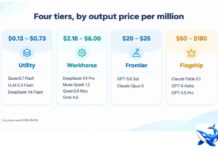
Four frontier models account for a significant share of enterprise AI spending: GPT-6 Astra, Claude Fable 5.1, Gemini 3.1 Pro, and Grok 4.6.
At first glance, some of them appear nearly interchangeable from a pricing standpoint. GPT-6 Astra and Claude Fable 5.1, for example, are both listed at $10 per million input tokens and $50 per million output tokens. That comparison becomes much less useful once actual token consumption is taken into account.
An independent benchmark of frontier-model token economics tested 240 tasks and found that Claude Fable 5.1 used 3.14 times as many output tokens as GPT-6 Astra to complete equivalent work. Because both models charge the same published price for output tokens, that additional usage changes the economics substantially. At $50 per million output tokens, 3.14 times the token consumption produces an effective cost of roughly $157.14 for the same amount of completed work.
This is one reason headline token prices can be misleading. Two models can carry the same published rate and still generate very different bills because the models do not necessarily use the same number of tokens to reach an answer.
The difference can become even more pronounced with models that perform substantial internal reasoning. Those reasoning tokens may never appear in the final response, but they can still contribute to usage and, depending on the provider and pricing structure, to cost.
For enterprise buyers, the implication is straightforward: comparing models strictly on their advertised per-token prices can produce the wrong conclusion. The more meaningful comparison is the cost of completing the same representative task.
The Cheapest Model Depends on the Workload
Token efficiency is only part of the picture. Pricing also changes depending on the size and structure of the workload.
OpenAI, for example, applies a 2x input surcharge and a 1.5x output surcharge once a request exceeds 200,000 tokens, while Anthropic maintains a flat rate up to one million tokens. That difference has little relevance for a short customer-support interaction, but it can materially change the economics of a large repository review or another context-heavy task.
In one example, a 340,000-token repository review performed 1,000 times costs 37.2% less using Claude Fable 5.1 than GPT-6 Astra. Yet the economics can reverse for much smaller jobs. For short customer-service replies, lower-cost models can run at roughly one-fifth the cost of the premium tier.
That is why model selection is increasingly happening at the workload level rather than at the company level.
That is why model selection is increasingly happening at the workload level rather than at the company level.
A business may use one model for coding, another for document analysis, and a cheaper model for high-volume support interactions. The goal is no longer necessarily to standardize on one provider everywhere. It is to match the cost and capabilities of a model to the work being performed.
For finance and engineering leaders, this creates a more complicated procurement problem, but also a more rational one. A model that is economical for one workload can be unnecessarily expensive for another, even when both applications sit inside the same department.
Agentic Workflows Introduce a Different Kind of Cost
Multi-turn agentic systems add another layer of complexity because their costs accumulate differently from those of a simple one-shot prompt.
In an agentic workflow, the model often receives some or all of the previous conversation on every new turn. A coding agent, for example, may begin with a relatively modest prompt containing instructions, tools, repository information, and the user’s request. As the session continues, each new call can include the growing history of everything that came before it.
That means the amount of input sent to the model can increase dramatically even when the underlying task has not changed.
In the data cited in the original analysis, a coding session that began with 5,400 input tokens grew to 35,800 tokens per call by turn 50. Across 34 engineering teams, re-sent context accounted for between 58% and 69% of total AI spending. System prompts and tool definitions added roughly another fifth.
The chart on page 2 makes that imbalance especially clear. Depending on the model, re-sent context represents the majority of the monthly bill, ranging from 58% for Claude Fable 5.1 to 69% for Grok 4.6. New user input, the portion most people would intuitively think of as the “actual work,” represents only about 12% to 15%.
That changes how teams need to think about optimization. Reducing the price of a new prompt by a few percentage points may matter less than reducing the amount of old context that gets repeatedly sent back to the model.
Prefix caching can help by allowing providers to reuse portions of previously processed context rather than charging the full input price each time. But caching economics also differ considerably by vendor. According to the source data, cache-hit pricing ranges from 2.5% to 25% of the standard input price.
As agentic systems become more common, context management is therefore becoming a cost-management discipline in its own right.
Why Enterprise AI Budgets Are Hard to Forecast
These three variables, token consumption, workload-specific pricing, and repeated context, help explain why enterprise AI budgets can diverge sharply from initial estimates.
Median monthly API spending per developer across the four models in the analysis ranges from $310 to $2,340. More importantly, spending among heavy users rises much faster. At the 90th percentile, monthly costs are between 3.0 and 3.8 times the median.
That distribution matters because budgeting based on the “typical” developer can understate the costs generated by the teams doing the most intensive AI work.
A company may look at its median usage and conclude that its AI program is comfortably within budget, while a comparatively small group of engineers running long-context or highly agentic workloads accounts for a disproportionate share of total spending.
This resembles the cost-management problem enterprises encountered with cloud infrastructure. Average usage can be relatively easy to understand; the expensive edge cases are what disrupt forecasts. The same principle is beginning to apply to AI.
Enterprises Are Moving Toward Workload-Level Model Selection
The result is a gradual move away from the assumption that a company should choose one model provider and use it everywhere.
Instead, enterprises are increasingly benchmarking models against their own workloads, routing different tasks to different models, and revisiting those choices as pricing and model behavior change.
That approach recognizes something that the published rate card cannot capture: AI costs are partly a function of model behavior.
A pricing page can tell a buyer how much one million tokens cost. It cannot tell that buyer how many tokens a model will consume to complete a repository review, how much conversation history an agent will accumulate after 40 turns, or whether another model can perform the same customer-service task with a fraction of the usage.
Those answers require testing.
For enterprise teams planning AI spending in 2026, that is probably the most important change in mindset. Model economics can no longer be evaluated primarily through vendor pricing pages. Companies need representative tasks, realistic usage patterns, and enough production data to understand where their tokens are actually going.
The published rate is still useful. It is simply the beginning of the calculation rather than the end of it.