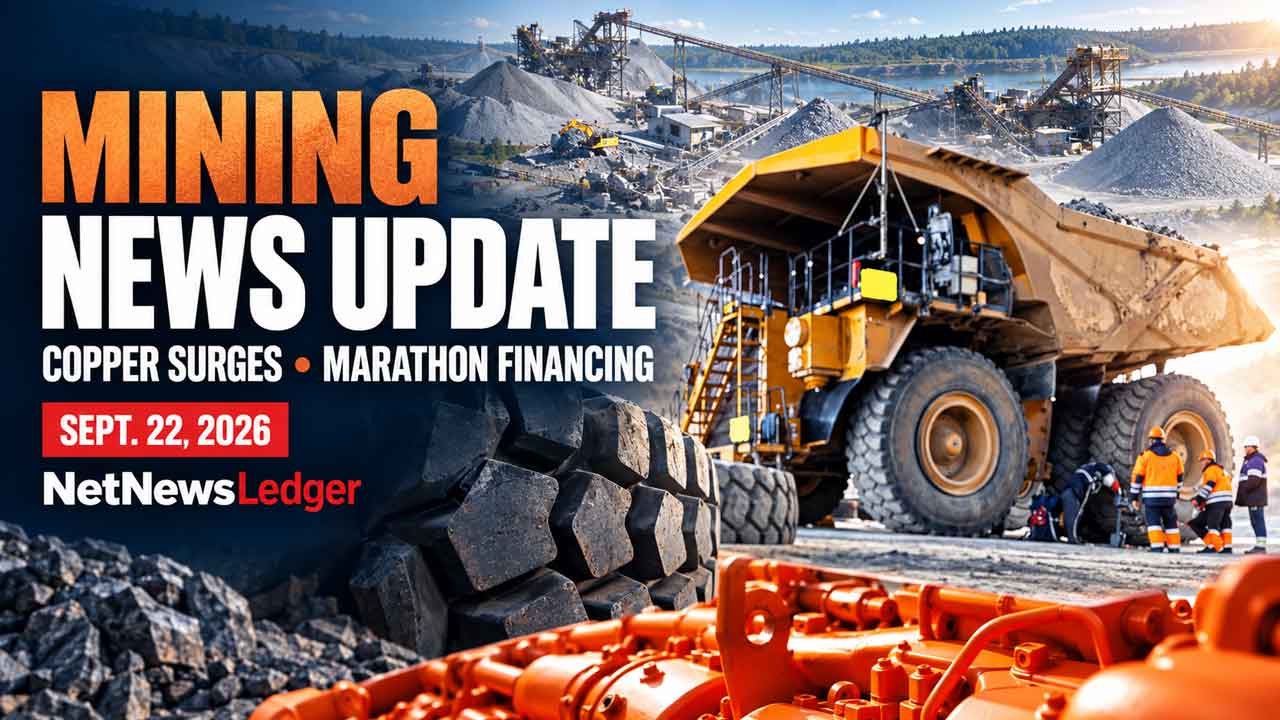
Generation Mining closes C$240 million in equity for the Marathon copper-palladium project, Capstone agrees to sell Cozamin, and strong Chinese demand lifts copper toward its record high
THUNDER BAY – MINING DESK – Tuesday, September 22, 2026 – Copper is again testing record territory, gold is under pressure from higher interest-rate expectations, and Canadian mining companies are at the centre of major financing, acquisition and critical-mineral stories.
For Northwestern Ontario, the most important development is Generation Mining’s closing of a C$240-million equity financing for the Marathon copper-palladium project. It is a major reduction in financing risk, but it does not remove construction, cost, market or execution risk.
Nationally, Vancouver-based Capstone Copper has agreed to sell its Cozamin mine in Mexico for up to US$385 million. Ottawa has also introduced legislation that could shorten federal project reviews, while a proposed U.S. potash deal with Belarus is raising questions for Canada’s fertilizer industry.
Mining Markets at a Glance
- Copper: Three-month copper on the London Metal Exchange rose 0.61 per cent to US$14,750.50 per tonne by 3:00 a.m. GMT, its sixth consecutive rising session. Strong Chinese buying and falling exchange inventories are supporting the market.
- Gold: Spot gold was down 0.6 per cent at US$4,319.39 per ounce by 6:52 a.m. GMT. Expectations that U.S. interest rates may remain higher for longer reduced demand for non-yielding bullion.
- Silver: US$65.28 per ounce, down 1.1 per cent.
- Platinum: US$1,777.29 per ounce, down 1.1 per cent.
- Palladium: US$1,290.07 per ounce, down 0.8 per cent.
These are early-market snapshots and will change during the trading day. Copper was the standout. Available metal in London Metal Exchange warehouses fell to 133,725 tonnes on Monday, while the Yangshan import premium remained well above its level at the start of September. That suggests Chinese consumers are paying for prompt supply rather than merely chasing a speculative price move.
International: Copper Demand Returns to Centre Stage
Copper’s move toward its recent record matters far beyond the mining market. The metal is used in power grids, electric vehicles, data centres, defence systems, construction and conventional manufacturing.
The immediate driver is strong demand in China, the world’s largest copper consumer. However, low visible inventories, mine disruptions and uncertainty over possible U.S. tariffs on refined copper have also tightened the market outside the United States.
For mine developers, a high copper price can improve projected economics and access to capital. It can also create a false sense of security. Construction costs, exchange rates, recoveries, grades and financing terms still determine whether a project produces an acceptable return. A record commodity price does not turn a marginal deposit into a mine on its own.
International: Titan Makes A$333-Million Bid for Global Lithium
Global Lithium Resources has entered a binding scheme implementation deed under which Titan Australia Mining proposes to acquire all Global Lithium shares for A$1.15 each in cash.
The proposed transaction values Global Lithium at approximately A$333 million on a fully diluted basis and represents a 73 per cent premium to the company’s September 18 closing price. Directors have indicated that they intend to support the proposal in the absence of a superior offer.
This is a signed implementation agreement, not a completed acquisition. It remains subject to conditions that include shareholder, court and regulatory approvals. The proposal is another sign that better-financed groups are using a weak period for lithium developers to acquire deposits and future supply.
International: Oil Shock Could Increase Pressure on Metal Supply
A Reuters analysis says persistently high fuel prices could accelerate electric-vehicle adoption outside the United States. Europe has recorded strong growth, while electric and plug-in hybrid vehicles have reached a 65 per cent share of China’s new-vehicle market.
Wood Mackenzie’s higher-adoption scenario estimates copper demand would rise only 2 per cent above its base case, but annual new mine capacity requirements would increase from a long-term average of about 850,000 tonnes to 960,000 tonnes between 2025 and 2040. Lithium demand would be 14 per cent higher than in the base case.
Those figures are scenario results, not a guaranteed forecast. Their value is in showing how a relatively small change in end-use demand can require a large response from mines because new projects take years to permit, finance and build.
Canada: Capstone Agrees to Sell Cozamin for Up to US$385 Million
Capstone Copper has signed a definitive agreement to sell the Cozamin copper-silver-zinc-lead mine in Zacatecas, Mexico, to Luca Mining.
The consideration includes:
- US$275 million in cash at closing, subject to adjustments;
- US$15 million in Luca shares at closing;
- US$35 million in deferred consideration one year after closing; and
- up to US$60 million in payments linked to annual copper prices from 2027 through 2029.
The structure gives Capstone immediate cash while preserving some exposure to Luca and to very high copper prices. Capstone says it intends to strengthen its balance sheet and redirect capital toward larger growth projects in Chile and the United States.
For Luca, Cozamin would add a mine with roughly 20 years of operating history and a historical reserve-based plan extending to 2030. Luca has cautioned that it has not adopted Capstone’s historical mine plan and intends to complete its own verification and update.
The sale is expected to close in the fourth quarter of 2026, subject to stock-exchange approval, Mexican competition approval and other conditions. It is not yet a completed transaction.
Canada: Proposed U.S.-Belarus Potash Deal Creates Political Risk, Not an Immediate Supply Shock
U.S. President Donald Trump says Washington is working on a large agreement to buy potash from Belarus at a lower price than it pays Canada.
The United States currently receives the large majority of its imported potash from Canada, making the statement important for Saskatchewan producers and the national trade relationship. However, no detailed purchase contract, volume or delivery schedule has been announced.
Logistics are also a major obstacle. Sanctions and the closure of a key Lithuanian port have made Belarusian potash expensive to move through Russia’s Arctic and across the Atlantic. Fertilizer analyst Josh Linville of StoneX told Reuters that he doubts Belarusian supply will materially lower U.S. prices or solve a shortage because the United States already has sufficient potash.
The responsible conclusion is that this is a trade and political warning for Canada, not evidence that Canadian potash has already lost the U.S. market.
Canada: U.S. Agency Approves Up to US$414 Million for Canadian Uranium Project in Niger
The U.S. International Development Finance Corporation has approved up to US$414 million in financing for Global Atomic’s Dasa uranium project in Niger.
Global Atomic is Canadian, while the uranium project is in a country that has recently shifted away from several Western security relationships. The financing could improve U.S. access to uranium and help the project advance, but security, political and transportation risks remain significant.
This is a strategic financing commitment. It is not evidence that Dasa is already producing or that export routes are secure.
Canada: Ottawa Introduces One-Year Federal Review Legislation
The federal government introduced Bill C-39, the Building Canada Strong Act, on September 21. The legislation proposes federal project reviews and decisions within one year after a proponent submits a comprehensive application and the required studies.
Mining companies may welcome a more predictable timetable. For investors, uncertainty about how long approvals will take can be as damaging as a negative decision.
There are two important cautions. First, the one-year clock would begin only after an application is considered complete. The work needed to reach that point can take years. Second, Bill C-39 has been introduced but has not yet completed parliamentary review or become law.
The government says environmental standards and Indigenous rights will be maintained. How departments coordinate reviews, fund Indigenous participation and define a complete application will determine whether the new process is faster in practice.
Northwestern Ontario: Generation Mining Closes C$240-Million Equity Financing
Generation Mining closed a C$200-million public offering and a C$40-million private placement with the Canada Growth Fund on September 21.
The company issued 312.5 million shares in the public offering and 62.5 million shares in the private placement, all at C$0.64 per share. Canada Growth Fund also bought approximately C$49 million of shares through the public offering and now controls 19.9 per cent of Generation Mining’s outstanding shares on a non-diluted basis.
The closing is important because equity is the portion of a project-financing package that is usually hardest to replace with borrowed money. It also gives Generation cash that can be used for development, construction, operations and related financing costs at the Marathon copper-palladium project.
However, the issue of 375 million new shares also creates substantial dilution for previous shareholders. Canada Growth Fund has received board nomination, observer and future participation rights while it maintains specified ownership levels.
What the C$1.3-Billion Marathon Package Really Means
Generation describes the Marathon project as fully financed through an approximately C$1.3-billion package. That package combines the newly closed equity with senior secured debt, subordinated and convertible debt, an undrawn metal stream, estimated equipment leasing, surety bonds, letters of credit and a cost-overrun facility.
That is a much stronger position than having only expressions of interest. Still, “fully financed” does not mean every dollar is sitting in the company’s bank account without conditions.
- The C$240-million equity component has closed, but final Toronto Stock Exchange approval is still required.
- The C$100-million subordinated convertible-note financing requires shareholder and other approvals.
- Debt and other facilities include documentation, intercreditor arrangements, draw conditions and customary conditions precedent.
- The board’s final investment decision was expected after completion of the financing components.
- Actual construction costs, schedules, commodity prices and exchange rates can still differ from the feasibility assumptions.
The package includes a C$185-million cost-overrun facility and the feasibility estimate contains C$119 million in contingency. Those protections are meaningful, but they also show why cost control will remain central during construction.
Ontario Support Is Useful but Still Conditional
Generation Mining has also agreed to a non-binding term sheet with Ontario for a loan of up to C$11 million through the Critical Minerals Processing Fund.
The proposed loan would support a processing facility and related eligible infrastructure estimated at approximately C$410 million within the project’s C$992-million feasibility-level capital cost. The amount would depend on eligible spending and maintaining a minimum employment level.
The provincial loan is not yet a final funding agreement. Its value is less about its size than its signal: Ontario is willing to support processing in the province and connect public assistance to employment.
Why Marathon Matters to Northwestern Ontario
The company projects approximately 800 construction jobs, 350 direct mining jobs and more than 100 processing jobs at full operation. It also expects contracting and procurement opportunities for regional and Indigenous-owned businesses.
Those are company projections, not current payroll numbers. Local benefits will depend on hiring, training, procurement, housing capacity, transportation, construction execution and the strength of agreements with affected Indigenous communities.
Generation has signed a concentrate offtake agreement with Glencore. The plan would send Marathon concentrate containing copper, palladium, platinum, gold and silver to Glencore’s Horne smelter and CCR refinery in Quebec, supporting Canadian processing rather than exporting all concentrate overseas.
If construction proceeds as planned, Marathon could become one of Northwestern Ontario’s most important new industrial projects. The next proof points are the final investment decision, completion of remaining financing conditions, major construction contracts, early works and transparent reporting on costs and schedule.
Regional Exploration Watch: Visible Gold Is Encouraging, but Assays Come First
Dryden Gold reported visible gold in drill core from its first program at Mud Lake North in the Dryden District. The observation supports the company’s geological model and may help guide future drilling.
Visible gold is not an assay and does not establish grade, width, continuity, a mineral resource or economic value. Laboratory results and geological interpretation are still required. The company says its broader 2026 program is fully funded for 45,000 metres of drilling.
At Panther Metals’ Obonga project north of Lake Nipigon, portable X-ray fluorescence readings identified discrete copper mineralization with a point reading of 8.34 per cent copper. Panther explicitly cautions that portable readings are not representative assays of an interval. Crushed-core laboratory results are pending, and drilling is scheduled to resume after the autumn hunting pause.
What Mining Readers Should Watch Next
- Whether copper can hold near record levels after Chinese pre-holiday buying fades;
- Generation Mining’s final investment decision and remaining financing approvals;
- Major contract awards, construction timing and cost reporting for Marathon;
- Parliamentary changes to Bill C-39 and the practical definition of a complete project application;
- Details, volumes and logistics behind any U.S.-Belarus potash agreement;
- Regulatory approvals for the Capstone-Luca transaction; and
- Laboratory assays from Dryden Gold and Panther Metals in Northwestern Ontario.
This article is for news and general information. It is not investment advice. Commodity prices are time-sensitive. Company projections, exploration results and economic estimates carry technical, financing and market risk.
Sources
- Generation Mining – C$240-million equity financing closed, September 21, 2026
- Generation Mining – Marathon financing package, September 14, 2026
- Generation Mining – Ontario term sheet, September 18, 2026
- Capstone Copper – Cozamin sale agreement, September 21, 2026
- Luca Mining – Cozamin acquisition agreement and financing
- Reuters – precious-metals prices, September 22, 2026
- Reuters via Business Recorder – copper market, September 22, 2026
- Global Lithium Resources ASX announcement – proposed Titan scheme, September 22, 2026
- Reuters – proposed U.S.-Belarus potash deal
- Reuters – U.S. financing for Global Atomic’s Dasa project
- Reuters analysis – EV demand and metal supply
- Government of Canada – Bill C-39 introduction, September 21, 2026
- Dryden Gold – Mud Lake North update
- Panther Metals – Obonga project update