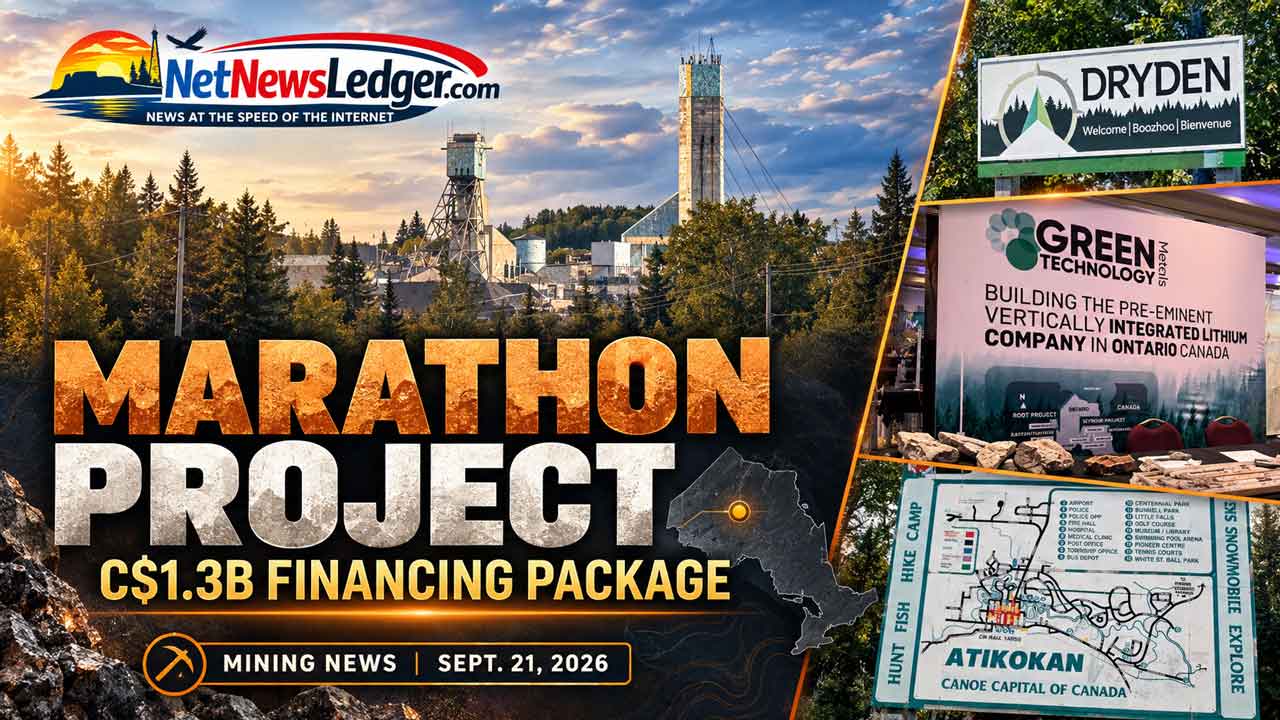
THUNDER BAY – MINING NEWS – September 21, 2026 – Northwestern Ontario is at the centre of Canada’s critical-minerals push this week as Generation Mining moves closer to building the Marathon Copper-Palladium Project near the Town of Marathon.
The company says it has assembled an approximately C$1.3-billion construction financing package. Ontario has also agreed to a non-binding term sheet for up to C$11 million through the province’s Critical Minerals Processing Fund.
That is a major financing milestone. It is not, however, the same as a completed mine or a final investment decision. Shareholder, regulatory and documentation requirements remain, and the company’s board is expected to make its final investment decision after the financing package is completed.
The Marathon update matters well beyond Northwestern Ontario. Copper is needed for power grids, electric vehicles, data centres and defence infrastructure. Palladium, platinum, gold and silver would add value to the projects’ concentrate and connect the region to a wider North American supply chain.
Generation Mining’s Ontario Agreement: What Was Announced?
On September 18, Generation Mining announced a non-binding term sheet with the Government of Ontario for a loan of up to C$11 million. The funding would come through Ontario’s C$500-million Critical Minerals Processing Fund, administered by Invest Ontario.
The proposed loan is tied to eligible expenditures and a minimum employment level. Generation Mining says the processing facility, related infrastructure and other eligible costs total about C$410 million. Those costs are part of the Marathon Project’s total estimated capital cost of C$992 million in the company’s updated feasibility study.
The Ontario loan is therefore a targeted contribution to the processing side of the project. It is not a cheque for the full mine, and it does not replace the larger financing package already announced by Generation Mining.
How the C$1.3-Billion Financing Stack Fits Together
Generation Mining’s September 14 financing announcement described C$340 million in final funding:
- C$200 million through a bought-deal share financing;
- C$40 million private placement by Canada Growth Fund; and
- C$100 million in subordinated unsecured convertible notes, split between Canada Growth Fund and Canada Infrastructure Bank.
The company says those funds complement senior secured debt, a CIB subordinated debt commitment, the undrawn portion of a metal stream and estimated equipment leasing. Together, the financing sources are described as a fully financed construction package of approximately C$1.3 billion.
The package also includes a C$185-million cost-overrun facility, a C$119-million capital-cost contingency and C$78 million in surety bonds and letters of credit. Those provisions are important because large mines routinely face inflation, schedule changes, equipment delays and unexpected engineering costs.
But the financing is not cost-free. The share financings dilute existing shareholders. The convertible notes carry nine per cent annual interest and could become shares under stated conditions. Debt, streaming and equipment leases also create future obligations that will have to be serviced by the mine once it is operating.
Why the Glencore Offtake Agreement Matters
Generation Mining also announced terms for a copper and metal supply contract with Glencore. The agreement would send Marathon’s polymetallic copper concentrate to Glencore Canada’s Horne smelter in Rouyn-Noranda, Quebec, and then to the CCR refinery and other domestic processing facilities.
This is strategically important because it gives the project a planned route into an existing Canadian processing network. It also helps answer one of the hardest questions facing new mines: who will buy and process the material?
Glencore is entitled to buy 100 per cent of concentrate production in the first two calendar years after commercial production and from year 13 onward, subject to the contract terms. During the intervening years, Glencore would receive approximately half of annual production, with other offtake commitments also recognized.
An offtake agreement is not a guarantee that the mine will produce on schedule. It does, however, reduce market risk and supports the case for developing domestic critical-minerals infrastructure.
What Marathon Could Produce
Generation Mining’s feasibility study describes a planned 13-year open-pit mine and processing complex. The company estimates payable production of approximately:
- 2.161 million ounces of palladium;
- 532 million pounds of copper;
- 488,000 ounces of platinum;
- 160,000 ounces of gold; and
- 3.051 million ounces of silver.
The study estimates a net present value of C$1.07 billion, a 28 per cent internal rate of return and a 1.9-year payback, based on the assumptions and metal prices used in the report.
Those figures are economic projections, not promises. They can change with copper, palladium and platinum prices, foreign exchange rates, construction costs, recovery rates, operating costs, financing terms and the timing of production.
What Happens Next at Marathon?
Generation Mining has said it expects early works construction to begin in the fourth quarter of 2026. Before that can happen, the financing transactions must close, final documents must be signed and required approvals and conditions must be satisfied.
The company’s board is expected to make a final investment decision after the final funding is in place. The convertible-note financing also requires shareholder approvals expected at a special meeting in the fourth quarter.
That means the most accurate description today is that Marathon is financing-ready and construction-ready, subject to closing conditions and a final investment decision. Calling it an operating mine would be incorrect. Calling it merely an exploration project would also miss the significance of the work completed.
What Marathon Could Mean for Northwestern Ontario
Generation Mining says the project could support approximately 800 construction jobs, about 350 direct mining jobs and more than 100 jobs at the processing complex once fully operating.
The wider regional effect could be larger. Mines require heavy equipment, fuel, electrical work, roads, engineering, environmental monitoring, camp services, trucking, catering, maintenance, security and professional services. Local and Indigenous-owned businesses could compete for contracts if procurement and training pathways are accessible.
The project also strengthens the case for a broader Northwestern Ontario supply chain. A mine near Marathon, processing in Quebec and suppliers across Northern Ontario would link communities that have often been treated as separate economic markets.
For the region, the next test will be whether the promised opportunities translate into long-term contracts, apprenticeships, skills training and meaningful Indigenous participation rather than only short construction bursts.
Global Critical-Minerals Pressure Is Raising the Stakes
The Marathon financing arrives as governments and manufacturers are reassessing their dependence on concentrated mineral supply chains.
Aerospace suppliers are testing older ceramic coating materials and recycling methods to reduce dependence on rare earths and other materials linked to China. The report shows that companies are exploring substitution because supply security has become an industrial and defence issue, not just a mining-sector concern.
Analysis says faster electric-vehicle growth outside the United States could increase pressure on lithium, nickel and copper supply. Even where EV demand slows in one market, demand can continue rising elsewhere, leaving manufacturers exposed to shortages and price swings if new mines and processing facilities do not keep pace.
That global competition gives Canadian projects a stronger strategic argument. It also raises expectations. Governments, investors and communities will want mines that can demonstrate credible financing, responsible environmental planning, reliable processing routes and durable Indigenous partnerships.
Other Mining Themes to Watch This Week
- Copper supply: Investors continue to watch whether new projects can replace declining grades and meet electrification demand.
- Palladium and platinum: Producers face changing vehicle technology while seeking growth in industrial, hydrogen and other applications.
- Rare earths: Substitution, recycling and new mines are being pursued, but building alternatives to established Chinese supply chains will take years.
- Project finance: Public capital is increasingly being used to attract private investment into mines and processing plants considered strategically important.
- Indigenous participation: Agreements, equity interests, contracting and consent processes are becoming central to project certainty.
The Bottom Line
Generation Mining has moved Marathon from a long-discussed Northwestern Ontario project toward a possible construction start. The C$1.3-billion financing package, the Ontario processing loan term sheet and the Glencore offtake arrangement together mark a substantial change in the project’s status.
The harder work is now beginning. Financing must close. Shareholders must approve the required transactions. Construction costs must be controlled. Relationships with Indigenous and local communities must remain strong. And the project must prove that its feasibility-study economics can survive changing metal prices and real-world construction conditions.
For Northwestern Ontario, Marathon is no longer only a question of whether the deposit is valuable. The question is whether the region can turn that value into jobs, businesses, infrastructure and lasting participation in a global critical-minerals economy.
This article is for news and general information and is not investment advice. Company production estimates, project economics and construction timelines are forward-looking information subject to risks and change.