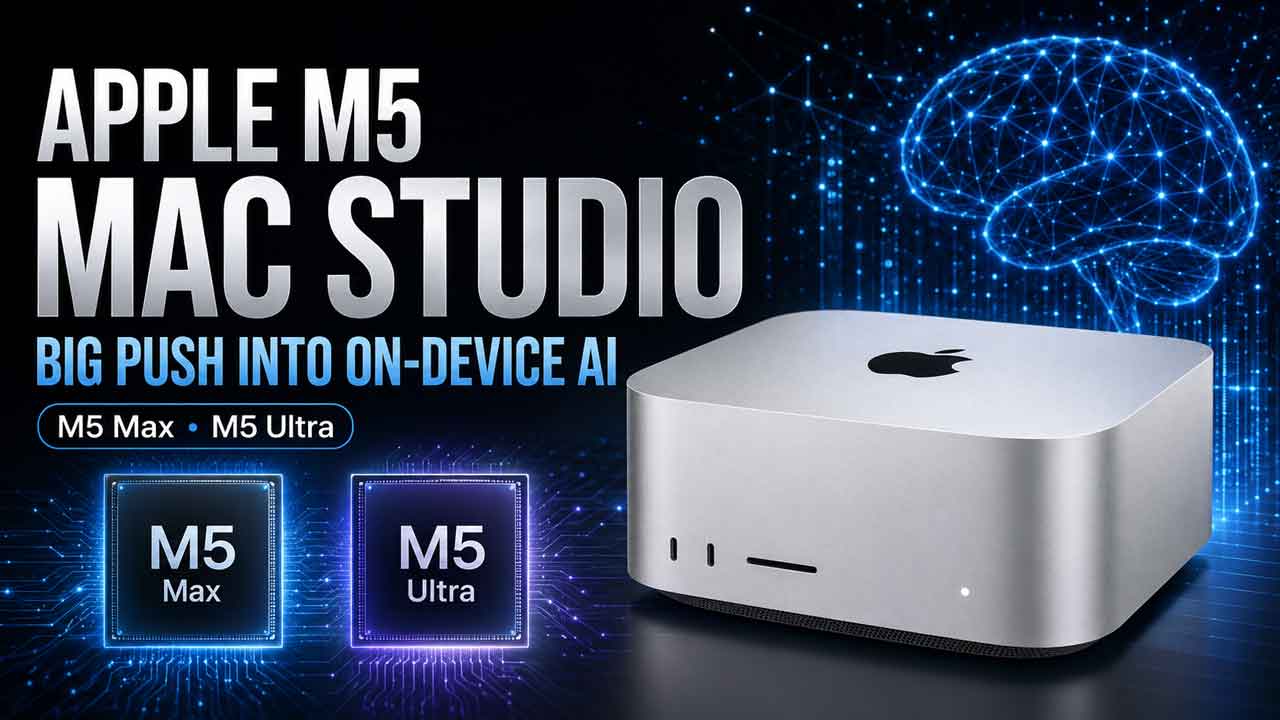
Apple Unveils M5 Max and M5 Ultra Mac Studio With Major Push Into On-Device AI
Thunder Bay – TECH News – Apple is pushing its professional desktop lineup deeper into artificial intelligence with a new Mac Studio powered by the M5 Max and M5 Ultra chips.
The Apple Silicon chips are lightning fast – especially when compared to the older Intel chips that were in Apple computers before.
Announced pn Aug. 25, the updated Mac Studio is aimed at developers, video professionals, researchers and other users handling demanding computing workloads. Apple says the new systems deliver major gains in AI processing, graphics and storage while allowing increasingly large AI models to run locally rather than relying entirely on cloud-based services.
For technology users and businesses, the most significant development may be the continuing shift toward powerful on-device AI. Local processing can be particularly useful where organizations are working with sensitive information, large datasets or limited access to high-speed cloud infrastructure.
Apple Makes Local AI the Centrepiece of Mac Studio
Apple is positioning the new Mac Studio as its most capable desktop yet for running artificial intelligence models directly on a user’s machine.
The M5 Max version can be configured with an 18-core CPU, up to a 40-core GPU and as much as 128GB of unified memory.
At the top of the lineup, the M5 Ultra can be configured with a 36-core CPU, an 80-core GPU and up to 512GB of unified memory.
Apple says the M5 Ultra system offers memory bandwidth of up to 1.2 terabytes per second. That combination of memory capacity and bandwidth is designed to allow users to run very large language models and other AI workloads locally.
That distinction matters as businesses increasingly weigh the advantages and costs of cloud AI.
Running models on local hardware can reduce dependence on subscription-based cloud computing and may give organizations greater control over proprietary or confidential data. Actual performance, cost savings and privacy benefits will depend on the software, models and security practices being used.
M5 Max Targets Developers and Creative Professionals
The M5 Max version of Mac Studio is designed for professional users including photographers, musicians, designers and software developers.
Apple says the chip includes six “super cores” and 12 performance cores within its 18-core CPU, alongside a GPU offering as many as 40 cores.
Neural Accelerators are built into the GPU cores to speed AI-related calculations.
According to Apple’s testing, the M5 Max Mac Studio can deliver up to:
- 10.7 times faster large-language-model prompt processing in LM Studio than a Mac Studio with M1 Max;
- 7.4 times faster text-to-image performance than an M1 Max system;
- 5.3 times faster Magic Mask processing in Blackmagic Design DaVinci Resolve Studio; and
- 3.5 times faster basecalling for DNA sequencing using Oxford Nanopore MinKNOW.
Those figures are manufacturer benchmarks and performance will vary depending on system configuration, software and workload. Apple says its testing was conducted in July 2026.
M5 Ultra Pushes Mac Studio Into Larger AI Workloads
The M5 Ultra model is designed for workloads that previously required substantially larger workstations or cloud computing infrastructure.
Apple says the chip can include up to 36 CPU cores and 80 GPU cores, with up to 512GB of unified memory.
The company claims peak AI compute performance is up to 4.3 times higher than its previous M3 Ultra generation and up to 9.8 times higher than the earlier M1 Ultra in some tests.
Apple is also promoting the machine for high-end video and visual-effects work. The M5 Ultra Media Engine can, according to the company, simultaneously play as many as 33 streams of 8K ProRes 422 video at 30 frames per second.
For independent film, digital media and production operations in Northern Ontario, systems capable of handling high-resolution footage locally could reduce the need to transfer massive project files to remote computing services.
Thunderbolt 5 Allows Multiple Macs to Work Together
One of the more notable additions is support for clustering multiple Mac Studio computers.
Apple says Thunderbolt 5 and remote direct memory access, or RDMA, can connect several systems and create a larger pool of computing resources for AI inference.
A four-system Mac Studio cluster can provide up to three times the AI inference performance of a single machine, according to Apple.
Thunderbolt 5 also provides bandwidth of up to 120 gigabits per second for compatible storage devices, expansion systems, displays and other professional peripherals.
The ability to cluster compact workstations could interest university research groups, engineering operations and specialized technology firms that need significant computing capacity but do not want to build conventional server infrastructure.
Why On-Device AI Could Matter for You
The push toward high-performance local AI has particular relevance in Northwestern Ontario.
Organizations operating in mining, forestry, health research, education and Indigenous communities frequently generate or handle information that may be commercially sensitive, culturally sensitive or subject to privacy requirements.
Local AI systems could potentially support tasks such as analyzing geological information, processing imagery, developing software, examining research datasets and creating digital media without continuously sending information to remote AI services.
They could also become useful in locations where internet connectivity is expensive, inconsistent or constrained.
That does not eliminate the need for cloud infrastructure. Training the largest AI models still requires computing resources far beyond a single workstation, and many commercial AI systems depend heavily on remote servers.
Instead, machines such as the new Mac Studio illustrate an industry trend toward hybrid computing, where some AI work happens in the cloud and other processing takes place directly on local devices.
Wi-Fi 7 and Bluetooth 6 Arrive on Mac Studio
The new Mac Studio also includes Apple’s N1 wireless chip, bringing Wi-Fi 7 and Bluetooth 6 support to the product line for the first time.
Apple says storage performance has also increased, with its new SSD architecture offering speeds up to twice those of the previous generation in some comparisons.
The machine supports up to eight displays, depending on configuration, and introduces USB-C genlock support for synchronizing compatible displays with professional video capture equipment.
macOS 27 Golden Gate and Siri AI
The Mac Studio will run macOS 27 Golden Gate, Apple’s next major Mac operating system.
Apple says the software will introduce an expanded version of Siri, referred to as Siri AI, alongside additional Apple Intelligence features.
The company says Siri AI will be able to use information from messages, emails and photos to provide more context-aware assistance and will be integrated into Spotlight and system-wide menus.
Apple Intelligence will also add features to Safari, Shortcuts and Photos.
Some features remain in beta testing and availability will depend on language, region and compatible hardware. Apple says Siri AI is expected to launch as a beta later in 2026.
Canadian Pricing Starts at $3,499
Canadian pricing for the Mac Studio with M5 Max starts at $3,499.
The M5 Ultra version starts at $7,799.
Apple says education pricing begins at $3,219 for the M5 Max model and $7,229 for the M5 Ultra.
Pre-orders opened Aug. 25, with general availability scheduled for Sept. 22. Configurations with 512GB of unified memory are expected later in October.
What This Signals for the AI PC Market
The new Mac Studio is less about competing with conventional consumer desktop computers and more about Apple’s attempt to move increasingly sophisticated AI workloads onto professional workstations.
For organizations in Thunder Bay and Northwestern Ontario, the important question will not simply be how fast the new hardware is.
It will be whether local AI computing can provide a practical alternative to continuously renting computing power from cloud providers.
With memory capacities reaching 512GB and support for clustering several machines together, Apple is clearly betting that at least part of the next phase of artificial intelligence will happen on desks and inside local organizations rather than exclusively inside massive data centres.