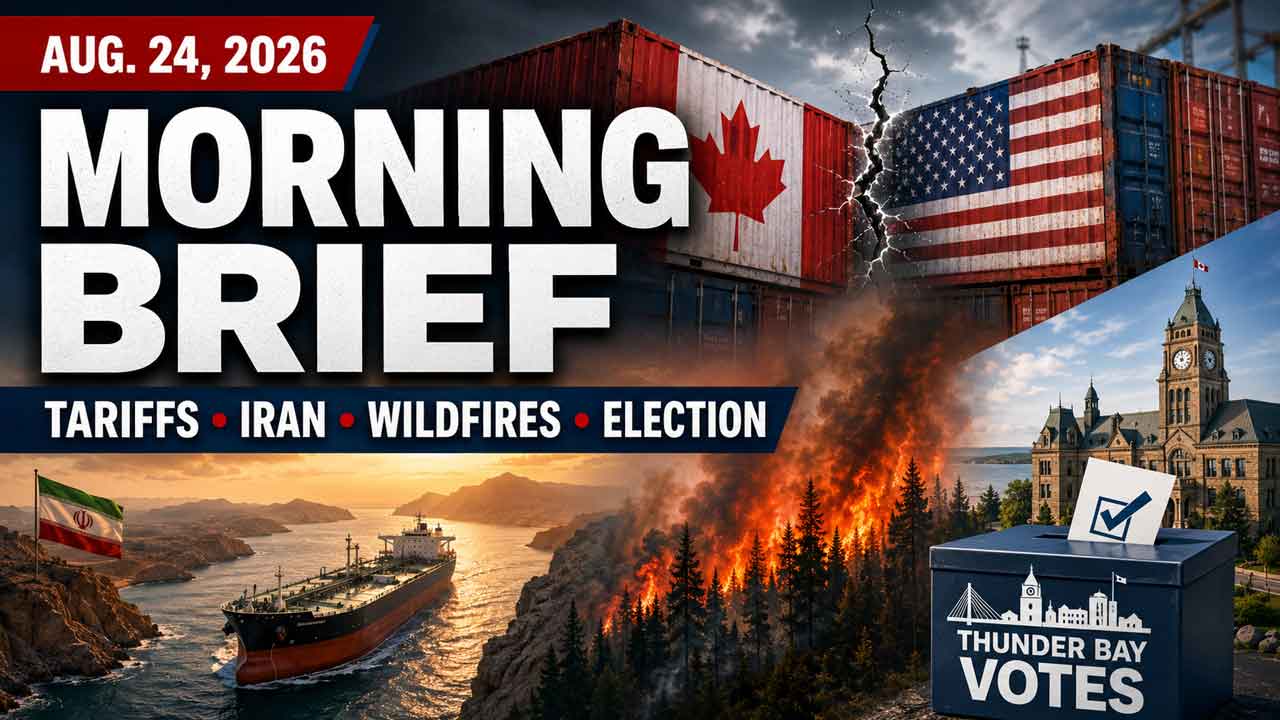
Aug. 24 news: Canada-U.S. tariffs, Iran, wildfires and Thunder Bay election
THUNDER BAY — The breakdown in Canada-U.S. trade negotiations is the story with the most immediate economic implications for Northwestern Ontario on Monday, Aug. 24, while escalating U.S.-Iran tensions are keeping energy markets and the Strait of Hormuz under close watch.
Internationally, Ukraine is marking Independence Day as its war with Russia continues, while the World Health Organization is warning that an Ebola outbreak in the Democratic Republic of the Congo has passed 5,200 cases.
Closer to home, Northwestern Ontario remains in an active — although improving — wildfire season. In Thunder Bay, municipal election nominations face their certification deadline today, the restructuring of the Workplace Safety and Insurance Board is raising questions about northern jobs and service delivery, and the city is pursuing a potentially major housing opportunity on the former Lakehead Psychiatric Hospital lands.
This briefing reflects information available early Monday morning. Several of these stories are developing and will require updates through the day.
The NewsHawk Morning Brief — Monday, Aug. 24, 2026
INTERNATIONAL — U.S.-Iran Confrontation Keeps Strait of Hormuz and Energy Markets in Focus
The Middle East remains the international story with the clearest potential economic consequences for Thunder Bay and Northwestern Ontario.
The United States is expected to announce another major package of sanctions against Iran Monday. Tehran, meanwhile, has intensified pressure on shipping through the Strait of Hormuz, with Iranian authorities blacklisting 45 tankers accused of violating its transit requirements and warning of possible fines, detention or cargo confiscation.
Oil prices were down Monday morning as traders took profits following recent gains, but that should not be mistaken for the disappearance of geopolitical risk. Reuters reported Brent crude had recently been trading above US$90 a barrel as markets assessed possible sanctions, Iranian retaliation and continuing disruption around one of the world’s most important energy corridors.
For Northwestern Ontario, the connection is transportation.
Long-distance trucking, aviation, mining, forestry and supplying remote communities are all heavily exposed to fuel costs. Sustained increases in world oil prices can eventually work their way into diesel, gasoline, freight and operating costs.
The important distinction for NewsHawks is that Monday morning’s decline in crude does not mean the Hormuz crisis is resolved. The U.S. sanctions announcement and Iran’s response are developments to watch throughout the day.
INTERNATIONAL — Ukraine Marks Independence Day With War and Territorial Questions Unresolved
Ukraine is marking the 35th anniversary of its independence from the Soviet Union with President Volodymyr Zelenskiy saying his country wants peace but will not accept an agreement amounting to surrender to Russia.
European leaders are in Kyiv for the anniversary, while the European Commission has approved another €6.1 billion in financial support for Ukraine’s defence, including air defence, missiles, ammunition and radar systems.
For Canada, the continuing war has implications for NATO commitments, defence spending, grain and commodity markets and Canadian support for Ukraine.
The direct impact in Northwestern Ontario is more limited, but the longer strategic connection includes critical minerals. Western governments continue looking for secure supplies of the minerals needed for defence systems, advanced manufacturing, batteries and energy infrastructure — sectors in which Northern Ontario is seeking substantially greater investment.
INTERNATIONAL HEALTH — Ebola Outbreak in Democratic Republic of the Congo Passes 5,200 Cases
The World Health Organization says more than 5,200 Ebola cases have now been recorded in the Democratic Republic of the Congo, 100 days after the latest outbreak was declared.
WHO describes it as the country’s fastest-growing Ebola outbreak. Transmission has spread across six provinces, with Ituri accounting for the large majority of reported cases and deaths, according to the agency.
This is a serious international public-health emergency, but context matters. WHO’s earlier Aug. 14 assessment classified the global risk as low and did not recommend restrictions on international travel or trade.
NATIONAL — Canada-U.S. Trade Talks Collapse and 50 Per Cent U.S. Tariffs Take Hold
The Canada-U.S. trade dispute is Canada’s leading national economic story — and the national story with the greatest potential consequences for Northwestern Ontario.
Negotiations collapsed late Friday after Canada rejected terms Prime Minister Mark Carney described as economically unacceptable. The United States has imposed 50 per cent tariffs on roughly US$20 billion in additional Canadian goods. Reuters reports no new negotiations are currently scheduled.
Ottawa says Canada will answer the latest tariffs dollar-for-dollar beginning Tuesday, Sept. 8.
Carney said Canada’s response will focus on sectors including steel, dairy, appliances, agricultural equipment, pulp and paper and electronics. Additional measures for Canadian businesses and workers affected by the trade dispute are expected to be announced.
The Canadian dollar weakened as markets absorbed the collapse of negotiations, while Canadian stock-market futures were subdued Monday morning.
For Northwestern Ontario, this is not an abstract Bay Street story.
Forestry and pulp and paper are directly relevant to the regional economy. Mining operations, contractors and construction companies depend on machinery, steel, electronics and other cross-border inputs. The region’s economy is also linked to Minnesota and the wider U.S. Midwest through tourism, trucking, rail, manufacturing and supply chains.
Retaliatory tariffs can protect some Canadian producers from U.S. competition, but they can also raise costs for businesses that rely on American equipment or components.
The next questions are which products Ottawa will specifically place on its Sept. 8 tariff list, what exemptions may apply and what assistance will be available to affected workers and employers.
NATIONAL INDIGENOUS NEWS — Treaty 6 Marks 150 Years
First Nations leaders, Elders, community members and representatives of the Crown gathered at Fort Carlton, Sask., Sunday to commemorate 150 years since the signing of Treaty 6.
Treaty 6 was first signed Aug. 23, 1876, between representatives of the Crown and Cree and other First Nations leaders. Its territory extends across large areas of what are now Saskatchewan and Alberta. Governor General Louise Arbour described treaties as enduring frameworks for the relationship between First Nations and the Crown.
The anniversary is important nationally because treaties are not simply historical documents. Questions involving treaty implementation, land, resources, consultation, economic participation and the Crown’s obligations remain active across Canada.
Treaty 6 does not cover Northwestern Ontario, but the issues resonate strongly here.
Thunder Bay and communities across the Northwest are situated within several historic treaty relationships, including the Robinson-Superior Treaty, Treaty 3 and Treaty 9. Major mining, forestry, infrastructure and energy proposals increasingly depend on governments and proponents building meaningful relationships with First Nations whose rights and territories are affected.
REGIONAL — Northwestern Ontario Wildfire Activity Has Eased, but Major Fires Remain Uncontrolled
Wildfire conditions have improved significantly from the most dangerous period of the summer, but Northwestern Ontario’s fire season is not over.
The latest Northwest Fire Region count available in NetNewsLedger’s weekend reporting, based on Ontario Aviation, Forest Fire and Emergency Services data from the evening of Aug. 21, listed 65 active wildland fires. Five were not under control, five were being held, 12 were under control and 43 were being observed.
Fire behaviour was reported as low across the Rinker Lake Complex, but Thunder Bay 36 remained approximately 301,240 hectares and not under control. Dryden 34 was approximately 45,800 hectares and Dryden 35 approximately 30,088 hectares, with both also listed as not under control.
The Atikokan-area complex also continues to require attention.
The falling number of active fires and lower fire behaviour are encouraging. They do not mean the regional emergency can simply be declared finished.
This year’s evacuations have again demonstrated the particular challenges facing remote First Nations, where moving residents to safety can require aircraft, receiving communities, medical transportation and extensive logistical support.
Ontario’s legislated forest fire season continues through Oct. 31. Travellers, hunters, anglers and people working in remote areas should continue checking current fire conditions and any local access or aviation restrictions.
REGIONAL ECONOMY — WSIB Restructuring Puts 55 Thunder Bay Jobs in the Spotlight
A Workplace Safety and Insurance Board restructuring has become a significant northern employment and public-service story.
The Ontario Compensation Employees Union says 55 Thunder Bay employees received redundancy notices as the WSIB consolidates some claim and account-management functions. The union says hundreds of employees have been affected provincewide, including workers in several Northern Ontario communities.
The WSIB has not confirmed the Thunder Bay job-loss figure but says access to services will not change.
The board notes its former Thunder Bay office has not provided in-person service since 2020 and that its lease expired in 2023. It says it continues working with 91 physical and mental-health providers in Thunder Bay and will maintain a local team providing in-person return-to-work support.
The regional issue is larger than the number of positions.
Injured-worker advocates argue that locally based staff understand Northern Ontario workplaces, industries, distances and service challenges in ways that can be difficult to replicate through centralized administration.
LOCAL — Thunder Bay Municipal Election Candidate Certification Is Due Today
Thunder Bay’s 2026 municipal election reaches an important procedural milestone Monday.
Nominations closed Friday at 2 p.m. Local reporting indicates 10 people filed to run for mayor and 36 filed for council positions.
However, there is an important legal distinction this morning: people who filed nomination papers are nominees until the city clerk completes the certification process.
Thunder Bay previously advised that nominations would be examined and eligible candidates certified by Aug. 24. Under Ontario’s municipal election timetable, the clerk has until 4 p.m. today to certify or reject nominations.
That means NewsHawks should watch for the city’s official certified list later Monday rather than treating the filing list as final first thing this morning.
Election day is Monday, Oct. 26.
Once the certified ballot is released, attention can shift more fully to policy: property taxes, infrastructure, housing, public safety, homelessness, economic development, roads and the city’s relationship with First Nations and neighbouring communities.
LOCAL DEVELOPMENT — Former Psychiatric Hospital Lands Could Become Major Housing File
Another Thunder Bay story worth watching is the future of the former Lakehead Psychiatric Hospital property.
City representatives say discussions with Infrastructure Ontario at the Association of Municipalities of Ontario conference were encouraging. Thunder Bay has asked for the right of first refusal should Ontario sell the site.
One concept being discussed could eventually accommodate approximately 2,000 homes, trails and collaboration with First Nations partners, potentially including an educational component.
There is no completed agreement.
The province still owns the property, the city does not yet know how or when it may be sold and city representatives acknowledge nothing is final until commitments are in writing.
That caution is important.
If the land does become available, however, its size and location could make it one of Thunder Bay’s largest long-term housing and urban-development opportunities. The possibility of First Nations involvement also makes the governance and partnership model as important as the number of housing units proposed.
What NewsHawks Should Watch Through Monday
The Canada-U.S. tariff dispute is the day’s biggest national file. Watch for details on Canadian counter-tariffs, business-support measures and any signal that negotiations could restart.
Internationally, watch the U.S. sanctions announcement on Iran and Tehran’s response, particularly anything affecting tanker traffic through the Strait of Hormuz. Energy markets can react quickly to changes in shipping access or military risk.
Regionally, watch for a newer Northwest Fire Region update. The latest available weekend count shows conditions improving, but several enormous fires remain uncontrolled.
And in Thunder Bay, watch city hall by late afternoon for the official certified municipal election candidate list. That will turn a crowded nomination period into the confirmed ballot voters will consider ahead of Oct. 26.
For Northwestern Ontario, the common thread through Monday’s news is exposure: exposure to cross-border trade, global energy markets, wildfire and decisions made by governments far from the Northwest.